Entomopathogenic potential of thermotolerant microorganisms isolated from infected Dermestes maculatus against Culex pipiens larvae
Abstract
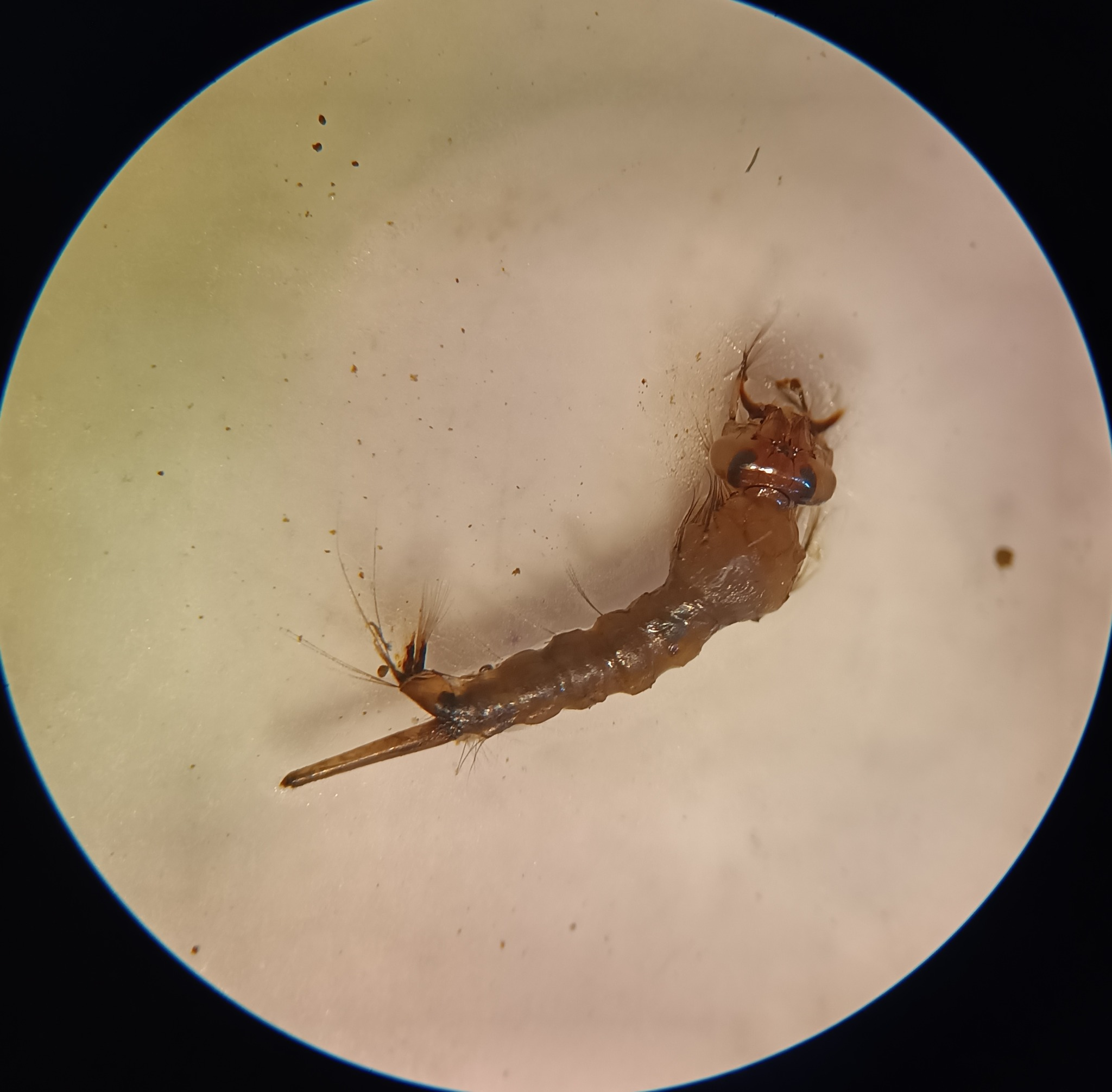
During summer, when temperatures reach extreme records, the inhabitants Sahara seek refuge in oases for shade and water. These ecosystems are characterized by a unique microclimate. Nevertheless, they face serious threats from two arthropod species: venomous scorpions and mosquitoes, which act as vectors of diseases. Chemicals impacting both biotic and abiotic components of the ecosystem, and more critically human health. Chitinolytic entomopathogenic microorganisms were isolated from dust samples collected from the cadavers of the Dermestes maculatus. Chitin extracted from shrimp shells (yield: 16.6 %) served as the sole carbon source in the selective culture media employed for their cultivation. Five strains were obtained: three fungi (Aspergillus flavus, A. fumigatus, Mucor sp.) and two bacteria (Bacillus sp. and Actinomycete). Bioassays against third-instar Culex pipiens larvae showed that Actinomycete (10⁶ CFU.mL-1) induced 90 % of mortality, followed by A. fumigatus, Mucor sp., and Bacillus sp. (80 %), Data were analyzed using one-way ANOVA and Duncan’s test (p<0.05). Microscopic observations revealed severe larval deformities. These findings confirm the strong larvicidal potential of microorganisms as eco-friendly alternatives to chemical insecticides.
Downloads
References
Aguilar-Durán, J. A., Villarreal-Treviño, C., Fernández-Santos, N. A., Hamer, Gabriel L., & Rodríguez-Pérez, M. A. (2023). Virulence of entomopathogenic fungi isolated from wild mosquitoes against Aedes aegypti. Entomological Research, 53(2), 158-166. https://doi.org/10.1111/1748-5967.12640
Al-Nagar, N. M. A., Shawir, M. S., & Abdelgaleil, S. A. M. (2024). Mosquitocidal activity of extracts derived from soil Actinomycete isolates. Alexandria Science Exchange Journal, 45(4), 719-729. https://doi.org/10.21608/asejaiqjsae.2024.395086
Arreguín-Pérez, C. A., Miranda-Miranda, E., Folch-Mallol, J. L., & Cossío-Bayúgar, R. (2023). Identification of virulence factors in entomopathogenic Aspergillus isolates. Microorganisms, 1(8), 2107. Jhttps://www.ncbi.nlm.nih.gov/pmc/articles/PMC10457961/
Bharadwaj, N., Sharma, R., Subramanian, M., Ragini, G., Nagarajan, S. A., & Rahi, M. (2025). Omics approaches in understanding insecticide resistance in mosquito vectors. International Journal of Molecular Sciences, 26(5), 1854. https://doi.org/10.3390/ijms26051854
Goettel, M. S., Eilenberg, J., & Glare, T. R. (2010). Entomopathogenic fungi and their role in regulation of insect populations. In L. A. Lacey (Ed.), Manual of Techniques in Invertebrate Pathology (2nd ed., pp. 387-432). Academic Press. https://doi.org/10.1016/C2010-0-66784-8
Izadi, H., Asadi, H., & Bemani, M. (2025). Chitin: A comparison between its main sources. Frontiers in Materials, 12: 1537067. https://doi.org/10.3389/fmats.2025.1537067
Balumahendhiran, K., Vivekanandhan, P., & Shivakumar, M. S. (2019). Mosquito control potential of secondary metabolites isolated from Aspergillus flavus and Aspergillus fumigatus. Biocatalysis and Agricultural Biotechnology, 21, 101334. https://doi.org/10.1016/j.bcab.2019.101334
Lacey, L. A. (2017). Entomopathogens used as microbial control agents. In Microbial control of insect and mite pests (pp. 3-12). Academic Press. https://doi.org/10.1016/B978-0-12-803527-6.00001-9
Lamy, D. L., Gnambani, E. J., Sare, I., Millogo, S. A., Sodré, F. A., Namountougou, M., Viana, M., Baldini, F., Diabaté, A., & Bilgo, E. (2025). Metarhizium pingshaense increases susceptibility to insecticides in highly resistant malaria mosquitoes Anopheles coluzzii. Wellcome Open Research, 9, 290. https://doi.org/10.12688/wellcomeopenres.21238.2
Lavine, M. D., & Strand, M. R. (2002). Insect hemocytes and their role in immunity. Insect Biochemistry and Molecular Biology, 32(10), 1295-1309. https://doi.org/10.1016/S0965-1748(02)00092-9.
Li, X., & Wiens, J. J. (2023). Estimating global biodiversity: The role of cryptic insect species. Systematic Biology, 72(2), 391-403. https://doi.org/10.1093/sysbio/syac069
Natrah, F. M. I., Ruwandeepika, H. A. D., Pawar, S., Karunasagar, I., Sorgeloos, P., Bossier, P., & Defoirdt, T. (2011). Regulation of virulence factors by quorum sensing in Vibrio harveyi. Veterinary Microbiology, 154(1-2), 124-129. https://doi.org/10.1016/j.vetmic.2011.06.024
Parco, J., Valverde-Rodríguez, A., Cornejo, A., Briceño, H., Barrionuevo, L., & Romero, J. (2023). Efficiency of entomopathogenic bacteria and fungi on Oligonychus yothersi in vitro and on Persea americana Mill. plants. Revista de la Facultad de Agronomía (LUZ), 40(4), e234033.
https://produccioncientificaluz.org/index.php/agronomia/article/view/40991/47103
Hossain, M. S., Anjum, M. F., Rabbani, M. A., Hasan, M. R., Sohag, M. M. H., Tasnim, N., Karmakar, D., Akter, S., Rahman, M. M., & Karim, M. R. (2025). Bacillus altitudinis: a sustainable mosquito controlling biopesticide isolated from the rhizospheric soil of Nypa fruticans in mangrove forest. BMC Microbiology, 25, 733. https://doi.org/10.1186/s12866-025-04168-0
Seratnahaei, M., Eshraghi, S. S., Pakzad, P., Zahraei-Ramazani, A., & Yaseri, M. (2023). Larvicidal effects of metabolites extracted from Nocardia and Streptomyces species against the forth larval stage of Anopheles stephensi (Diptera: Culicidae). Journal of Arthropod-Borne Diseases, 17(2), 187-196. https://doi.org/10.18502/jad.v17i2.13623
Renuka, S., Vani, H. C., & Alex, E. (2023). Entomopathogenic fungi as a potential management tool for the control of urban malaria vector Anopheles stephensi (Diptera: Culicidae). Journal of Fungi, 9(2), 223. https://doi.org/10.3390/jof9020223
Singh, R., & Dubey, A. K. (2015). Endophytic Actinomycetes as emerging source for therapeutic compounds. Indo Global Journal of Pharmaceutical Sciences, 5(2), 106-116. https://doi.org/10.35652/igjps.2015.11
Valdez, D., Farah, S., Espinoza, W., Veliz, F., Villon, H., & Herrera, L. (2025). Biocontrol of Cosmopolites sordidus using entomopathogenic fungi under laboratory conditions, Ecuador. Revista de la Facultad de Agronomía (LUZ), 42(2), e254217. https://doi.org/10.47280/RevFacAgron(LUZ).v42.2
Vega, F. E., & Kaya, H. K. (Eds.). (2012). Insect pathology (2nd ed.). Academic Press. https://doi.org/10.1016/B978-0-12-384984-7.00001-4
Zogo, B., Tchiekoi, B. N., Koffi, A. A., Dahounto, A., Ahoua Alou, L. P., Dabiré, R. K., Baba-Moussa, L., Moiroux, N., & Pennetier, C. (2019). Impact of sunlight exposure on the residual efficacy of biolarvicides Bacillus thuringiensis israelensis and Bacillus sphaericus against the main malaria vector Anopheles gambiae. Malaria Journal, 18, 55. https://doi.org/10.1186/s12936-019-2687-0
Zhu, G., Ding, W., Zhao, H., Xue, M., Chu, P., & Jiang, L. (2023). Effects of the entomopathogenic fungus Mucor hiemalis BO-1 on the physical functions and transcriptional signatures of Bradysia odoriphaga larvae. Insects, 14(2), 162. https://doi.org/10.3390/insects14020162
Copyright (c) 2026 Ali Boulanouar, Zineb Hamani, Benlarbi Larbi

This work is licensed under a Creative Commons Attribution-NonCommercial-ShareAlike 4.0 International License.