Notes for understanding the political transition
Abstract
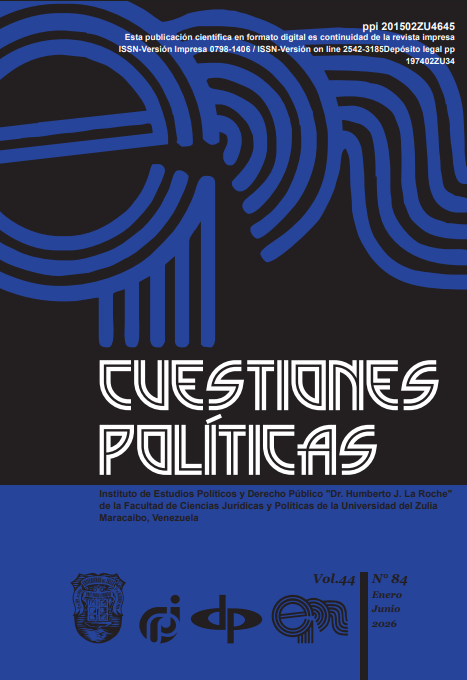
This editorial presents volume 44, number 84 of Cuestiones Políticas (Political Issues) and, at the same time, offers concise reflections on the assumptions and limits of a possible political transition. Rather than anticipating automatic results, the text invites us to specify what institutional and regulatory conditions must accompany any change of government for it to translate into tangible improvements for citizens and a comprehensive, sustainable recovery. The central idea is preventive: it is advisable to avoid simplistic interpretations that confuse economic relief with democratic consolidation. It emphasizes that a possible oil boom may provide resources and reduce short-term tensions but does not in itself guarantee the restoration of democracy or the strengthening of institutions. Therefore, the editorial concludes that the way out of the crisis requires political and legal reforms capable of reorganizing the incentives of power, strengthening controls, and rebuilding the rule of law.
Downloads
References
Sartori, G. (2009). La democracia en 30 lecciones. Taurus.
Copyright
The authors who publish in this journal agree to the following terms:
The authors retain the copyright and guarantee the journal the right to be the first publication where the article is presented, which is published under a Creative Commons Attribution License, which allows others to share the work prior to the recognition of the authorship of the article work and initial publication in this journal.
Authors may separately establish additional agreements for the non-exclusive distribution of the version of the work published in the journal (for example, placing it in an institutional repository or publishing it in a book), with an acknowledgment of its initial publication in this journal.
This work is under license:
Creative Commons Reconocimiento-NoComercial-CompartirIgual 4.0 Internacional (CC BY-NC-SA 4.0)