Caracterização agro-morfológica de cultivares de Allium sativum L. cultivados em condições semiáridas
Resumo
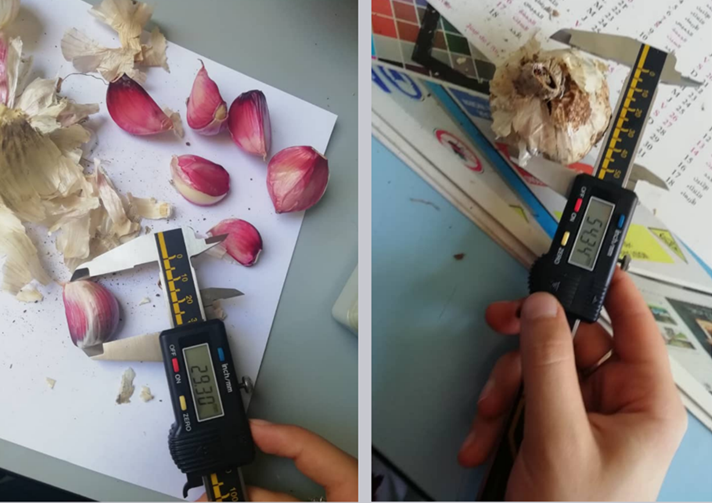
O alho (Allium sativum L.) e uma cultura hortícola e medicinal com importante diversidade genética nas regiões mediterrânicas. A valorização deste condimento é uma necessidade para satisfazer a demanda de produção. Foi realizado um experimento no ITCMI de Sidi Bel Abbes, Argélia, para avaliar a variação das propriedades agromorfológicas de dez cultivares de alho durante a safra 2023/2024. A avaliação morfológica revelou efeitos significativos da variedade sobre folhas, bulbos e dentes. As variedades Rose de Chine, Rouge Local e Germidour apresentaram dimensões importantes de comprimento foliar (52,79; 53,23 e 52,1 cm) e área foliar (97,61; 88,48 e 86,26 cm²), respectivamente. Quanto aos bulbos e dentes, as variedades Messidrômes e Mocta Bulgare indicaram melhor desempenho em peso (54,45 e 6,9 g) e diâmetro (52,69 e 22,71 mm), respectivamente. A variedade Fructidor apresentou o maior número de dentes por bulbo (14,16). Estes resultados destacam o potencial dos cultivares selecionados para usos específicos: variedades de folhagem vigorosa para programas orientados à biomassa, e variedades de alto rendimento em bulbo para a produção comercial em condições semiáridas. A diversidade agromorfológica identificada constitui uma base valiosa para a seleção varietal, os programas de melhoramento genético e a conservação do germoplasma de alho localmente adaptado.
Downloads
Referências
Benke, A. P., Khar, A., Mahajan, V., Gupta, A., & Singh, M. (2020). Study on dispersion of genetic variation among Indian garlic ecotypes using agro-morphological traits. Indian Journal of Genetics and Plant Breeding, 80(1), 94-102. https://doi.org/10.31742/IJGPB.80.1.12
Egea, L. A., Mérida-García, R., Kilian, A., Hernández, P., & Dorado, G. (2017). Assessment of genetic diversity and structure of large garlic (Allium sativum) germplasm bank by diversity arrays technology. Frontiers in Genetics, 8, 98. https://doi.org/10.3389/fgene.2017.00098
El-Fiki, A., & Adly, M. (2020). Morphological, molecular, and organosulphur compounds characterization in irradiated garlic (Allium sativum) by GC-MS and SCoT markers. Journal of Radiation Research and Applied Sciences, 13(1), 61-70. https://doi.org/10.1080/16878507.2019.1697079
Food and Agriculture Organization of the United Nations (FAO). (2025). FAOSTAT Database. https://www.fao.org/faostat
Goyal, H., Bafna, A., Vyas, N., & Gupta, R. (2025). Effect of soluble silica on plant growth, leaf chlorophyll content and bulb quality of garlic (Allium sativum L.) under drought stress. Indian Journal of Agricultural Research, 59(1). https://doi.org/10.18805/IJARe.A-5889
Jia, H., Zhao, Q., Song, J., Zhang, X., Yang, W., Du, Z., Zhu, Y., & Wang, H. (2023). Large-scale population structure and genetic architecture of agronomic traits of garlic. Horticulture Research, 10(4), uhad034. https://doi.org/10.1093/hr/uhad034
Karaman, K., Dalda-Sekerci, A., Yetisir, H., Gulsen, O., & Coskun, O. F. (2022). Morphological and molecular characterization of garlic (Allium sativum L.) genotypes sampled from Turkey. Genetic Resources and Crop Evolution, 69, 1833–1845. https://doi.org/10.1007/s10722-022-01343-4
Lim, T. K. (2015). Allium sativum. In T. K. Lim (Ed.), Edible medicinal and non-medicinal plants (Vol. 9, pp. 210-360). Springer.
Parreño, R., Rodríguez-Alcocer, E., Martínez-Guardiola, C., Carrasco, L., Castillo, P., Arbona, V., Jover-Gil, S., & Candela, H. (2023). Turning garlic into a modern crop: State of the art and perspectives. Plants, 12(6), 1212. https://doi.org/10.3390/plants12061212
Pasupula, K., Verma, P., Zimik, M., Kaur, C., Vasudev, S., & Khar, A. (2024). Morphological, biochemical and molecular characterization of short-day tropical Indian garlic (Allium sativum L.). Heliyon, 10, e37553. https://doi.org/10.1016/j.heliyon.2024.e37553
Polyzos, N., Papasotiropoulos, V., Lamari, F. N., Petropoulos, S. A., & Bebeli, P. J. (2019). Phenotypic characterization and quality traits of Greek garlic (Allium sativum L.) germplasm cultivated at two different locations. Genetic Resources and Crop Evolution, 66(8), 1671-1689. https://doi.org/10.1007/s10722-019-00831-4
Popa, P. M., & Cosmuleseu, S. (2024). Evaluation and comparison of morphological traits in garlic as influenced by year and genotypic diversity. Journal of Central European Agriculture, 25(4), 978-987. https://doi.org/10.5513/JCEA01/25.4.4321
Tesfaye, Y., Gebru, G., & Bekele, T. (2023). Effect of garlic genotypes (Allium sativum L.) on phenotype, growth, yield-related attributes, and nutritional quality at Bule Hora agro-ecology. Heliyon, 9(6), e16638. https://doi.org/10.1016/j.heliyon.2023.e16638
Direitos de Autor (c) 2026 Abdenour Belagrouz, Hocine Bendada, Zineb Tifouri, Farah Tabet Derraz

This work is licensed under a Creative Commons Attribution-NonCommercial-ShareAlike 4.0 International License.