Controle biológico da podridão cinzenta da videira: avaliação in vitro e in vivo da atividade antagônica de cepas indígenas de Trichoderma harzianum (Mascara, Argélia)
Resumo
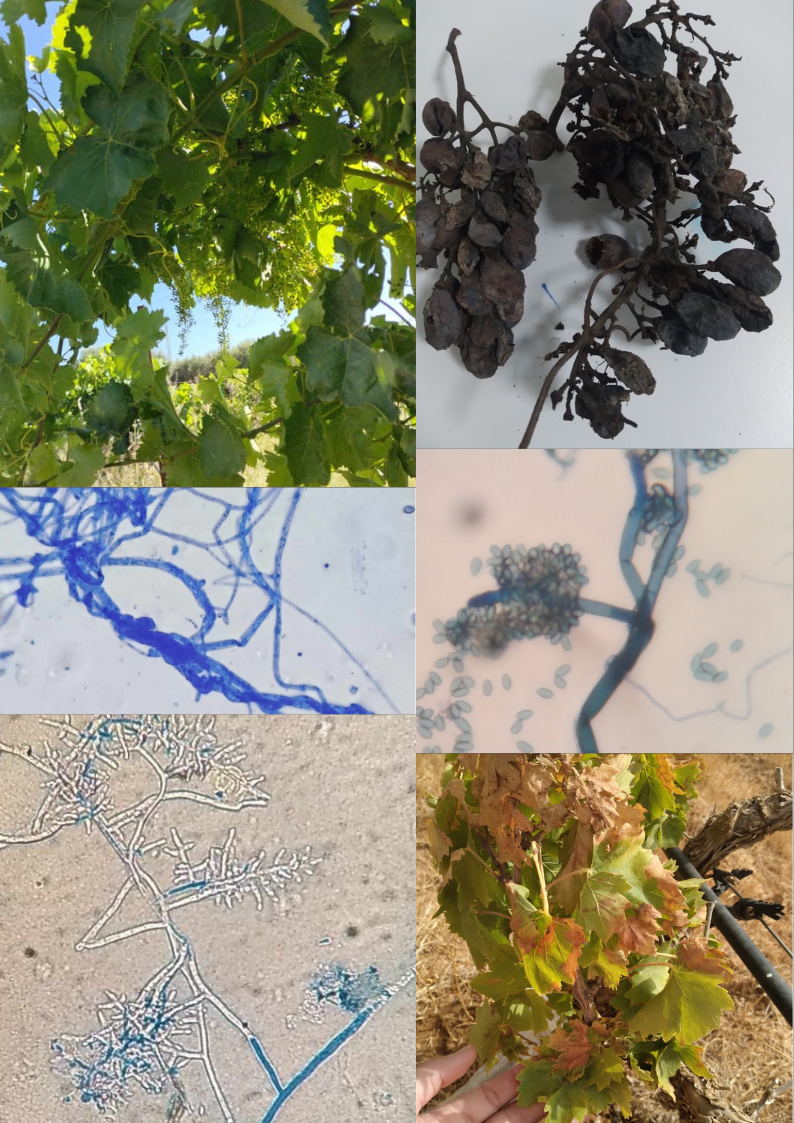
O mofo cinzento, causado pelo fungo necrotrófico Botrytis cinerea, foi responsável por perdas econômicas significativas na produção de videira (Vitis vinifera L.) em todo o mundo, incluindo a Argélia, o que destacou a necessidade de alternativas de controle sustentáveis. O objetivo deste estudo foi avaliar o potencial antagônico de uma cepa indígena de Trichoderma harzianum contra isolados locais de B. cinerea de Mascara, Argélia. Um isolado altamente virulento de B. cinerea (BC3) foi coletado de folhas de videira infectadas e identificado por meio de análises morfológicas e moleculares, enquanto o isolado antagonista de T. harzianum (T5) foi obtido da rizosfera de videiras saudáveis. Ensaios de dupla cultura in vitro mostraram que T. harzianum inibiu significativamente o crescimento micelial de B. cinerea, com inibição direta de 80,50 % e inibição indireta de 72,87 %. Experimentos in vivo confirmaram ainda mais sua eficácia, reduzindo a incidência da doença em 56,25 % e acelerando o crescimento das plantas, aumentando a altura de 60 para 96 cm, com notável melhora na biomassa vegetativa. Esses resultados sugerem que a cepa nativa T. harzianum T5 é um agente de biocontrole promissor e eficaz para o manejo sustentável do mofo cinzento em vinhedos.
Downloads
Referências
Bekkar, A. A., Belabid, L., & Zaim, S. (2016). Biocontrol of phytopathogenic Fusarium spp. by antagonistic Trichoderma. Biopesticides International, 12(1), 37-45. https://connectjournals.com/pages/articledetails/toc025433
Bendahmane, B. S., Mahiout, D., Benzohra, I. E., & Benkada, M. Y. (2012). Antagonism of three Trichoderma species against Botrytis fabae and B. cinerea, the causal agents of chocolate spot of faba bean (Vicia faba L.) in Algeria. World Applied Sciences Journal, 17(3), 278-283. http://idosi.org/wasj/wasj17(3)12/2.pdf
Carbone, I., & Kohn, L. M. (1999). A method for designing primer sets for speciation studies in filamentous ascomycetes. Mycologia, 91(3), 553-556. https://doi.org/10.1080/00275514.1999.12061051
Dos Santos Castro, L., Antoniêto, A. C. C., Pedersoli, W. R., Silva-Rocha, R., Persinoti, G. F., & Silva, R. N. (2014). Expression pattern of cellulolytic and xylanolytic genes regulated by transcriptional factors XYR1 and CRE1 are affected by carbon source in Trichoderma reesei. Gene Expression Patterns, 14(2), 88-95. https://doi.org/10.1016/j.gep.2014.01.003
Druzhinina, I. S., Kopchinskiy, A. G., Komoń, M., Bissett, J., Szakacs, G., & Kubicek, C. P. (2010). An oligonucleotide barcode for species identification in Trichoderma and Hypocrea. Fungal Genetics and Biology, 47(4), 385-392. https://doi.org/10.1016/j.fgb.2005.06.007
Gorman, Z., Chen, J., de Leon, A. A. P., & Wallis, C. M. (2023). Comparison of assembly platforms for the assembly of the nuclear genome of Trichoderma harzianum strain PAR3. BMC genomics, 24(1), 454. https://doi.org/10.1186/s12864-023-09544-6
Harman, G. E., Howell C. R., Viterbo A., Chet I. & Lorito, M. (2004). Trichoderma species-opportunistic, avirulent plant symbionts. Nature Reviews Microbiology, 2, 43-56. https://doi.org/10.1038/nrmicro797
Harman, G. E., Doni, F., Khadka, R. B., & Uphoff, N. (2021). Endophytic strains of Trichoderma increase plants’ photosynthetic capability. Journal of Applied Microbiology, 130(2), 529-546. https://doi.org/10.1111/jam.14368
International Organisation of Vine and Wine (OIV). (2022). State of the world vine and wine sector in 2023. OIV. https://www.oiv.int/sites/default/files/documents/OIV_Annual_Assessment-2023.pdf
Khan, R. A. A., Najeeb, S., Hussain, S., Xie, B., & Li, Y. (2020). Bioactive secondary metabolites from Trichoderma spp. against phytopathogenic fungi. Microorganisms, 8(6), 817. https://doi.org/10.3390/microorganisms8060817
Kouadri, M. E. A., Bekkar, A. A., & Zaim, S. (2023a). First report of using Trichoderma -longibrachiatum as a biocontrol agent against Macrophomina pseudophaseolina causing charcoal rot disease of lentil in Algeria. Egyptian Journal of Biological Pest Control, 33(1), 38. https://doi.org/10.1186/s41938-023-00683-2
Kouadri, M. E. A., Bekkar, A. A., & Zaim, S. (2023b). Morphological, molecular and pathogenic characterization of Macrophomina pseudophaseolina, the causal agent of charcoal rot disease on lentil (Lens culinaris) in Algeria. Physiological and Molecular Plant Pathology, 128, 102143. https://doi.org/10.1016/j.pmpp.2023.102143
Kthiri, Z., Jabeur, M. B., Machraoui, M., Gargouri, S., Hiba, K., & Hamada, W. (2020). Coating seeds with Trichoderma strains promotes plant growth and enhances systemic resistance against Fusarium crown rot in durum wheat. Egyptian Journal of Biological Pest Control, 30, 139. https://doi.org/10.1186/s41938-020-00338-6
Kuzmanovska, B., Rusevski, R., Jankulovska, M., & Oreshkovikj, K. B. (2018). Antagonistic activity of Trichoderma asperellum and Trichoderma harzianum against genetically diverse Botrytis cinerea isolates. Chilean Journal of Agricultural Research, 78(3), 391-399. http://dx.doi.org/10.4067/S0718-58392018000300391
Leslie, J. F., & Summerell, B. A. (2006). The Fusarium Laboratory Manual. Blackwell Publishing / Wiley Blackwell. ISBN 978 0 8138 1919 8. https://doi.org/10.1002/9780470278376
Lian, J., Han, H., Zhao, J., & Li, C. (2018). In-vitro and in-planta Botrytis cinerea inoculation assays for tomato. Bio-protocol, 8(8), e2810. https://doi.org/10.21769/BioProtoc.2810
Lorito, M., Woo, S. L., Harman, G. E., & Monte, E. (2010). Translational research on Trichoderma: From 'omics to the field. Annual Review of Phytopathology, 48(1), 395-417. https://doi.org/10.1146/annurev-phyto-073009-114314
Maruyama, C. R., Bilesky-José, N., de Lima, R., & Fraceto, L. F. (2020). Encapsulation of Trichoderma harzianum preserves enzymatic activity and enhances the potential for biological control. Frontiers in Bioengineering and Biotechnology, 8, 225. https://doi.org/10.3389/fbioe.2020.00225
Mokhtar, H., & Dehimat, A. (2012). Antagonism capability in vitro of Trichoderma harzianum against some pathogenic fungi. Agriculture Biology Journal of North America, 3(11), 452-460. https://doi.org/10.5251/abjna.2012.3.11.452.460
Okoth, S. A., Roimen, H., Mutsotso, B., Muya, E., Kahindi, J., Owino, J. O., & Okoth, P. (2007). Land use systems and distribution of Trichoderma species in Embu region, Kenya. Tropical and Subtropical Agroecosystems, 7(2), 105-122. https://www.redalyc.org/pdf/939/93970205.pdf
Rhouma, A., Hajji-Hedfi, L., Kouadri, M. E., Atallaoui, K., Matrood, A. A., & Khrieba, M. I. (2023). Botrytis cinerea: The cause of tomatoes gray mold. Egyptian Journal of Phytopathology, 51(2), 68-75. https://doi.org/10.21608/ejp.2023.224842.1101
Saddek, D., Messgo-Moumene, S., Chemat-Djenni, Z., Bendifallah, L., & Bencheikh, K. (2023). Antagonism of isolates of Trichoderma spp. against Botrytis cinerea Pers., agent of gray rot of tomato (Lycopersicum esculentum Mill.) under greenhouse conditions. Journal of Fundamental and Applied Sciences, 12(2), 583-606. https://doi.org/10.4314/jfas.v12i2.5
Shao, W., Zhao, Y., & Ma, Z. (2021). Advances in understanding fungicide resistance in Botrytis cinerea in China. Phytopathology, 111(3), 455-463. https://doi.org/10.1094/PHYTO-07-20-0313-IA
Wang, R., Liu, C., Jiang, X., Tan, Z., Li, H., Xu, S., Zhang, S., Shang, Q., Deising, H. B., Behrens, S. E, & Wu, B. (2022). The newly identified Trichoderma harzianum partitivirus (ThPV2) does not diminish spore production and biocontrol activity of its host. Viruses, 14(7), 1532. https://doi.org/10.3390/v14071532
White, T. J., Bruns, T., Lee, S. J. W. T., & Taylor, J. (1990). Amplification and direct sequencing of fungal ribosomal RNA genes for phylogenetics. PCR Protocols, 18(1), 315-322. http://dx.doi.org/10.1016/B978-0-12-372180-8.50042-1
Yan-gang, P., Qin-ju, T., Xiao-juan, Z., Ying, L., Xiao-fang, S., Zhi-fei, L., Xiao-bo, Q., Jing, X., Min, Z., Hua-bao, C., Xiao-li, C., Hui-min, T., Li-yun, S., & Guo-shu, G. (2019). Phenotypic and genetic characterization of Botrytis cinerea population from kiwifruit in Sichuan Province, China. Plant Disease, 103(4), 748-758. https://doi.org/10.1094/PDIS-04-18-0707-RE
Yao, X., Guo, H., Zhang, K., Zhao, M., Ruan, J., & Chen, J. (2023). Trichoderma and its role in biological control of plant fungal and nematode disease. Frontiers in Microbiology, 14, 1160551. https://doi.org/10.3389/fmicb.2023.1160551
Direitos de Autor (c) 2025 Imen Benbahi, Aoumria Merzoug, Mohamed El Amine Kouadri, Amel Bennacer

This work is licensed under a Creative Commons Attribution-NonCommercial-ShareAlike 4.0 International License.