Effect of management practices on yield and seed loss in durum wheat under arid conditions
Abstract
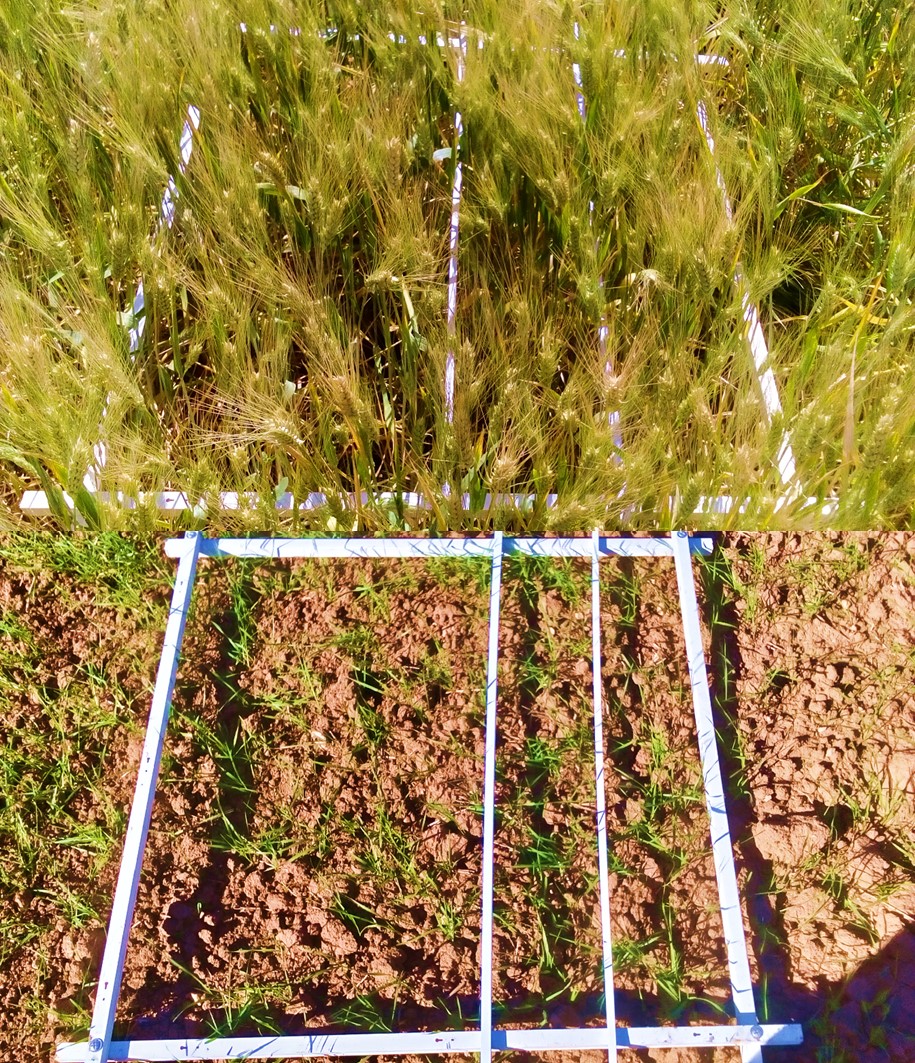
Despite irrigation expansion, durum wheat yields in Algeria remain substantially below genetic potential. This study quantified emergence, natural, and mechanical losses under irrigated arid conditions in Laghouat Province, Algeria, during 2024-2025. Five experimental fields (Vitron variety) were monitored, measuring emergence densities, potential yield components, pre-harvest yield, and harvested yield. Emergence losses (24-43 %) were compensated through tillering (r = -0.996, p≤0.001), though excessive densities (> 600 seeds.m-2) increased losses without yield benefit. Potential yield ranged from 9.3 to 13.7 t.ha-1, with grain number per spike as primary determinant (r = 0.994, p≤0.001). Natural losses (12-38 %) were amplified by extreme weather (hail, 36 mm.h-1 rainfall, May 14, 2025). Mechanical losses (31-47 %) exceeded international standards (3-7 %). Cumulative losses reached 54-60 % of potential, valorizing between 40 and 46 %. Optimization must prioritize mechanical loss reduction, legume rotations, and row seeding at moderate density.
Downloads
References
Al-Sammarraie, M. A. J., & Alhadithi, S. A. (2021). Determination of Grain Losses on Combine Harvester. Journal of Scientific and Engineering Research, 8(1), 196-202. https://doi.org/10.5281/zenodo.10552653
Bucheli, J., Visse-Mansiaux, M., Herrera, J., Haner, L. L., Tack, J., & Finger, R. (2024). Precipitation causes quality losses of large economic relevance in wheat production. Q Open, 4(1), qoae008. https://doi.org/10.1093/qopen/qoae008
Dahiya, S., Kumar, S., Chaudhary, H., & Chaudhary, C. (2018). Lodging: Significance and preventive measures for increasing crop production. International Journal of Chemical Studies, 6(1), 700-705. https://www.chemijournal.com/archives/2018/vol6issue1/PartJ/5-6-322-652.pdf
Delchev, N., & Trendafilov, K. (2013). Method for rapid determination of the percentage rate of grain losses by the combine harvester according to its parameters. Agricultural Science and Technology, 5(1), 62-64. https://www.cabidigitallibrary.org/doi/pdf/10.5555/20133136521
Grosse-Heilmann, M., Cristiano, E., Deidda, R., & Viola F. (2024). Durum wheat productivity to day and tomorrow: A review of influencing factors and climatec hange effects. Resources, Environment and Sustainability, 17, 100170. https://doi.org/10.1016/j.resenv.2024.100170
Hack, H., Bleiholder, H., Buhr, L., Meier, U., Schnock-Fricke, U., Weber, E., & Witzenberger, A. (1992). Einheitliche Codierung der phänologischen Entwicklungsstadien mono- und dikotyler Pflanzen - Erweiterte BBCH-Skala, Allgemein. Nachrichtenbl. Deut. Pflanzenschutzd, 44(12), 265-270. https://api.agrometeo.ch/storage/uploads/bbch-skala_deutsch.pdf
Hattab, M., Kessaissia, A., & Boughar, S. (2025). Situation de la luzerne pérenne dans une région agropastorale aride. Fourrages, 261, 19-29. https://doi.org/10.64256/FOU2449
Kondic, D., Bajic, M., Hajder, D., & Bosancic, B. (2017). The Rate of Productive Tillers per Plant of Winter Wheat (Triticum aestivum L.) Cultivars under Different Sowing Densities. Agro-knowledge Journal, 17(4), 345-357. https://doi.org/10.7251/AGREN1604345K
Kutzbach, H. D. (2000). Trends in Power and Machinery. Journal of Agricultural Engineering Research, 76(3), 237-247. https://doi.org/10.1006/jaer.2000.0574
Ladjal, I., & Azouzi, B. (2014). Etude du comportement varietal de cinq varietes de ble dur sous l'effet des deux doses de semis differentes en environnement semi-aride de Djelfa. Sciences and Technologie, 40, 36-42. https://revue.umc.edu.dz/c/article/view/1689/1809
Liu, P., Yin, B., Liu, X., Gu, L., Guo, J., Yang, M., & Zhen, W. (2023). Optimizing plant spatial competition can change phytohormone content and promote tillering, thereby improving wheat yield. Frontiers in Plant Science, 14, 1147711. https://doi.org/10.3389/fpls.2023.1147711
MADR, Ministère de l'Agriculture et du Développement Rural. (2021). Direction des Statistiques Agricoles et des Systèmes d'Information. Superficies et productions. Alger. Algérie. 87 p. https://madr.gov.dz/wp-content/uploads/2022/04/SERIE-B-2019.pdf
Mahdi, L., Bell, C. J., & Ryan, J. (1998). Establishment and yield of wheat (Triticum turgidum L.) after early sowing at various depths in a semi-arid Mediterranean environment. Field Crops Research, 58(3), 187-196. https://doi.org/10.1016/S0378-4290(98)00094-X
Merouche, A., Debaeke, P., Messahel, M., & Kelkouli, M. (2014). Response of durum wheat varieties to water in semi-arid Algeria. African Journal of Agricultural Research, 9(38), 2880-2893. https://doi.org/10.5897/AJAR2013.7318
Ni, H., Chu, H. K., Zhang, Z. X., Lai, X. F., Yang, X. L., & Shen, Y. Y. (2026). Sustainable alfalfa-winter wheat rotation maintains yield and soil water balance under precipitation variation. European Journal of Agronomy, 172, 127824. https://doi.org/10.1016/j.eja.2025.127824
Peoples, M. B., Brockwell, J., Herridge, D. F., Rochester, I. J., Alves, B. J. R., Urquiaga, S., Boddey, R. M., Dakora, F. D., Bhattarai, S., Maskey, S. L., Sampet, C., Rerkasem, B., Khans, D. F., Hauggaard-Nielsen, H., & Jensen, E. S. (2009). The contributions of nitrogen-fixing crop legumes to the productivity of agricultural systems. Symbiosis, 48, 1-17. https://doi.org/10.1007/BF03179980
Singh, B., Mukherjee, A., Norton, R., & Elshikha, D. E. (2025). Preliminary Evaluation of Wheat, Barley and Triticale Varieties at the Maricopa Agricultural Center for Early to Mid-Season 2024–2025. The University of Arizona Cooperative Extension, 6 p. https://hdl.handle.net/10150/678672
Slafer, G. A., Savin, R., & Sadras, V. O. (2014). Coarse and fine regulation of wheat yield components in response to genotype and environment. Field Crops Research, 157, 71–83. https://doi.org/10.1016/j.fcr.2013.12.004
Yadav, K., Kumar, M., Gulaiya, S., Singh, N., Singh, S., Salar, A., Joshi, M., Pal, S. S., & Singh, P. P. (2024). Adverse impacts of lodging and strategies for management in cereal crops: a comprehensive review. Plant Archives, 24(2), 495-503. https://doi.org/10.51470/PLANTARCHIVES.2024.v24.no.2.069
Zahiryan, R., & Hamayoun, H. (2020). Effect of irrigation frequency on growth and yield of wheat (Triticum aestivum L. var. Chonte 1) under Kabul agro-climatic conditions, Afghanistan. e-planet, 18(1), 22-28. https://e-planet.co.in/images/Publication/vol-18-1/effect_of_irrigation.pdf
Zhai, Y., Wu, Q., Chen, G., Zhang, H., Yin, X., & Chen, F. (2018). Broadcasting Winter Wheat Can Increase Grain Yield without Reducing the Kernels per Spike and the Kernel Weight. Sustainability, 10(12), 4858. https://doi.org/10.3390/su10124858
Zhou, N., & Vilar-Zanon, J. L. (2025). Climate change and crop insurance: geographical heterogeneity in hailstorm risk for wine grapes in Spain. European Actuarial Journal. https://doi.org/10.1007/s13385-025-00419-6
Copyright (c) 2026 Mourad Hattab, Abderrahmane Kessaissia

This work is licensed under a Creative Commons Attribution-NonCommercial-ShareAlike 4.0 International License.