Avaliação dos compostos fenolicos e atividade antioxidante em diferentes partes da planta de variedades de sorgo
Resumo
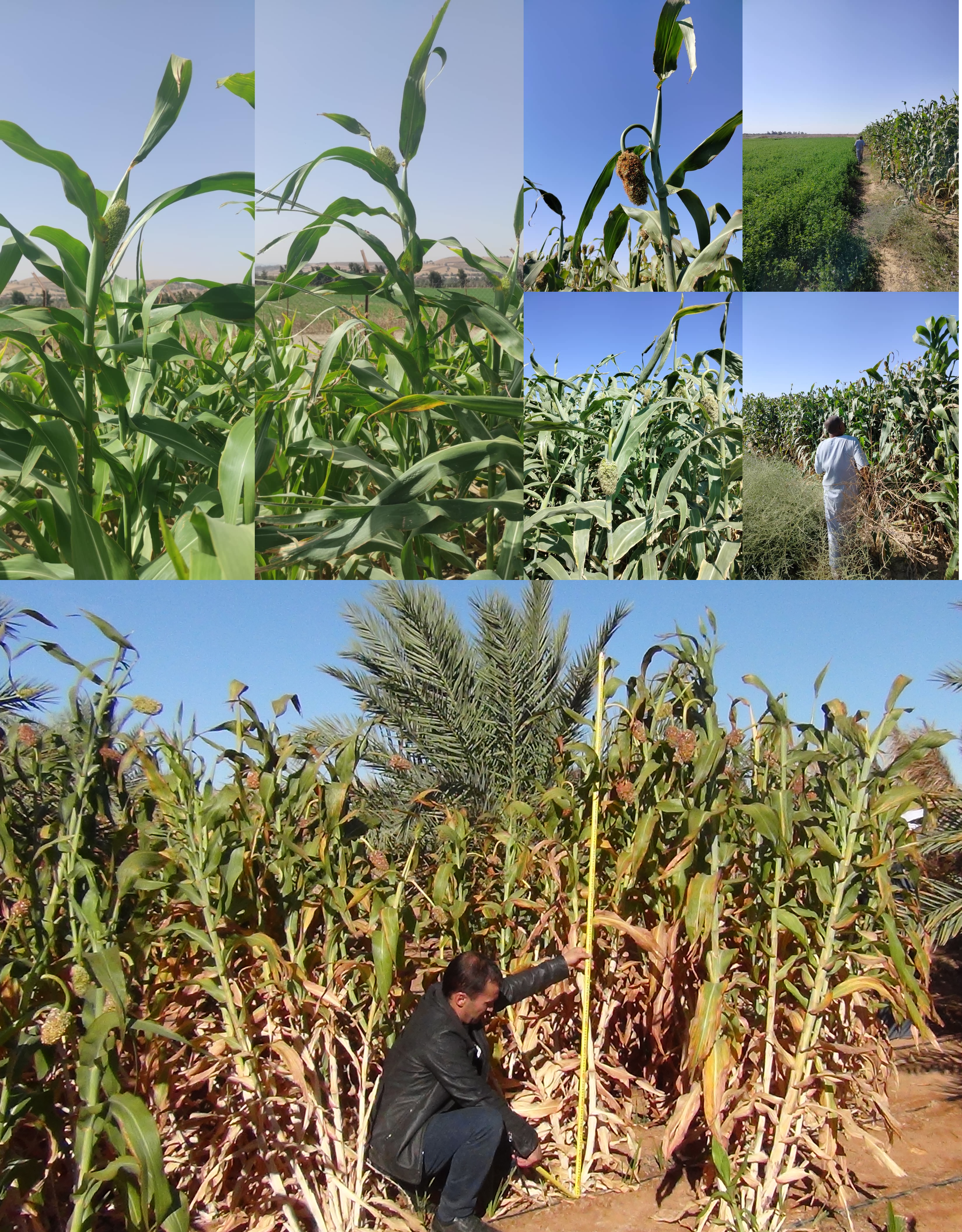
O campo da produção de ração animal é considerado uma das áreas mais importantes na produção pecuária. Dado que o setor pecuário na Argélia enfrentou muitos problemas, como a escassez de água e o alto custo dos alimentos tradicionais, é importante encontrar outras fontes locais para superar essas dificuldades. Este estudo teve como objetivo determinar o conteúdo de metabólitos secundários, incluindo compostos fenólicos totais, taninos e flavonoides, e a atividade antioxidante em diferentes partes (folhas, caules e resíduos de panícula) de dez variedades de sorgo encontradas no deserto argelino e cultivadas na região de Bordj Bou Arreridj, na Argélia. Os resultados mostraram diferenças significativas entre os conteúdos das amostras estudadas, bem como entre as três partes diferentes da planta, a saber, as folhas, os caules e os resíduos da panícula. O conteúdo total de fenólicos variou de 122,33 a 1.344,44 mg EAG.100 g-1, com níveis de taninos de 4,84 a 927,78 mg EAG.100 g-1, enquanto os valores de flavonoides variaram de 0,24 a 558,25 mg EQ.100 g-1. A atividade antioxidante também mostrou uma variação significativa, com valores de DPPH entre 46,10 e 1481,68 mg AAE.100 g-1, FRAP de 31,76 a 1.145,92 mg AAE.100 g-1, e valores de ABTS variando de 28,89 a 459,92 mg AAE.100 g-1. Esses resultados confirmaram que as plantas de sorgo não apenas representavam uma fonte de compostos metabólicos primários, como fibras, amido, proteínas e materiais energéticos usados como ração animal, mas também poderiam ser utilizadas como uma rica fonte de compostos fenólicos com um valor efetivo na saúde humana.
Downloads
Referências
Awika, J. M., & Rooney, L. W. (2004). Sorghum phytochemicals and their potential impact on human health. Phytochemistry, 65(9), 1199-1221.https://doi.org/10.1016/j.phytochem.2004.04.001
Benzie, I. F. F., & Strain, J. J. (1996). The Ferric Reducing Ability of Plasma (FRAP) as a Measure of “Antioxidant Power”: The FRAP Assay. Analytical Biochemistry, 239(1), 70-76. https://doi.org/10.1006/ABIO.1996.0292
Chang, C.-C., Yang, M.-H., Wen, H.-M., & Chern, J.-C. (2002). Estimation of totl flavonoid content in propolis by two complementary colorimetric methods. Journal of Food and Drug Analysis, 10(3), 178-182. https://doi.org/https://doi.org/10.38212/2224-6614.2748
Charyulu, D. K., Afari-Sefa, V., & Gumma, M. K. (2024). Trends in global sorghum production: Perspectives and limitations. In E. Habyarimana, M. A. Nadeem, F. S. Baloch, & N. Zencirci (Eds.), Omics and Biotechnological Approaches for Product Profile-Driven Sorghum Improvement (pp. 1-19). Springer Nature Singapore. https://doi.org/10.1007/978-981-97-4347-6_1
Chauhan, J., Solanki, S., Singh, A., & Singh, M. (2025). Forage Sorghum: Potential feedstock for bioenergy. In R. K. Singhal, Indu, A. El Sabagh, & K. K. Dwivedi (Eds.), Forage Crops in the Bioenergy Revolution: From Fields to Fuel (pp. 183-193). Springer Nature Singapore. https://doi.org/10.1007/978-981-96-2536-9_9
Chen, H., Xu, Y., Chen, H., Liu, H., Yu, Q., & Han, L. (2022). Isolation and identification of polyphenols from fresh sweet sorghum stems and their antibacterial mechanism against foodborne pathogens. Frontiers in Bioengineering and Biotechnology, 9, 770726. https://doi.org/10.3389/fbioe.2021.770726
D’almeida, C. T. D. S., Morel, M.-H., Terrier, N., Mameri, H., & Ferreira S. L., M. (2025). Dynamic metabolomic changes in the phenolic compound profile and antioxidant activity in developmental sorghum grains. Journal of Agricultural and Food Chemistry, 73(2), 1725-1738. https://doi.org/10.1021/acs.jafc.4c08975
Duke, K., Syeunda, C., Brantsen, J. F., Nindawat, S., & Awika, J. M. (2024). Polyphenol recovery from sorghum bran waste by microwave assisted extraction: Structural transformations as affected by grain phenolic profile. Food Chemistry, 444, 138645. https://doi.org/10.1016/J.FOODCHEM.2024.138645
Dykes, L., & Rooney, L. W. (2006). Sorghum and millet phenols and antioxidants. Journal of Cereal Science, 44(3), 236-251. https://doi.org/10.1016/J.JCS.2006.06.007
Estrada-Angulo, A., Coronel-Burgos, F., Castro-Pérez, B. I., Barreras, A., Zinn, R. A., Corona-Gochi, L., & Plascencia, A. (2019). Evaluation of panicle residue from broom sorghum as a feed ingredient in finishing diets for lambs. Animal, 13(1), 106-111. https://doi.org/10.1017/S1751731118001015
Hossain, M. S., Islam, M. N., Rahman, M. M., Mostofa, M. G., & Khan, M. A. R. (2022). Sorghum: A prospective crop for climatic vulnerability, food and nutritional security. Journal of Agriculture and Food Research, 8, 100300. https://doi.org/10.1016/j.jafr.2022.100300
Kumar, K., Debnath, P., Singh, S., & Kumar, N. (2023). An overview of plant phenolics and their involvement in abiotic stress tolerance. Stresses, 3(3), 570-585. https://doi.org/10.3390/stresses3030040
Mawouma, S., Condurache, N. N., Turturică, M., Constantin, O. E., Croitoru, C., & Rapeanu, G. (2022). Chemical composition and antioxidant profile of sorghum (Sorghum bicolor (L.) Moench) and pearl millet (Pennisetum glaucum (L.) R.Br.) grains cultivated in the far-north region of Cameroon. Foods, 11(14), 2026. https://doi.org/10.3390/foods11142026
Mérillon, J. M., & Ramawat, K. G. (2025). Reference Series in Phytochemistry Series Editors: Plant Specialized Metabolites Phytochemistry, Ecology and Biotechnology (J. M. Mérillon & K. G. Ramawat, Eds.). Springer Nature Switzerland AG. https://doi.org/https://doi.org/10.1007/978-3-031-51158-5
More, A., Morya, S., & Iyiola, A. O. (2024). Sorghum and Millets. In J. Singh, S. Kaur, P. Rasane, & J. Singh (Eds.), Cereals and Nutraceuticals (pp. 121-144). Springer Nature Singapore. https://doi.org/10.1007/978-981-97-2542-7_6
Sánchez-Moreno, C., Larrauri, J. A., & Saura-Calixto, F. (1998). A procedure to measure the antiradical efficiency of polyphenols. Journal of the Science of Food and Agriculture, 76(2), 270-276. https://doi.org/10.1002/(SICI)1097-0010(199802)76:2<270::AID-JSFA945>3.0.CO;2-9
Silanikove, N., Perevolotsky, A., & Provenza, F. D. (2001). Use of tannin-binding chemicals to assay for tannins and their negative postingestive effects in ruminants. Animal Feed Science and Technology, 91(1-2), 69-81. https://doi.org/10.1016/S0377-8401(01)00234-6
Singleton, V. L., Orthofer, R., & Lamuela-Raventós, R. M. (1999). Analysis of total phenols and other oxidation substrates and antioxidants by means of folin-ciocalteu reagent. Methods in Enzymology, 299, 152-178. https://doi.org/10.1016/S0076-6879(99)99017-1
Statistical Product and Service Solutions (SPSS). (2019). IBM SPSS Statistics for
Windows, Versión 26.0. Armonk, NY: IBM Corp. https://www.ibm.com/analytics/spss-statistics-software.
Taylor, J. R. N., Schober, T. J., & Bean, S. R. (2006). Novel food and non-food uses for sorghum and millets. Journal of Cereal Science, 44(3), 252-271. https://doi.org/10.1016/J.JCS.2006.06.009
Tugli, L. S., Essuman, E. K., Kortei, N. K., Nsor-Atindana, J., Nartey, E. B., & Ofori-Amoah, J. (2019). Bioactive constituents of waakye; a local Ghanaian dish prepared with Sorghum bicolor (L.) Moench leaf sheaths. Scientific African, 3, e00049. https://doi.org/10.1016/j.sciaf.2019.e00049
Woisky, R. G., & Salatino, A. (1998). Analysis of propolis: some parameters and procedures for chemical quality control. Journal of Apicultural Research, 37(2), 99-105. https://doi.org/10.1080/00218839.1998.11100961
Yi, R., García-Vaquero, M., Vigors, S., Wang, Y. H., Xu, J. C., Yu, Z. T., Ma, L., & Bu, D. P. (2025). Phytochemical extracts from the leaves and stem of red sorghum (Sorghum bicolor, L. Moench) potentially improve in vitro fermentation by modulating rumen protozoa. Journal of Dairy Science, 108(10), 10939-10955. https://doi.org/10.3168/jds.2025-26727
Yousfi, M., Djeridane, A., Bombarda, I., Duhem, B., & Gaydou, E. M. (2009). Isolation and characterization of a new hispolone derivative from antioxidant extracts of Pistacia atlantica. Phytotherapy Research, 23(9), 1237-1242. https://doi.org/10.1002/ptr.2543
Direitos de Autor (c) 2026 Mohamed Zaitri, Badreddine Belhadi, Mohamed Benalia, Redha Ould Kiar, Rachid Souilah, Djaffar Djabali

This work is licensed under a Creative Commons Attribution-NonCommercial-ShareAlike 4.0 International License.