Eficácia de Armadilhas com Feromônios Sexuais no Manejo Integrado de Planococcus ficus Signoret (Hemiptera: Pseudococcidae) em Vinhedos
Resumo
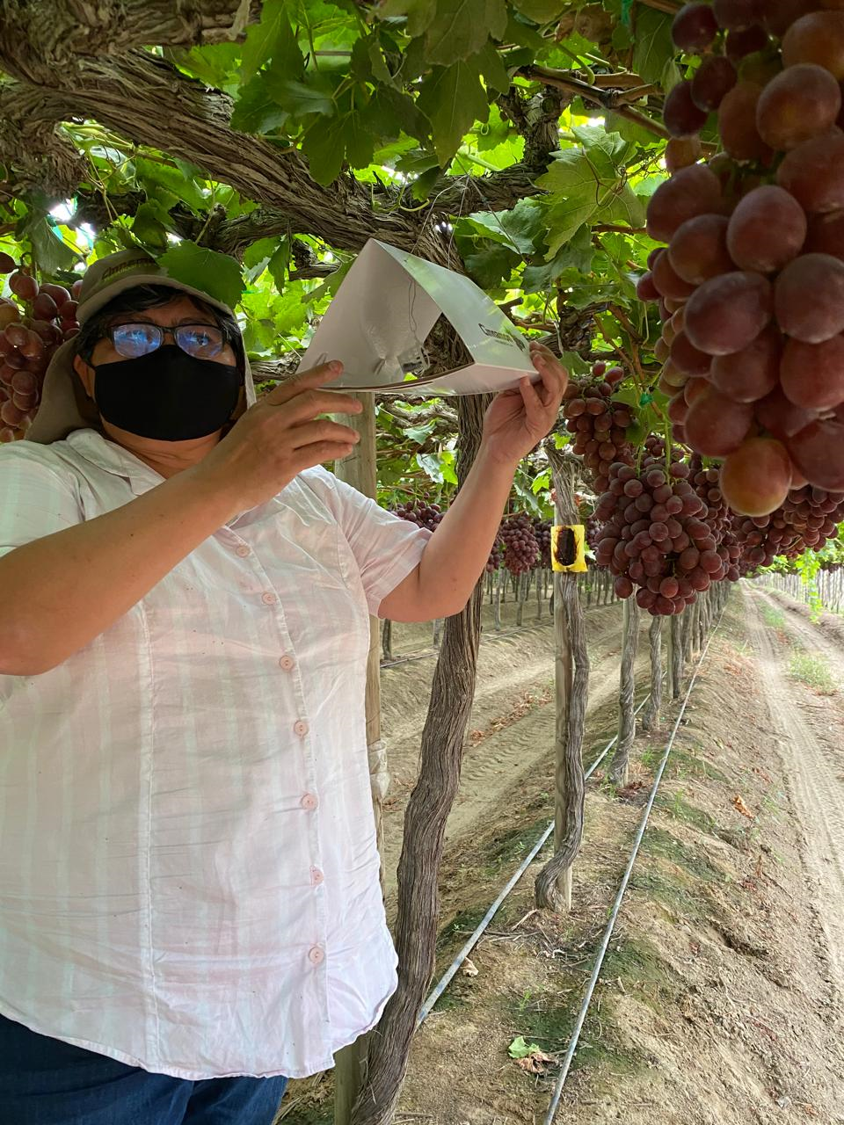
Planococcus ficus (Signoret) é uma praga de grande relevância econômica na viticultura, exigindo intervenções oportunas, inovadoras e eficazes para seu controle. Embora o uso de feromônios sexuais tenha se concentrado na confusão sexual, este estudo teve como objetivo avaliar a eficácia de armadilhas com feromônio sexual (CINNAFIC®) como ferramenta de controle. Conduzido em um vinhedo comercial da variedade Crimson Seedless em Ica, Peru (2020-2021); as 15 armadilhas de feromonas.ha-1, capturaram 16.927 machos, com pico de 112,20 machos.armadilha-1.semana-1 durante o desenvolvimento das bagas. A maior eficácia ocorreu na colheita, com redução de 59,12 % na população total de cochonilhas, e produção de cachos totalmente exportáveis, frente a 7 % de infestação na parcela controle. A limitação do acasalamento resultou em queda significativa de ninfas e fêmeas ovígeras na área tratada. Integradas a práticas culturais e aplicações pontuais de pesticidas e extratos vegetais, as armadilhas permitiram controle efetivo sem depender exclusivamente de inseticidas químicos. Conclui-se que as armadilhas com feromônio são uma alternativa sustentável e viável no manejo integrado de P. ficus em vinhedos.
Downloads
Referências
Castillo, G., & Bello-Bedoy, R. (2022). Effect of Planococcus ficus (Signoret) on the growth of three wine grape cultivars. Revista Fitotecnia Mexicana, 45(2), 227-233. https://doi.org/10.35196/rfm.2022.2.227
Cocco, A., Lentini, A., & Serra G. (2014). Mating disruption of Planococcus ficus (Hemiptera: Pseudococcidae) in vineyards using reservoir pheromone dispensers, Journal of Insect Science, 14(1), 144. https://doi.org/10.1093/jisesa/ieu006
Cocco, A., Muscas, E., Mura, A., Iodice, A., Savino, F., & Lentini, A. (2018). Influence of mating disruption on the reproductive biology of the vine mealybug, Planococcus ficus (Hemiptera: Pseudococcidae), under field conditions. Pest Management Science, 74(12), 2806-2816. https://doi.org/10.1002/ps.5067
Cocco, A., Pacheco da Silva, V., Benelli, G., Botton, M., Lucchi, A., & Lentini, A. (2021). Sustainable management of the vine mealybug in organic vineyards. Journal of Pest Science, 94, 1-33. https://doi.org/10.1007/s10340-020-01305-8
Daane, K., Yokota, G., Walton, V., Hogg, B., Cooper, M., Bentley, W., & Millar, J. (2020). Development of a mating disruption program for a mealybug, Planococcus ficus, in vineyards. Insects, 11(9), 635. https://doi.org/10.3390/insects11090635
Geiger, C., Daane, K., Bentley, W. J., Yokota, G., & Martin, L. A. (2001). Sampling program for grape mealybugs improves pest management. California Agriculture, 55(3), 19-27. https://doi.org/10.3733/ca.v055n03p19
González-Luna, M., & La Rossa, F. (2016). Parámetros biológicos y poblacionales de Planococcus ficus (Hemiptera: Pseudococcidae) sobre dos cultivares de Vitis vinifera. Revista de la Sociedad Entomológica Argentina, 75(1-2), 45-54. https://www.redalyc.org/articulo.oa?id=322046181004
Hinkens, D., Mcelfresh, J., & Millar, J. (2001). Identification and synthesis of the sex pheromone of the vine mealybug, Planococcus ficus. Tetrahedron Letters, 42, 1619-1621. https://doi.org/10.1016/S0040-4039(00)02347-9
Hogg, B., Cooper, M., & Daane, K. (2021). Area wide mating disruption for vine mealybug in California vineyards. Crop Protection, 148, 105735. https://doi.org/10.1016/j.cropro.2021.105735
Kirk, W., de Kogel, W., Koschier, E., & Teulon, D. (2021). Semiochemicals for thrips and their use in pest management. Annual Review of Entomology, 66, 101-119. https://doi.org/10.1146/annurev-ento-022020-081531
Lee, Y.-S., Lee, H. A., Lee, H. J., Choi, J. Y., Lee, S.-W., & Lee, Y. S. (2020). Control effect of plant extracts mixture on Metcalfa pruinosa (Say) (Hemiptera: Flatidae). Korean Journal of Applied Entomology, 58(4), 281–282. https://doi.org/10.5656/KSAE.2019.10.0.045
Levi-Zada, A., Sadowsky, A., Dobrinin, S., Ticuchinski, T., David, M., Fefer, D., & Byers, J. (2018). Monitoring and mass-trapping methodologies using pheromones: The lesser date moth Batrachedra amydraula. Bulletin of Entomological Research, 108(1), 58-68. https://doi.org/10.1017/S0007485317000487
Lucchi, A., Suma, P., Ladurner, E., Iodice, A., Savino, F., Ricciardi, R., Cosci, F., Marchesini, E., Conte, G., & Benelli, G. (2019). Managing the vine mealybug, Planococcus ficus, through pheromone-mediated mating disruption. Environmental Science and Pollution Research International, 26(11), 10708-10718. https://doi.org/10.1007/s11356-019-04530-6
Mansour, R., Grissa-Lebdi, K., Khemakhem, M., Chaari, I., Trabelsi, I., Sabri, A., & Marti, S. (2017). Pheromone-mediated mating disruption of Planococcus ficus (Hemiptera: Pseudococcidae) in Tunisian vineyards: Effect on insect population dynamics. Biologia 72, 333-341. https://doi.org/10.1515/biolog-2017-0034
Millar, J., Daane, K., Mcelfresh, J., Moreira, J., Malakar-Kuenen, R., Guillén, M., & Bentley, W. (2002). Development and optimization of methods for using sex pheromone for monitoring the mealybug Planococcus ficus (Homoptera: Pseudococcidae) in California vineyards. Journal of Economic Entomology, 95(4), 706-714. https://doi.org/10.1603/0022-0493-95.4.706
Norman, K., Ahmad, Siti Nurulhidayah, A., & Moh, W. (2010). Pheromone mass trapping of bagworm moths, Metisa plana Walker (Lepidoptera: Psychidae), for its control in mature oil palms in Perak, Malaysia. Journal of Asia-Pacific Entomology, 13(2), 101-106. https://doi.org/10.1016/j.aspen.2009.11.003
Pertot, I., Caffi, T., Rossi, V., Mugnai, L., Hoffmann, C., Grando, M. S., Gary, C., Lafond, D., Duso, C., Thiery, D., Mazzoni, V., & Anfora, G. (2017). A critical review of plant protection tools for reducing pesticide use on grapevine and new perspectives for the implementation of IPM in viticulture. Crop Protection, 97, 70-84. https://doi.org/10.1016/j.cropro.2016.11.025
Rizvi, S., George, J., Reddy, G., Zeng, X., & Guerrero, A. (2021). Latest developments in insect sex pheromone research and its application in agricultural pest management. Insects, 12(6), 484. https://doi.org/10.3390/insects12060484
Sharon, R., Zahavi, T., Sokolsky, T. Sofer-Arad, C., Tomer, M., Kedoshim, R., & Harari A.R. (2016). Mating disruption method against the vine mealybug, Planococcus ficus: Effect of sequential treatment on infested vines. Entomologia Experimentalis et Applicata, 161(1), 65-69. https://doi.org/10.1111/eea.12487
Servicio Nacional de Sanidad Agraria del Perú. (2020). Guía para la implementación de Buenas Prácticas Agrícolas (BPA) para el cultivo de uva. https://www.gob.pe/institucion/senasa/informes-publicaciones/936623-guia-de-buenas-practicas-agricolas-para-cultivo-de-uva
Walton, V., & Pringle, K. (2003). Vine mealybug, Planococcus ficus (Signoret) (Hemiptera: Pseudococcidae), a Key Pest in South African vineyards. South African Journal of Enology and Viticulture, 25(2), 54-62. https://doi.org/10.21548/25-2-2140
Walton, V., Daane, K., & Pringle, K. L. (2004). Monitoring Planococcus ficus in South African vineyards with sex pheromone-baited traps. Crop Protection, 23(11), 1089-1096. https://doi.org/10.1016/j.cropro.2004.03.016
Witzgall, P., Kirsch, P., & Cork, A. (2010). Sex pheromones and their impact on pest management. Journal of Chemical Ecology, 36(1), 80-100. https://doi.org/10.1007/s10886-009-9737-y
Direitos de Autor (c) 2026 Mónica Narrea-Cango, Luz Gómez Pando

This work is licensed under a Creative Commons Attribution-NonCommercial-ShareAlike 4.0 International License.