Estratégias de preservação do limão (Citrus aurantifolia): efeitos da temperatura e do armazenamento na qualidade dos frutos
Resumo
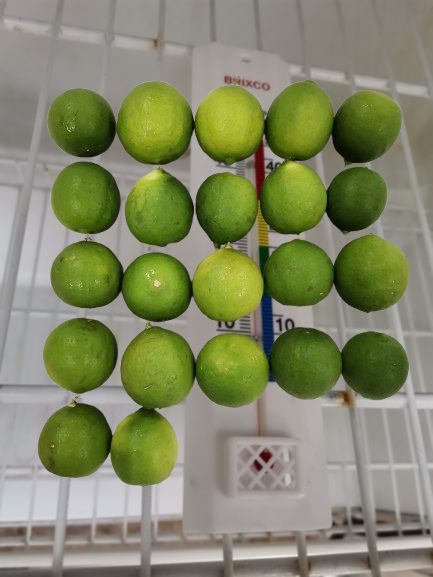
O limão (Citrus aurantifolia Swingle) é uma cultura de grande importância econômica e nutricional, cuja vida útil é limitada pela rápida deterioração pós-colheita. As perdas ocorridas durante o armazenamento afetam atributos de qualidade, como firmeza, retenção de umidade e teor de suco, tornando necessário identificar estratégias de conservação eficazes. O objetivo deste estudo foi avaliar o efeito de diferentes temperaturas e períodos de armazenamento na qualidade pós-colheita do limão-sutil produzido em Manabí, Equador. Utilizou-se um delineamento em blocos ao acaso, com arranjo fatorial 4 × 3, incluindo quatro temperaturas (10, 12, 14 e 26 °C) e três períodos de armazenamento (9, 12 e 15 dias), com quatro repetições e um total de 800 frutos por localidade. Foram avaliadas características físicas e químicas, como peso do fruto, diâmetro, teor de suco, peso do pericarpo, pH e sólidos solúveis totais. Os resultados mostraram que as temperaturas de 12 °C e 14 °C conservaram melhor a qualidade do fruto, enquanto 10 °C acelerou a desidratação e aumentou a perda de peso do pericarpo. Conclui-se que a temperatura de armazenamento é um fator determinante para manter a qualidade pós-colheita do limão, e este estudo fornece informações essenciais para otimizar as práticas de manejo e reduzir perdas ao longo da cadeia produtiva.
Downloads
Referências
Badiche-El Hilali, F., Valverde, J. M., García-Pastor, M. E., Serrano, M., Castillo, S., & Valero, D. (2023). Melatonin postharvest treatment in leafy ‘Fino’ lemon maintains quality and bioactive compounds. Foods, 12(15), 2979. https://doi.org/10.3390/foods12152979
Baltazari, A., Mtui, H.D., Mwatawalaa, M.W., Chove, L.M., Msogoya, T., Samwela, J., & Subramanian, J. (2020). Effects of storage conditions, storage duration and post-harvest treatments on nutritional and sensory quality of orange (Citrus sinensis (L.) Osbeck) fruits. International Journal of Fruit Science, 20(4), 737-749. https://doi.org/10.1080/15538362.2019.1673278
Budiarto, R., Mubarok, S., Sholikin, M.M., Sari, D.N., Khalisha, A., Rahmat, B.P., & Adli, D.N. (2024). Vitamin C variation in citrus in response to genotypes, storage temperatures, and storage times: A systematic review and meta-analysis. Heliyon, 10(8), e29125. https://doi.org/10.1016/j.heliyon.2024.e29125
Castellano, G., Ramírez, R., Sindoni, M.J., Hidalgo, P.R., Burgos, M.E., Marín, C., & Martínez, L. (2016). Efecto de la temperatura de almacenaje sobre las características organolépticas de frutos de limón persa (Citrus latifolia Tanaka). Revista Iberoamericana de Tecnología Postcosecha, 17(1), 8-14. https://www.redalyc.org/journal/813/81346341002/
Cao, J., Wang, C., Xu, S., Chen, Y., Wang, Y., Li, X., & Sun, C. (2019). The effects of transportation temperature on the decay rate and quality of postharvest Ponkan (Citrus reticulata Blanco) fruit in different storage periods. Scientia Horticulturae, 247, 42-48. https://doi.org/10.1016/j.scienta.2018.12.009
Cheng, X., Li, R., Zhao, Y., Bai, Y., Wu, Y., Bao, P., Huang, Z., & Bi, Y. (2023). Modeling mathematical relationship with weight loss and texture on table grapes of ‘Red Globe’ and ‘Wink’ during cold and ambient temperature storage. Foods, 12(13), 2443. https://doi.org/10.3390/foods12132443
Deng, W., Wu, J., Da, Y., & Ma, Z. (2020). Effect of temperature treatment on fruit quality and immunoregulation of Satsuma (Citrus unshiu Marc.) during storage. Critical Reviews in Food Science and Nutrition, 8(10), 5443-5451. https://doi.org/10.1002/fsn3.1771
Garganese, F., Sanzani, S.M., Di, Rella D., Schena, L., & Ippolito, A. (2019). Pre- and postharvest application of alternative means to control alternaria brown spot of citrus. Crop Protection, 121, 73-79. https://doi.org/10.1016/j.cropro.2019.03.014
Habibi, I., & Susila, A.D. (2024). Quality improvement of lime fruit (Citrus aurantifolia) between packaged and unpackaged conditions combined with different storage temperatures. Journal of Agrosociology and Sustainability, 2(1), 17-29. https://doi.org/10.61511/jassu.v2i1.2024.849
Hasbullah, R., & Ismail, E.R. (2022). Shelf-life prediction of citrus lemon using a multivariate accelerated shelf-life testing (MASLT) approach. Journal of Horticultural Research, 30(1), 51-60. https://doi.org/10.2478/johr-2022-0005
Jain, S., Saxena, S., Minz, V., Behera, S.D., Harini, K., Shivani, Mishra, S., & Nidhi, N. (2023). Post-harvest handling of fruit crops. International Journal of Environment and Climate Change, 13(11), 1990-1999. https://doi.org/10.9734/IJECC/2023/v13i113357
Latocha, P., Krupa, T., Jankowski, P., & Radzanowska, J. (2014). Changes in postharvest physicochemical and sensory characteristics of hardy kiwifruit (Actinidia arguta and its hybrid) after cold storage under normal versus controlled atmosphere. Postharvest Biology and Technology, 88, 21-33. https://doi.org/10.1016/j.postharvbio.2013.09.005
Lerslerwong, L., Buapuean, C., Rugkong, A., & Bunya-Atichart, K. (2023). Effects of 1-methylcyclopropene, gibberellic acid, and aloe vera coating on lime storage life and fruit quality. Horticulture Journal, 92(2), 125-133. https://doi.org/10.2503/hortj.QH-033
Liao, L., Li, S., Li, Y., Huang, Z., Li, J., Xiong, B., & Wang, Z. (2022). Pre- or post-harvest treatment with MeJA improves post-harvest storage of lemon fruit by stimulating the antioxidant system and alleviating chilling injury. Plants, 11(21), 2840. https://doi.org/10.3390/plants11212840
Liu, Y., Heying, E., & Tanumihardjo, S.A. (2012). History, global distribution, and nutritional importance of citrus fruits. Comprehensive Reviews in Food Science and Food Safety 11(6), 530-545. https://doi.org/10.1111/j.1541-4337.2012.00201.x
López-Gómez, A., Navarro-Martínez, A., & Martínez-Hernández, G.B. (2023). Effects of essential oils released from active packaging on the antioxidant system and quality of lemons during cold storage and commercialization. Scientia Horticulturae, 312, 111855. https://doi.org/10.1016/j.scienta.2023.111855
Lufu, R., Ambaw, A., & Opara, U.L. (2020). Water loss of fresh fruit: Influencing pre-harvest, harvest and postharvest factors. Scientia Horticulturae, 272, 109519. https://doi.org/10.1016/j.scienta.2020.109519
Nasrin, T.A., Rahman, M.A., Arfin, M.S., Islam, M.N., & Ullah, M.A. (2020). Effect of novel coconut oil and beeswax edible coating on postharvest quality of lemon at ambient storage. Journal of Agriculture and Food Research, 2, 100019. https://doi.org/10.1016/j.jafr.2019.100019
Onwude, D., Cronje, P., Norte, J., & Defraeye, T. (2024). Digital replica to unveil the impact of growing conditions on orange postharvest quality. Scientific Reports, 14, 14437. https://doi.org/10.1038/s41598-024-65285-w
Quintieri, L., Palumbo, M., Ricci, I., Pace, B., Caputo, L., Adduci, A., & Cozzolino, R. (2024). Postharvest quality of Citrus medica L. (cv Liscia-Diamante) fruit stored at different temperatures: Volatile profile and antimicrobial activity of essential oils. Foods 13(11), 1596. https://doi.org/10.3390/foods13111596
Rastgoo, N., Rastegar, S., & Rohani, A. (2024). Maintaining quality of Lisbon lemon (Citrus limon) in cold storage using natural elicitors. Journal of Horticulture and Postharvest Research, 7(2), 99-114. https://doi.org/10.22077/jhpr.2024.7125.1352
Reyna-Gonzales, K., Pesantes-Gallardo, M. G., Huamán-Grandez, E. O., Valdivia-Culqui, J. E., Paredes-Tarrillo, F. A., Raymundo-Vasquez, P. A., & Balcázar-Zumaeta, C. R. (2024). Physicochemical properties of sweet limes (Citrus limetta) during storage at different temperatures. Food Science and Preservation, 31(5), 709-720. https://doi.org/10.11002/fsp.2024.31.5.709
Santistevan Méndez, M., Helfgott Lerner, S., Loli Figueroa, O., & Julca Otiniano, A. (2017). Comportamiento del cultivo del limón (Citrus aurantifolia Swingle) en "fincas tipo" en Santa Elena, Ecuador. IDESIA, 35(1), 45-49. http://dx.doi.org/10.4067/S0718-34292017005000003
Serna-Escolano, V., Giménez, M.J., García-Pastor, M.E., Dobón-Suárez, A., Pardo-Pina, S., & Zapata, P.J. (2022). Effects of degreening treatment on quality and shelf-life of organic lemons. Agronomy, 12(2), 270. https://doi.org/10.3390/agronomy12020270
Strano, M.C., Altieri, G., Allegra, M., Di Renzo, G.C., Paterna, G., Matera, A., & Genovese, F. (2022). Postharvest technologies of fresh citrus fruit: Advances and recent developments for the loss reduction during handling and storage. Horticulturae, 8(7), 612. https://doi.org/10.3390/horticulturae8070612
Sun, Y., Li, Y., Xu, Y., Sang, Y., Mei, S., Xu, C., Yu, X., Pan, T., Cheng, C., Zhang, J., Jiang, Y., & Gao, Z. (2022). The effects of storage temperature, light illumination, and low-temperature plasma on fruit rot and change in quality of postharvest Gannan navel oranges. Foods, 11, 3707. https://doi.org/10.3390/foods11223707
Verreydt, C., Cobbinah-Sam, E., Celis, A.M., Meckesheimer, M., Prountzos, N., Sacher, R., & Defraeye, T. (2024). Identifying cooling heterogeneity during precooling and refrigerated trailer transport for the citrus supply chain by extensive temperature monitoring within full-scale experiments. Food Control, 165, 110672. https://doi.org/10.1016/j.foodcont.2024.110672
Yaddanapudi, P., & Kumar, K.K. (2020). Effect of post-harvest degreening on quality parameters of acid lime Cv. Balaji. International Research Journal of Pure and Applied Chemistry, 21(16), 15–27. https://doi.org/10.9734/irjpac/2020/v21i1630256
Zacarías, L., Cronje, P. J. R., & Palou, L. (2020). Postharvest technology of citrus fruits. En. M. Talón, M. Caruso & F. G. Gmitter Jr. (Eds.), The genus citrus (pp. 421–446). https://doi.org/10.1016/B978-0-12-812163-4.00021-8
Direitos de Autor (c) 2026 Fanny Estefanía Cedeño Guaranda, Adriana del Carmen Celi Soto, Frank Guillermo Intriago Flo, Freddy Eli Zambrano Gavilanes, Dayana Elizabeth Mieles Macías

This work is licensed under a Creative Commons Attribution-NonCommercial-ShareAlike 4.0 International License.