Assessment of phenolic compounds and antioxidant activity in different plants parts of sorghum landraces
Abstract
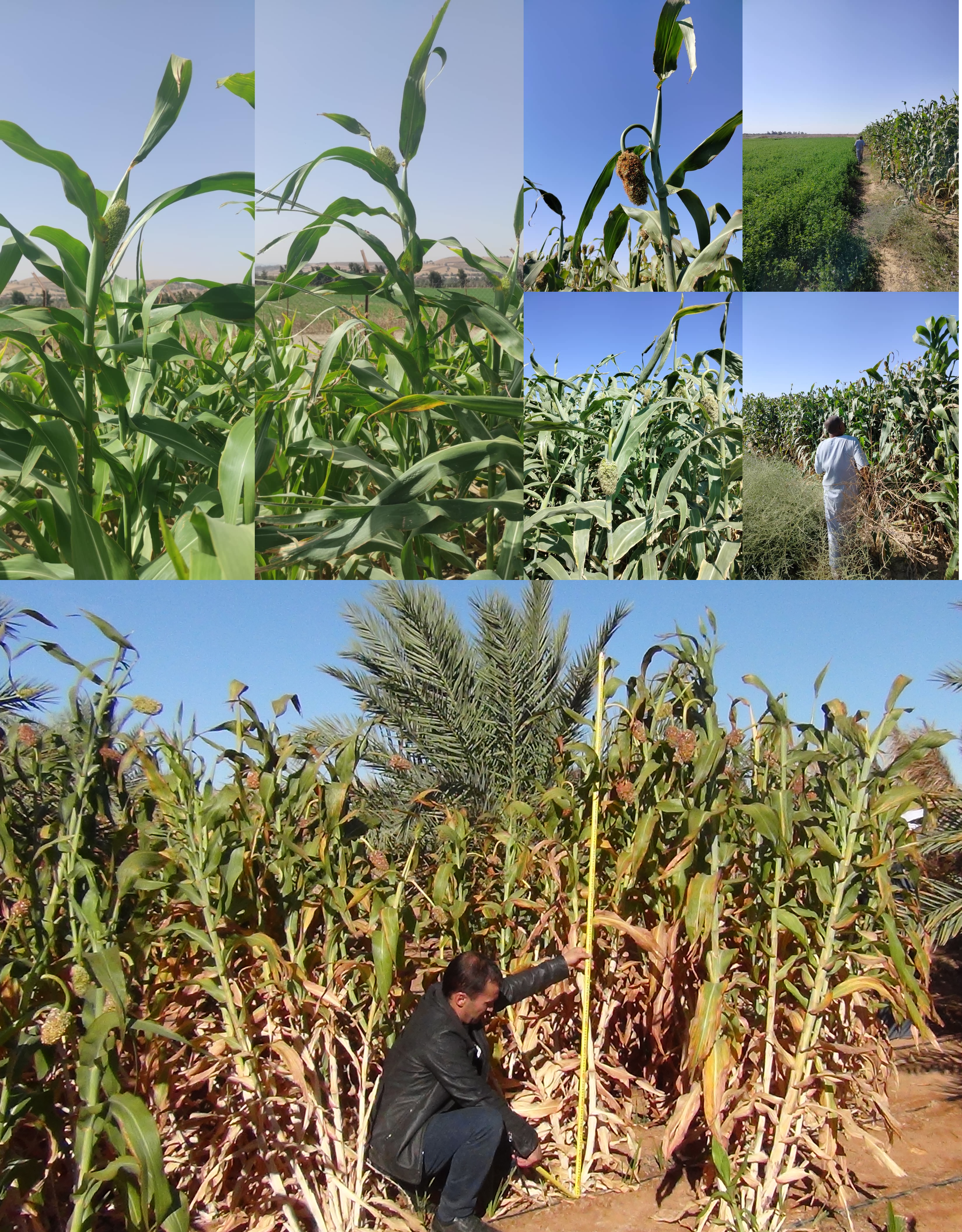
The field of animal feed production it is consider one of the most important areas in livestock production. Given that the livestock sector in Algeria faced many problems, such as water scarcity and the high cost of traditional feed, it is important to find other local sources to overcome those difficulties. This study aimed to determine the content of secondary metabolites, including total phenolic compounds, tannins, and flavonoids, and the antioxidant activities in different parts (leaves, stems, and panicle residues) of ten landraces of sorghum found in the Algerian desert and cultivated in the Bordj Bou Arreridj region of Algeria. The results showed significant differences between the contents of the studied samples, as well as among the three different parts of the plant, namely the leaves, stems, and panicle residues. The total phenolic content ranged from 122.33 to 1344.44 mg EAG.100 g-1, with tannin levels from 4.84 to 927.78 mg EAG.100 g-1, while the flavonoid values ranged from 0.24 to 558.25 mg EQ.100 g-1. The antioxidant activitie also showed a significant variation, with DPPH values between 46.10 and 1481.68 mg AAE.100 g-1, FRAP from 31.76 to 1145.92 mg AAE.100 g-1, and ABTS values ranging from 28.89 to 459.92 mg AAE.100 g-1. These results confirmed that the sorghum plants not only represented a source of primary metabolic compounds such as fibers, starch, proteins, and energy materials used as animal feed, but they could also be utilized as a rich source of phenolic compounds with effective value in the health field.
Downloads
References
Awika, J. M., & Rooney, L. W. (2004). Sorghum phytochemicals and their potential impact on human health. Phytochemistry, 65(9), 1199-1221.https://doi.org/10.1016/j.phytochem.2004.04.001
Benzie, I. F. F., & Strain, J. J. (1996). The Ferric Reducing Ability of Plasma (FRAP) as a Measure of “Antioxidant Power”: The FRAP Assay. Analytical Biochemistry, 239(1), 70-76. https://doi.org/10.1006/ABIO.1996.0292
Chang, C.-C., Yang, M.-H., Wen, H.-M., & Chern, J.-C. (2002). Estimation of totl flavonoid content in propolis by two complementary colorimetric methods. Journal of Food and Drug Analysis, 10(3), 178-182. https://doi.org/https://doi.org/10.38212/2224-6614.2748
Charyulu, D. K., Afari-Sefa, V., & Gumma, M. K. (2024). Trends in global sorghum production: Perspectives and limitations. In E. Habyarimana, M. A. Nadeem, F. S. Baloch, & N. Zencirci (Eds.), Omics and Biotechnological Approaches for Product Profile-Driven Sorghum Improvement (pp. 1-19). Springer Nature Singapore. https://doi.org/10.1007/978-981-97-4347-6_1
Chauhan, J., Solanki, S., Singh, A., & Singh, M. (2025). Forage Sorghum: Potential feedstock for bioenergy. In R. K. Singhal, Indu, A. El Sabagh, & K. K. Dwivedi (Eds.), Forage Crops in the Bioenergy Revolution: From Fields to Fuel (pp. 183-193). Springer Nature Singapore. https://doi.org/10.1007/978-981-96-2536-9_9
Chen, H., Xu, Y., Chen, H., Liu, H., Yu, Q., & Han, L. (2022). Isolation and identification of polyphenols from fresh sweet sorghum stems and their antibacterial mechanism against foodborne pathogens. Frontiers in Bioengineering and Biotechnology, 9, 770726. https://doi.org/10.3389/fbioe.2021.770726
D’almeida, C. T. D. S., Morel, M.-H., Terrier, N., Mameri, H., & Ferreira S. L., M. (2025). Dynamic metabolomic changes in the phenolic compound profile and antioxidant activity in developmental sorghum grains. Journal of Agricultural and Food Chemistry, 73(2), 1725-1738. https://doi.org/10.1021/acs.jafc.4c08975
Duke, K., Syeunda, C., Brantsen, J. F., Nindawat, S., & Awika, J. M. (2024). Polyphenol recovery from sorghum bran waste by microwave assisted extraction: Structural transformations as affected by grain phenolic profile. Food Chemistry, 444, 138645. https://doi.org/10.1016/J.FOODCHEM.2024.138645
Dykes, L., & Rooney, L. W. (2006). Sorghum and millet phenols and antioxidants. Journal of Cereal Science, 44(3), 236-251. https://doi.org/10.1016/J.JCS.2006.06.007
Estrada-Angulo, A., Coronel-Burgos, F., Castro-Pérez, B. I., Barreras, A., Zinn, R. A., Corona-Gochi, L., & Plascencia, A. (2019). Evaluation of panicle residue from broom sorghum as a feed ingredient in finishing diets for lambs. Animal, 13(1), 106-111. https://doi.org/10.1017/S1751731118001015
Hossain, M. S., Islam, M. N., Rahman, M. M., Mostofa, M. G., & Khan, M. A. R. (2022). Sorghum: A prospective crop for climatic vulnerability, food and nutritional security. Journal of Agriculture and Food Research, 8, 100300. https://doi.org/10.1016/j.jafr.2022.100300
Kumar, K., Debnath, P., Singh, S., & Kumar, N. (2023). An overview of plant phenolics and their involvement in abiotic stress tolerance. Stresses, 3(3), 570-585. https://doi.org/10.3390/stresses3030040
Mawouma, S., Condurache, N. N., Turturică, M., Constantin, O. E., Croitoru, C., & Rapeanu, G. (2022). Chemical composition and antioxidant profile of sorghum (Sorghum bicolor (L.) Moench) and pearl millet (Pennisetum glaucum (L.) R.Br.) grains cultivated in the far-north region of Cameroon. Foods, 11(14), 2026. https://doi.org/10.3390/foods11142026
Mérillon, J. M., & Ramawat, K. G. (2025). Reference Series in Phytochemistry Series Editors: Plant Specialized Metabolites Phytochemistry, Ecology and Biotechnology (J. M. Mérillon & K. G. Ramawat, Eds.). Springer Nature Switzerland AG. https://doi.org/https://doi.org/10.1007/978-3-031-51158-5
More, A., Morya, S., & Iyiola, A. O. (2024). Sorghum and Millets. In J. Singh, S. Kaur, P. Rasane, & J. Singh (Eds.), Cereals and Nutraceuticals (pp. 121-144). Springer Nature Singapore. https://doi.org/10.1007/978-981-97-2542-7_6
Sánchez-Moreno, C., Larrauri, J. A., & Saura-Calixto, F. (1998). A procedure to measure the antiradical efficiency of polyphenols. Journal of the Science of Food and Agriculture, 76(2), 270-276. https://doi.org/10.1002/(SICI)1097-0010(199802)76:2<270::AID-JSFA945>3.0.CO;2-9
Silanikove, N., Perevolotsky, A., & Provenza, F. D. (2001). Use of tannin-binding chemicals to assay for tannins and their negative postingestive effects in ruminants. Animal Feed Science and Technology, 91(1-2), 69-81. https://doi.org/10.1016/S0377-8401(01)00234-6
Singleton, V. L., Orthofer, R., & Lamuela-Raventós, R. M. (1999). Analysis of total phenols and other oxidation substrates and antioxidants by means of folin-ciocalteu reagent. Methods in Enzymology, 299, 152-178. https://doi.org/10.1016/S0076-6879(99)99017-1
Statistical Product and Service Solutions (SPSS). (2019). IBM SPSS Statistics for
Windows, Versión 26.0. Armonk, NY: IBM Corp. https://www.ibm.com/analytics/spss-statistics-software.
Taylor, J. R. N., Schober, T. J., & Bean, S. R. (2006). Novel food and non-food uses for sorghum and millets. Journal of Cereal Science, 44(3), 252-271. https://doi.org/10.1016/J.JCS.2006.06.009
Tugli, L. S., Essuman, E. K., Kortei, N. K., Nsor-Atindana, J., Nartey, E. B., & Ofori-Amoah, J. (2019). Bioactive constituents of waakye; a local Ghanaian dish prepared with Sorghum bicolor (L.) Moench leaf sheaths. Scientific African, 3, e00049. https://doi.org/10.1016/j.sciaf.2019.e00049
Woisky, R. G., & Salatino, A. (1998). Analysis of propolis: some parameters and procedures for chemical quality control. Journal of Apicultural Research, 37(2), 99-105. https://doi.org/10.1080/00218839.1998.11100961
Yi, R., García-Vaquero, M., Vigors, S., Wang, Y. H., Xu, J. C., Yu, Z. T., Ma, L., & Bu, D. P. (2025). Phytochemical extracts from the leaves and stem of red sorghum (Sorghum bicolor, L. Moench) potentially improve in vitro fermentation by modulating rumen protozoa. Journal of Dairy Science, 108(10), 10939-10955. https://doi.org/10.3168/jds.2025-26727
Yousfi, M., Djeridane, A., Bombarda, I., Duhem, B., & Gaydou, E. M. (2009). Isolation and characterization of a new hispolone derivative from antioxidant extracts of Pistacia atlantica. Phytotherapy Research, 23(9), 1237-1242. https://doi.org/10.1002/ptr.2543
Copyright (c) 2026 Mohamed Zaitri, Badreddine Belhadi, Mohamed Benalia, Redha Ould Kiar, Rachid Souilah, Djaffar Djabali

This work is licensed under a Creative Commons Attribution-NonCommercial-ShareAlike 4.0 International License.