Capsaicin in the control of Spodoptera frugiperda in corn (Zea mays L.) var. Blanco Urubamba
Abstract
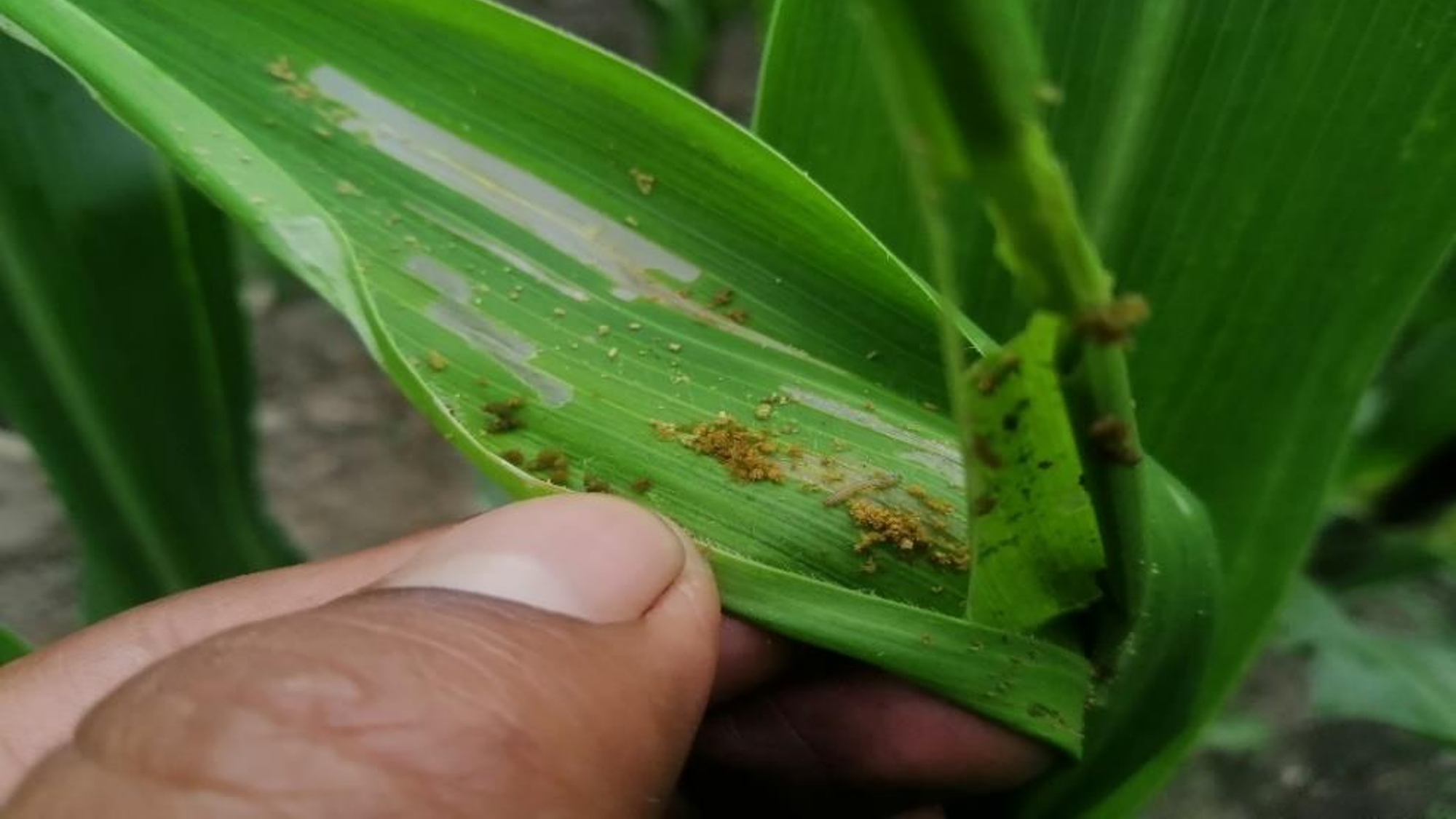
Spodoptera frugiperda Smith (Lepidoptera: Noctuidae) causes severe losses in corn (Zea mays L.) crops, which leads to the evaluation of sustainable management alternatives. The objective of this research was to determine the efficacy of capsaicin in controlling S. frugiperda in the corn Blanco Urubamba var. A randomized complete block design with six treatments and three replicates was used: four concentrations of water-soluble capsaicin (6.70; 10.05; 13.40 and 16.75 mL.L-¹), rocoto pepper extract (Capsicum pubescens Ruiz & Pav. (Solanaceae), 50 g.L-¹), and an absolute control. Applications were made at 80, 90, 100, 110, and 120 days after sowing (das). The 16.75 mL.L-¹ dose was the most effective, reducing larval density from 3.12 to 0.13 larvae per plant, and the infestation percentage from 61.12 to 2.78 %, with a control efficacy of 96.69%. Intermediate concentrations (13.40 and 10.05 mL.L-1) also showed significant effects, with final efficacies of 93.83 and 85.19 %, respectively. T1 had moderate efficacy (78.30%), while T5 recorded the lowest control values (72.86 %), with increasing infestations being observed in the control. In terms of yield, T4 (16.75 mL.L-¹) produced ears of 16.77 cm in length and 385.13 g in average weight, reaching a yield of 17.12 t.ha-¹ compared to 9.54 t.ha-¹ for the control. In conclusion, water-soluble capsaicin, especially at 16.75 mL.L-¹, proved to be an effective and sustainable alternative for the management of S. frugiperda in corn.
Downloads
References
Ahn, S., Badenes-Pérez, F., & Heckel, D. (2011). A host-plant specialist, Helicoverpa assulta, is more tolerant to capsaicin from Capsicum annuum than other noctuid species. Journal of Insect Physiology, 57(9), 1212-1219. https://doi.org/10.1016/j.jinsphys.2011.05.015
Aza-González, C., Núñez-Palenius, H., & Ochoa-Alejo, N. (2011). Molecular biology of capsaicinoid biosynthesis in chili pepper (Capsicum spp.). Plant Cell Reports, 30, 695-706. https://link.springer.com/article/10.1007/s00299-010-0968-8
Cabrera Verdezoto, R., Morán Morán, J., Mora Velasquez, B., Molina Triviño, H., Moncayo Carreño, O., Díaz Ocampo, E., & Cabrera Verdesoto, C. (2016). Evaluación de dos insecticidas naturales y un químico en el control de plagas en el cultivo de frejol en el litoral ecuatoriano. Idesia (Arica), 34(5), 27-35. http://dx.doi.org/10.4067/S0718-34292016005000025
Capinera, J. L. (2017). Encyclopedia of entomology. Springer.
Cárdenas-De la Peña, A., Muñoz-MadridAlba, A., Montero-Solís, F., & Hernández-Arzaba, J. (2022). Factibilidad económica de biopreparados: Una alternativa en la producción de hortalizas en Valle de Santiago, Guanajuato, México. Agro-Divulgación, 2(4), 49-51. https://agrodivulgacion-colpos.org/index.php/1agrodivulgacion1/article/view/92
Castillo-López, I., Rodríguez-Africano, P., Montes-Pérez, R., & González-Valderrama, D. (2017). Fauna silvestre que afecta los cultivos en Boyacá y control del daño a cultivos de maíz. Ciencia y Agricultura, 14(1), 75-84. https://doi.org/10.19053/01228420.v14.n1.2017.6090
Caterina, M., Schumacher, M., Tominaga, M., Rosen, T., Levine, J., & Julius, D. (1997). The capsaicin receptor: a heat-activated ion channel in the pain pathway. Nature, 389(6653), 816-824. https://www.nature.com/articles/39807
Chabaane, Y., Arce, C., Glauser, G., & Benrey, B. (2021). Altered capsaicin levels in domesticated chili pepper varieties affect the interaction between a generalist herbivore and its ectoparasitoid. Journal of Pest Science, 95, 735-747. https://doi.org/10.1007/s10340-021-01399-8
Chapman, J., Williams, T., Martínez, A., Cisneros, J., Caballero, P., Cave, R., & Goulson, D. (1999). Does cannibalism in Spodoptera frugiperda (Lepidoptera: Noctuidae) reduce the risk of Bt resistance? Journal of Economic Entomology, 92(4), 935-940. https://doi.org/10.1093/jee/92.4.935
Clark, P., Molina-Ochoa, J., Martinelli, S., Skoda, S., Isenhour, D., Lee, D., Krumm, J., & Foster, J. (2007). Population variation of the fall armyworm, Spodoptera frugiperda, in the Western Hemisphere. Journal of Insect Science, 7(1), 5. https://doi.org/10.1673/031.007.0501
Cowles, R., Keller, J., & Miller, J. (1989). Pungent spices, ground red pepper, and synthetic capsaicin as onion fly ovipositional deterrents. Journal of Chemical Ecology, 15, 719-730. https://link.springer.com/article/10.1007/bf01014714
Davis, F., Ng, S., & Williams, W. (1992). Visual rating scales for screening whorl-stage corn for resistance to fall armyworm. Mississippi Agricultural and Forestry Experiment Station. Technical Bulletin, 186, 1-9.
Du Plessis, H., Schlemmer, M., & Van den Berg, J. (2020). The effect of temperature on the development of Spodoptera frugiperda (Lepidoptera: Noctuidae). Insects, 11(4), 228. https://doi.org/10.3390/insects11040228
Figueroa Gualteros, A., Castro Triviño, E., & Castro Salazar, H. (2019). Efecto bioplaguicida de extractos vegetales para el control de Spodoptera frugiperda en el cultivo de maíz (Zea mays). Acta Biológica Colombiana, 24(1), 58-66. https://doi.org/10.15446/abc.v24n1.69333
Gonçalves, G., Lira, S., GlSSI, D., & Vendramim, J. (2021). Bioactivity of extracts from solanaceae against Zabrotes subfasciatus. Acta Biológica Colombiana, 26(1), 62-71. https://doi.org/10.15446/abc.v26n1.84712
Henderson, F., & Tilton, W. (1955). Tests with acaricides against the brown wheat mite 12. Journal of Economic Entomology, 48(2), 157-161. https://doi.org/10.1093/jee/48.2.157
Holdridge, L. (1987). Ecología basada en zonas de vida. Agroamerica.
Hori, M., Nakamura, H., Fujii, Y., Suzuki, Y., & Matsuda, K. (2011). Chemicals affecting the feeding preference of the Solanaceae‐feeding lady beetle Henosepilachna vigintioctomaculata (Coleoptera: Coccinellidae). Journal of Applied Entomology, 135(1‐2), 121-131. https://doi.org/10.1111/j.1439-0418.2010.01519.x
Ileer, V., Peralta, J., Palacios, C., & Burgos, A. (2022). Bioinsecticidas elaborados con extractos botánicos utilizados contra Spodoptera spp. en el cultivo de sandía (Citrullus lanatus T.) en Los Ríos-Ecuador. Uniciencia, 36(1), 659-669. http://doi.org/10.15359/ru.36-1.42
Kim, S., Boo, K., Na, Y., & Tak, J. (2023). Screening of insecticidal activity of plant essential oils and extract-based formulations against four agricultural insect pests and their risk assessment. Journal of Asia-Pacific Entomology, 26(4), 102127. https://doi.org/10.1016/j.aspen.2023.102127
Lamsal, S., Sibi, S., & Yadav, S. (2020). Fall armyworm in South Asia: Threats and management. Asian Journal of Advances in Agricultural Research, 13(3), 21–34. https://doi.org/10.9734/ajaar/2020/v13i330106
Li, B., Yang, M., Shi, R., & Ye, M. (2019). Insecticidal activity of natural capsaicinoids against several agricultural insects. Natural Product Communications, 14(7). https://doi.org/10.1177/1934578X19862695
Madhumathy, A., Aivazi, A., & Vijayan, V. (2007). Larvicidal efficacy of Capsicum annum against Anopheles stephensi and Culex quinquefasciatus. Journal of Vector Borne Diseases, 44(3), 223-226. PMID: 17896626.
Meckelmann, S., Jansen, C., Riegel, D., van Zonneveld, M., Ríos, L., Peña, K., Mueller-Seitz, E., & Petz, M. (2015). Phytochemicals in native Peruvian Capsicum pubescens (Rocoto). European Food Research and Technology, 241(6), 817-825. https://doi.org/10.1007/s00217-015-2506-y
Ministerio de Desarrollo Agrario y Riego. (2020). Anuario estadísticas de la producción agrícola y ganadera. Lima, Perú, Dirección de Estadística Agraria. http://frenteweb.minagri.gob.pe/sisca/?mod=consultacult
Miranda, A., Espejo, Y., Salas, J., Gonzales, H., Aguilera, J., & Martínez, L. (2021). Bioplaguicidas: Mecanismos de acción biocida en insectos plaga. Research, Society and Development, 10(7), e42010716893-e42010716893. https://doi.org/10.33448/rsd-v10i7.16893
Montezano, D., Sosa-Gómez, D., Specht, A., Roque-Specht, V., Sousa-Silva, J., Paula-Moraes, S., Peterson, J., & Hunt, T. (2018). Host plants of Spodoptera frugiperda (Lepidoptera: Noctuidae) in the Americas. African Entomology, 26(2), 286-300. https://hdl.handle.net/10520/EJC-112bc26060
Negrete, F., & Morales, J. (2003). El gusano cogollero del maíz: (Spodoptera frugiperda. Smith): Manejo del gusano cogollero del maíz utilizando extractos de plantas. Corpoica. http://hdl.handle.net/20.500.12324/2220
Neira, M., & Pérez, E. (2020). Manejo ecológico para el control de Spodoptera frugiperda en el cultivo de maíz amarillo duro en las regiones de Lambayeque y La Libertad. Instituto Nacional de Innovación Agraria - INIA. https://repositorio.inia.gob.pe/handle/20.500.12955/1148
Paredes-Sánchez, F., Rivera, G., Bocanegra-García, V., Martínez-Padrón, H., Berrones-Morales, M., Niño-García, N., & Herrera-Mayorga, V. (2021). Avances en estrategias de control contra Spodoptera frugiperda. Una revisión. Moléculas, 26(18), 5587. https://doi.org/10.3390/molecules26185587
Rakesh, V., Patgiri, P., Borah, A., Nandhini, D., & Gogoi, I. (2024). Comparative study on the repellency and chemical profiles of different chilli peppers formulations against Sitophilus oryzae (L.) (Coleoptera: Curculionidae) in stored wheat. Journal of Stored Products Research, 106, 102312. https://doi.org/10.1016/j.jspr.2024.102312
Reyes-Escogido, M., Gonzalez-Mondragon, E., & Vazquez-Tzompantzi, E. (2011). Chemical and pharmacological aspects of capsaicin. Molecules, 16(2), 1253-1270. https://doi.org/10.3390/molecules16021253
Salgado-Aristizabal, N., Galvis-Nieto, J., Narvaez-Perez, J., Jurado-Erazo, D., Rodríguez, L., & Orrego, C. (2024). Evaluation of a sustainable production of encapsulated chili pepper powder (Capsicum pubescens) through convective and vacuum drying. Processes, 12(10), 2154. https://doi.org/10.3390/pr12102154
Sánchez-Alonso, I., Fonseca-González, A., Olmedo-Juárez, A., Olivares-Pérez, J., González-Cortazar, M., Monteon-Ojeda, A., & Rojas Hernández, S. (2024). Insecticidal activity of two organic extracts from Libidibia coriaria (Jacq.) Schltdl. fruits against Spodoptera frugiperda JE Smith. Natural Product Research, 1-7. https://doi.org/10.1080/14786419.2024.2368274
Santoa, L., & Santos, L. (2024). Effect of Capsicum chinense as a botanical insecticide on the mortality of Spodoptera frugiperda (J.E. Smith) (Lepidoptera: Noctuidae) in soybeans. Contribuciones a las Ciencias Sociales, 17(13), e13891. https://doi.org/10.55905/revconv.17n.13-370
Servicio Nacional de Meteorología e Hidrología del Perú. (2024). Datos climáticos históricos de la región Huánuco 1991-2020. Plataforma de Datos Climáticos. https://www.senamhi.gob.pe
Sinha, R., Shaham, Y., & Heilig, M. (2011). Translational and reverse translational research on the role of stress in drug craving and relapse. Psychopharmacology, 218, 69-82. https://link.springer.com/article/10.1007/s00213-011-2263-y
Stirle, J., Matias, J., Mendes, G., Moscardini, V., Maia, J., Michaud, J., & Gontijo, P. (2024). Differential susceptibility of Spodoptera frugiperda (Lepidoptera: Noctuidae) to single versus pyramided Bt traits in Brazilian soybean: what doesn't kill you makes you stronger?. Pest Management Science, 80(12), 6535-6544. https://doi.org/10.1002/ps.8391
Tang, X., Lyu, B., Lu, H., Tang, J., & Zhang, Y. (2024). Effects of cannibalism on the growth and development of Spodoptera frugiperda (Lepidoptera: Noctuidae). International Journal of Pest Management, 70(4), 1423-1433. https://doi.org/10.1080/09670874.2022.2140856
Van den Berg, J., & du Plessis, H. (2022). Chemical control and insecticide resistance in Spodoptera frugiperda (Lepidoptera: Noctuidae). Journal of Economic Entomology, 115(6), 1761-1771. https://doi.org/10.1093/jee/toac108
Zelaya-Molina, L., Chávez-Díaz, I., De los Santos-Villalobos, S., Cruz-Cárdenas, C., Ruíz-Ramírez, S., & Rojas-Anaya, E. (2022). Control biológico de plagas en la agricultura mexicana. Revista Mexicana de Ciencias Agrícolas, 13(SPE27), 69-79. https://doi.org/10.29312/remexca.v13i27.3251
Zhu, J., Tian, K., Reilly, C., & Qiu, X. (2020). Capsaicinoid metabolism by the generalist Helicoverpa armigera and specialist H. assulta: Species and tissue differences. Pesticide Biochemistry and Physiology, 163, 164-174. https://doi.org/10.1016/j.pestbp.2019.11.013
Copyright (c) 2026 Hecar Herrera Marchino, Agustina Valverde-Rodríguez, Manuel Jorge Castillo Nole, Laura Carmen Barrionuevo Torres, Luisa Madolyn Alvarez-Benaute, Miltao Edelio Campos-Albornoz

This work is licensed under a Creative Commons Attribution-NonCommercial-ShareAlike 4.0 International License.