
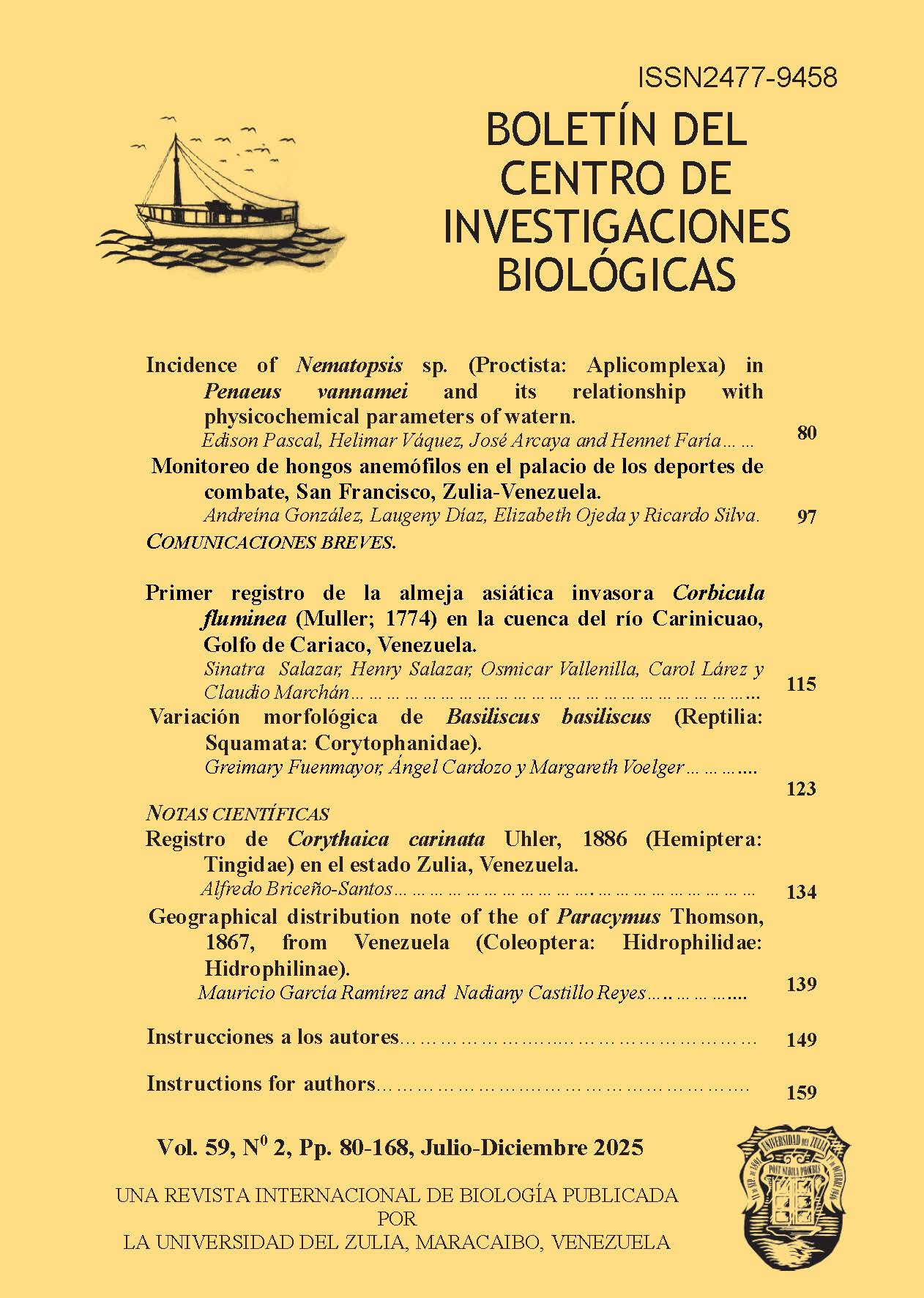
Incidence of Nematopsis sp. (Protoctista: Apicomplexa) in Penaeus vannamei and its relationship with physicochemical parameters of water
Abstract
This study evaluated the incidence of parasitosis caused by Nematopsis sp. (Protoctista: Apicomplexa) in farmed shrimp (Penaeus vannamei) at a farm in the Falcón State, Venezuela, over four months (June–September). A total of 1000 specimens were sampled using a cast net, and microscopic counts of gregarines in the intestines were performed to estimate parasitic load. Concurrently, water physical parameters (pH, salinity, temperature, and transparency) were measured to analyze their relationship with parasitosis incidence. Results showed a significant progressive increase in incidence, from 39.52% in June to 143.52% in September, indicating a considerable rise in parasitosis levels. Monthly variations in physical parameters were observed, with decreases in pH, salinity, and transparency correlating with increased incidence. Correlation analyses revealed a strong negative association between pH and transparency with incidence (r ≈ -0.82, R² ≈ 0.67), and a moderate negative correlation with salinity (r ≈ -0.64). Temperature had a lesser and non-significant influence (r ≈ - 0.28). These findings suggest that environmental factors, especially pH and transparency, play a crucial role in the parasitic dynamics of Nematopsis sp., affecting the health and productivity of P. vannamei. The study emphasizes the importance of continuous monitoring of physicochemical water parameters for sanitary control in aquaculture and recommends integrated strategies considering environmental conditions to prevent parasitic outbreaks.
Downloads
References
CABRERA, F. y M. RUBIO. 2012. Protozoarios epibiontes en el cultivo del camarón Litopenaeus vannamei. Revista Facultad de Ciencias Veterinarias 53(2): 100-
106. http://ve.scielo.org/scielo.php?pid=S0258-65762012000200002&script=sciarttetxtt=sci_
FAO. 2020. Acuicultura en América Latina: situación actual y perspectivas. Organización de las Naciones Unidas para la Alimentación y la Agricultura. https://www.fao.org/4/u1780s/U1780S04.htm
FAJARDO-GUTIÉRREZ, A. 2017. Medición en epidemiología: prevalencia, incidencia, riesgo, medidas de impacto. Revista Alergia México 64(1): 109-120. https://doi.org/10.29262/ram.v64i1.252
FLORES, G., M. LÓPEZ AND R. MORALES. 2014. Impacto de la parasitosis por gregarinas (Nematopsis sp.) en el crecimiento del camarón blanco Litopenaeus vannamei de cultivo. Revista de Investigación Acuícola. 10(3): 45-53. https://raximhai.uaim.edu.mx/index.php/rx/article/view/713
GARCÍA, J. y S. PARRALES. 2019. Enfermedades parasitarias en camarones de cultivo: avances y retos. Acuicultura Latinoamericana 22(1): 15-29. https://revistaespirales.consultorioampuero.com/index.php/es/article/view/379
GRANADOS, J. T. 1995. Medidas de prevalencia y relación incidencia-prevalencia. Med. Clin. (Barc.) 105: 216-218. https://www.academia.edu/download/36330523/prevalencia.pdf
HANNA INSTRUMENTS. 2023. HI98194 Portable multiparameter meter: Technical specifications. https://www.hannainst.es
HERNÁNDEZ, M., R. LÓPEZ, y F. MARTÍNEZ. 2021. Métodos prácticos para la medición de parámetros físicos en acuicultura. Revista de Tecnología Acuícola 14(2): 89-98. https://revistas.utm.edu.ec/index.php/aquatechnica/
LIGHTNER, D. V. 1988. A Handbook of normal penaeid shrimp histology. World Aquaculture Society. https://cesarom.files.wordpress.com/2013/08/bell-lightner
_1988_handbook-of-shrimp-histology.pdf
LÓPEZ, V., S. HERNÁNDEZ, Y D. PÉREZ. 2022. Dinámica del cultivo de camarón en América Latina: cifras y proyecciones. Boletín Pesquero Latinoamericano 18(4): 32-42. http://dspace.unach.edu.ec/handle/51000/12334
MORA-FAUBLA, G. M., C. R. DELGADO-VILLAFUERTE, F. F. PEÑARRIETA-MACIA, y L. C. URDANIGO-MENDOZA. 2025. Producción de camarón blanco (Litopenaeus vannamei) y su impacto en los componentes fisicoquímicos del agua en el golfo de Guayaquil, Ecuador. MQR Investigar 9(2): e639. https://doi.org/10.56048/MQR20225.9.2.2025.e639
MORALES, M. S., A. RUIZ, A. PEREIRA, V. SOLÍS y G. CONROY. 2011. Prevalencia de enfermedades de camarón blanco (Litopenaeus vannamei) cultivados en ocho regiones de Latinoamérica. Revista Científica. Facultad de Ciencias Veterinarias de la Universidad del Zulia 21(5): 434-446. https://www.redalyc.org/pdf/959/95919362010.pdf
PASCAL, E., Y. ALVARADO y H. VÁSQUEZ. 2024. Prevalence of intestinal parasitosis caused by Nematopsis sp. (Protozoa: Apicomplexa) in Litopenaeus vannamei and its relationship with water turbidity, in a fattening farm. J. Mod. Agric. Biotechnol. 2024: 3: 7. DOI: 10.53964/jmab.2024007.
PASCAL, E., E. PORTILLO, A. MÉNDEZ y H. VÁSQUEZ. 2023. Relationship between infection caused by the apicomplex protozoan Nematopsis sp. and the weight of white shrimp Litopenaeus vannamei in a cultivation system. J. Biomed Res Environ Sci. Oct 13. 4(10): 1405-1411. Doi: 10.37871/jbres1810, https://www.jelsciences.com/articles/ jbres1810.pdf
PASCAL, E., H. VÁSQUEZ, N. CASTILLO, Y. SANDREA y K. FERRER. 2022. Prevalencia de parasitosis en camarón blanco de cultivo (Penaeus vannamei) en dos fincas de la costa occidental del estado Falcón, Venezuela. Redieluz 12(2): 94 - 98. https://doi.org/10.5281/zenodo.7423301
PRADO, C. 1996. Diagnóstico, tratamiento y prevención de infestaciones por gregarinas en camarones Penaeus vannamei mediante dieta medicada. Degree thesis. ESPOL, Guayaquil, Ecuador. https://www.dspace.espol.edu.ec/handle/123456789/4
Los autores/as que publiquen en esta revista aceptan las siguientes condiciones:Â
- Los autores/as conservan los derechos de autor y ceden a la revista el derecho de la primera publicación, con el trabajo registrado con la licencia de atribución de Creative Commons, que permite a terceros utilizar lo publicado siempre que mencionen la autoría del trabajo y a la primera publicación en esta revista.
- Los autores/as pueden realizar otros acuerdos contractuales independientes y adicionales para la distribución no exclusiva de la versión del artículo publicado en esta revista (p. ej., incluirlo en un repositorio institucional o publicarlo en un libro) siempre que indiquen claramente que el trabajo se publicó por primera vez en esta revista.
- Se permite y recomienda a los autores/as a publicar su trabajo en Internet (por ejemplo en páginas institucionales o personales) antes y durante el proceso de revisión y publicación, ya que puede conducir a intercambios productivos y a una mayor y más rápida difusión del trabajo publicado (vea The Effect of Open Access).


