Evaluación histológica del hipocampo en ratas con diabetes tipo 2: funciones neuroprotectoras de la exenatida, la empagliflozina y la quercetina
Resumen
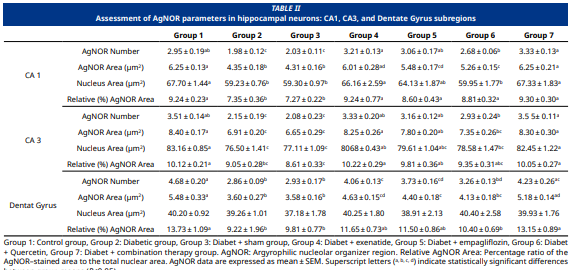
Este estudio tuvo como objetivo evaluar los cambios histológicos en el tejido hipocampal después de la monoterapia con exenatida, empagliflozina y quercetina, así como el tratamiento combinado, en ratas con diabetes tipo 2. Las ratas se dividieron en 7 grupos: grupo 1 (control no diabético), grupo 2 (control diabético), grupo 3 (diabético + placebo), grupo 4 (diabético + exenatida, 10 μg·kg–1), grupo 5 (diabético + empagliflozina, 50 mg·kg–1), grupo 6 (diabético + quercetina, 50 mg·kg–1) y grupo 7 (diabético+tratamiento combinado). El estudio duró 8 semanas. Al final del estudio, se recolectaron tejidos cerebrales de las ratas y se fijaron en formaldehído bufferado al 10 %. Después de la fijación, se realizó el procesamiento rutinario del tejido y se crearon bloques de parafina. Se aplicaron tinciones de May–Grünwald Giemsa y Región organizadora nucleolar argirófila a las secciones de parafina. Se evaluaron las regiones CA1, CA3 y del giro dentado del hipocampo. El estudio reveló un aumento en el número de neuronas encogidas y oscuras con núcleos picnóticos en ratas diabéticas, mientras que se observó una disminución en el número de neuronas sanas. La proliferación celular se evaluó mediante tinción con Región organizadora nucleolar argirófila, que mostró que la diabetes causa una disminución en la proliferación celular. La exenatida, la empagliflozina y la quercetina mejoraron la disminución del número de neuronas sanas inducida por la diabetes, y la terapia combinada produjo mejores resultados que la monoterapia.
Descargas
Citas
Sadeghi A, Hami J, Razavi S, Esfandiary E, Hejazi Z. The effect of diabetes mellitus on apoptosis in hippocampus: cellular and molecular aspects. Int. J. Prev. Med. [Internet]. 2016; 7(1):57. doi: https://doi.org/q5rh DOI: https://doi.org/10.4103/2008-7802.178531
Li M, Li Y, Zhao K, Tan X, Chen Y, Qin C, Qiu S, Liang Y. Changes in the structure, perfusion, and function of the hippocampus in type 2 diabetes mellitus. Front. Neurosci. [Internet]. 2023; 16:1070911. doi: https://doi.org/q5rj DOI: https://doi.org/10.3389/fnins.2022.1070911
Dakic T, Jevdjovic T, Lakic I, Ruzicic A, Jasnic N, Djurasevic S, Djordjevic J, Vujovic P. The expression of insulin in the central nervous system: what have we learned so far? Int. J. Mol. Sci. [Internet]. 2023; 24(7):6586. doi: https://doi.org/q5rk DOI: https://doi.org/10.3390/ijms24076586
Grillo CA, Woodruff JL, Macht VA, Reagan LP. Insulin resistance and hippocampal dysfunction: disentangling peripheral and brain causes from consequences. Exp. Neurol. [Internet]. 2019; 318 (2019):71-77. doi: https://doi.org/q5rm DOI: https://doi.org/10.1016/j.expneurol.2019.04.012
Agircan D, Parlak TM, Tufan O, Demircioglu M, Dik B. Neuroprotective effects of bexarotene and icariin in a diabetic rat model. Cureus [Internet]. 2024; 16(8):e68238. doi: https://doi.org/q5rn DOI: https://doi.org/10.7759/cureus.68238
Kısadere İ, Karaman M, Aydın M F, Donmez N, Usta M. The protective effects of chitosan oligosaccharide (COS) on cadmium-induced neurotoxicity in Wistar rats. Arch. Environ. Occup. Health 2022; 77(9):755-763. doi: https://doi.org/q5rp DOI: https://doi.org/10.1080/19338244.2021.2008852
Ahmadpour S, Behrad A, Vega IF. Dark neurons: A protective mechanism or a mode of death. J. Med. Histol. [Internet]. 2019; 3(2):125-131. doi: https://doi.org/q5rr DOI: https://doi.org/10.21608/jmh.2020.40221.1081
Ahmadpour SH, Haghir H. Diabetes mellitus type 1 induces dark neuron formation in the dentate gyrus: a study by Gallyas' method and transmission electron microscopy. Rom. J. Morphol. Embryol. [Internet]. 2011 [cited 25 Jun 2025]; 52(2):575-579. Cited in: PubMed; PMID 21655645. Available in: https://goo.su/UGxJPd4
Butterfield DA, Halliwell B. Oxidative stress, dysfunctional glucose metabolism and Alzheimer disease. Nat. Rev. Neurosci. [Internet]. 2019; 20(3):148-160. doi: https://doi.org/gfvjx3 DOI: https://doi.org/10.1038/s41583-019-0132-6
González-Reyes RE, Aliev G, Ávila-Rodrigues M, Barreto GE. Alterations in glucose metabolism on cognition: A possible link between diabetes and dementia. Curr. Pharm. Des. [Internet]. 2016; 22(7):812-818. doi: https://doi.org/f8dqcd DOI: https://doi.org/10.2174/1381612822666151209152013
Lee HJ, Seo HI, Cha HY, Yang YJ, Kwon SH, Yang SJ. Diabetes and Alzheimer's disease: mechanisms and nutritional aspects. Clin. Nutr. Res. [Internet]. 2018; 7(4):229-240. doi: https://doi.org/gfk3x3 DOI: https://doi.org/10.7762/cnr.2018.7.4.229
Choudhary AK. Neuroinflammation and cognitive health in type 2 diabetes. Med. Res. Arch. [Internet]. 2025; 13(8):1-12. doi: https://doi.org/q5rz DOI: https://doi.org/10.18103/mra.v13i8.6866
Candeias E, Sebastião I, Cardoso S, Carvalho C, Santos MS, Oliveira CR, Moreira PI, Duarte AI. Brain GLP-1/IGF-1 signaling and autophagy mediate exendin-4 protection against apoptosis in type 2 diabetic rats. Mol. Neurobiol. [Internet]. 2018; 55(5):4030-4050. doi: https://doi.org/gffnbp DOI: https://doi.org/10.1007/s12035-017-0622-3
Holst JJ, Vilsbøll T, Deacon CF. The incretin system and its role in type 2 diabetes mellitus. Mol. Cell. Endocrinol. [Internet]. 2009; 297(1-2):127-136. doi: https://doi.org/d23rbk DOI: https://doi.org/10.1016/j.mce.2008.08.012
Frampton JE. Empagliflozin: a review in type 2 diabetes. Drugs [Internet]. 2018; 78:1037-1048. doi: https://doi.org/gdt5ht DOI: https://doi.org/10.1007/s40265-018-0937-z
Korkmaz Y, Dik B. The comparison of the antidiabetic effects of exenatide, empagliflozin, quercetin, and combination of the drugs in type 2 diabetic rats. Fundam. Clin. Pharmacol. [Internet]. 2024; 38(3):511-522. doi: https://doi.org/q5r2 DOI: https://doi.org/10.1111/fcp.12975
Ansari P, Choudhury ST, Seidel V, Rahman AB, Aziz MA, Richi AE, Rahman A, Jafrin UH, Hannan JMA, Abdel-Wahab YHA. Therapeutic potential of quercetin in the management of type-2 diabetes mellitus. Life [Internet]. 2022; 12(8):1146. doi: https://doi.org/q5r3 DOI: https://doi.org/10.3390/life12081146
Donmez HH, Donmez N, Kısadere I, Undag I. Protective effect of quercetin on some hematological parameters in rats exposed to cadmium. Biotech. Histochem. [Internet]. 2019; 94(5):381-386. doi: https://doi.org/qpgg DOI: https://doi.org/10.1080/10520295.2019.1574027
Khan H, Ullah H, Aschner M, Cheang WS, Akkol EK. Neuroprotective effects of quercetin in Alzheimer's disease. Biomolecules [Internet]. 2019; 10(1):59. doi: https://doi.org/gmc85n DOI: https://doi.org/10.3390/biom10010059
Yan L, Vaghari-Tabari M, Malakoti F, Moein S, Qujeq D, Yousefi B, Asemi Z. Quercetin: an effective polyphenol in alleviating diabetes and diabetic complications. Crit. Rev. Food Sci. Nutr. [Internet]. 2023; 63(28):9163-9186. doi: https://doi.org/gq7zfb DOI: https://doi.org/10.1080/10408398.2022.2067825
Dik B, Parlak TM, Ates MB, Tufan O. Exploring the combined therapeutic efficacy of bexarotene and icariin in type 2 diabetic rats. J. Pharm. Pharmacol. [Internet]. 2024; 76(11):1474-1481. doi: https://doi.org/q54g DOI: https://doi.org/10.1093/jpp/rgae100
Lu X, Xie Q, Pan X, Zhang R, Zhang X, peng G, Zhang Y, Shen S, Tong N. Type 2 diabetes mellitus in adults: pathogenesis, prevention and therapy. Sig. Transduct. Target. Ther. [Internet]. 2024; 9(1):262. doi: https://doi.org/g9rswd DOI: https://doi.org/10.1038/s41392-024-01951-9
DiK B, Bahcivan E, Eser-Faki H, Uney K. Combined treatment with interleukin-1 and tumor necrosis factor-alpha antagonists improve type 2 diabetes in rats. Can. J. Physiol. Pharmacol. [Internet]. 2018; 96(8):751-756. doi: https://doi.org/gd28hk DOI: https://doi.org/10.1139/cjpp-2017-0769
Kleinridders A, Ferris HA, Cai W, Kahn CR. Insulin action in brain regulates systemic metabolism and brain function. Diabetes [Internet]. 2014; 63(7):2232-2243. doi: https://doi.org/f57jmt DOI: https://doi.org/10.2337/db14-0568
Scherer T, Sakamoto K, Buettner C. Brain insulin signalling in metabolic homeostasis and disease. Nat. Rev. Endocrinol. [Internet]. 2021; 17(8):468-483. doi: https://doi.org/gkhfmj DOI: https://doi.org/10.1038/s41574-021-00498-x
Chen W, Cai W, Hoover B, Kahn CR. Insulin action in the brain: cell types, circuits, and diseases. Trends Neurosci. [Internet]. 2022; 45(5):384-400. doi: https://doi.org/q54j DOI: https://doi.org/10.1016/j.tins.2022.03.001
Ündağ İ, Dönmez HH. Protective effect of Nigella sativa oil on hippocampus in acrylamide-induced toxicity in rats. Pak. Vet. J. [Internet]. 2023; 43(3):616-622. doi: https://doi.org/q54m
Chaudhary P, Janmeda P, Docea AO, Yeskaliyeva B, Abdull-Razis AF, Modu B, Calina D, Sharifi-Rad, J. Oxidative stress, free radicals and antioxidants: potential crosstalk in the pathophysiology of human diseases. Front. Chem. [Internet]. 2023; 11:1158198. doi: https://doi.org/mpwj DOI: https://doi.org/10.3389/fchem.2023.1158198
Hatipoğlu D, Dik I, Gülersoy E. Determination of oxidative stress and antioxidant activities in dogs infected with Canine Distemper Virus. Van. Vet. J. [Internet]. 2022; 33(3):67-70. doi: https://doi.org/q54n DOI: https://doi.org/10.36483/vanvetj.1136569
Yavru S, Avci O, Dik I, Atlı K. Herpes Simplex Virus tip 1 inokule edilen Vero hücre kültüründe antioksidan enzim aktiviteleri [Antioxidant enzyme activities in Vero cell line inoculated with Herpes Simplex Virus type 1]. Eurasian J. Vet. Sci. 2015; 31(2):122-126. Turkish. doi: https://doi.org/q54p DOI: https://doi.org/10.15312/EurasianJVetSci.2015210084
Dik B, Avci O, Dik I. In vitro antiviral and antioxidant activities of silymarin and Panax ginseng on vero cells infected with bovine ephemeral fever virus and bluetongue virus. Acta Pol. Pharm. 2019; 76(2):291-297. doi: https://doi.org/q54q DOI: https://doi.org/10.32383/appdr/96330
Biessels GJ, Whitmer RA. Cognitive dysfunction in diabetes: how to implement emerging guidelines. Diabetologia [Internet]. 2020; 63(1):3-9. doi: https://doi.org/ghbfm6 DOI: https://doi.org/10.1007/s00125-019-04977-9
McCrimmon RJ, Ryan CM, Frier BM. Diabetes and cognitive dysfunction. Lancet [Internet]. 2012; 379(9833):2291-2299. doi: https://doi.org/f2ff47 DOI: https://doi.org/10.1016/S0140-6736(12)60360-2
Shalimova A, Graff B, Gąsecki D, Wolf J, Sabisz A, Szurowska E, Jodzio K, Narkiewicz K. Cognitive dysfunction in type 1 diabetes mellitus. J. Clin. Endocrinol. Metab. [Internet]. 2019; 104(6):2239-2249. doi: https://doi.org/grzhxh DOI: https://doi.org/10.1210/jc.2018-01315
Elsaeed E, Hamad A, Erfan O, El-Shahat MA, Ebrahim FA. Effect of exenatide on apoptosis, autophagy, and necroptosis in the hippocampus of STZ-induced diabetic female rats: an immunohistochemical study. Egyptian Acad. J. Biol. Sci. Histol. Histochem. [Internet]. 2022; 14(1):1-25. doi: https://doi.org/q54r DOI: https://doi.org/10.21608/eajbsd.2022.214866
Alipour M, Salehi I, Ghadiri-Soufi F. Effect of exercise on diabetes-induced oxidative stress in the rat hippocampus. Iran Red. Crescent. Med. J. [Internet]. 2012 [cited 25 Jun 2025]; 14(4):222-228. Cited in: PubMed; PMID 22754685. Available in: https://goo.su/WmnOx
Cosar M, Songur A, Sahin O, Uz E, Yilmaz R, Yagmurca M, Ozen OA. The neuroprotective effect of fish n-3 fatty acids in the hippocampus of diabetic rats. Nutr. Neurosci. [Internet]. 2008; 11(4):161-166. doi: https://doi.org/d4d9rm DOI: https://doi.org/10.1179/147683008X301531
Yonguc GN, Dodurga Y, Adiguzel E, Gundogdu G, Kucukatay V, Ozbal S, Yilmaz I, Cankurt U, Yilmaz Y, Akdogan I. Grape seed extract has superior beneficial effects than vitamin E on oxidative stress and apoptosis in the hippocampus of streptozotocin induced diabetic rats. Gene [Internet]. 2015; 555(2):119-126. doi: https://doi.org/f6vt7x DOI: https://doi.org/10.1016/j.gene.2014.10.052
Li DX, Wang CN, Wang Y, Ye CL, Jiang L, Zhu XY, Liu YJ. NLRP3 inflammasome-dependent pyroptosis and apoptosis in hippocampus neurons mediates depressive-like behavior in diabetic mice. Behav. Brain Res. [Internet]. 2020; 391:112684. doi: https://doi.org/gnn22n DOI: https://doi.org/10.1016/j.bbr.2020.112684
Denizci E, Altun G, Kaplan S. Morphological evidence for the potential protective effects of curcumin and Garcinia kola against diabetes in the rat hippocampus. Brain Res. [Internet]. 2024; 1839:149020. doi: https://doi.org/q54t DOI: https://doi.org/10.1016/j.brainres.2024.149020
Keshvari M, Rahmati M, Mirnasouri R, Chehelcheraghi F. Effects of endurance exercise and Urtica dioica on the functional, histological and molecular aspects of the hippocampus in STZ-Induced diabetic rats. J. Ethnopharmacol. [Internet]. 2020; 256:112801. doi: https://doi.org/gm2625 DOI: https://doi.org/10.1016/j.jep.2020.112801
Wang J, Zhang J, Yu ZL, Chung SK, Xu B. The roles of dietary polyphenols at crosstalk between type 2 diabetes and Alzheimer's disease in AIC ameliorating oxidative stress and mitochondrial dysfunction via PI3K/Akt signaling pathways. Ageing Res. Rev. [Internet]. 2024; 99:102416. doi: https://doi.org/g57n37 DOI: https://doi.org/10.1016/j.arr.2024.102416
Deng W, Aimone JB, Gage FH. New neurons and new memories: how does adult hippocampal neurogenesis affect learning and memory? Nat. Rev. Neurosci. [Internet]. 2010; 11(5):339-350. doi: https://doi.org/fswhpz DOI: https://doi.org/10.1038/nrn2822
Lazarov O, Marr RA. Neurogenesis and Alzheimer's disease: at the crossroads. Exp. Neurol. [Internet]. 2010; 223(2):267-281. doi: https://doi.org/bp9r2j DOI: https://doi.org/10.1016/j.expneurol.2009.08.009
Kempermann G. What is adult hippocampal neurogenesis good for? Front. Neurosci. [Internet]. 2022; 16:852680. doi: https://doi.org/q54v DOI: https://doi.org/10.3389/fnins.2022.852680
Jackson-Guilford J, Leander JD, Nisenbaum LK. The effect of streptozotocin-induced diabetes on cell proliferation in the rat dentate gyrus. Neurosci. Lett. [Internet]. 2000; 293(2):91-94. doi: https://doi.org/d39v5s DOI: https://doi.org/10.1016/S0304-3940(00)01502-0
Yi SS, Hwang IK, Yoo KY, Park OK, Yu J, Yan B, Kim IY, Kim YN, Pai T, Song W, Lee IN, Won MH, Seong JK, Yoon YS. Effects of treadmill exercise on cell proliferation and differentiation in the subgranular zone of the dentate gyrus in a rat model of type II diabetes. Neurochem. Res. [Internet]. 2009; 34:1039-1046. doi: https://doi.org/ftk4wf DOI: https://doi.org/10.1007/s11064-008-9870-y
Çetin-Sorkun H, Yalçın N, Erken G, Erken HA, Genç O. Assessment of proliferative activity in rat brain with AgNOR following exposure to magnetic field. J. Neurol. Sci. [Internet]. 2009 [cited 22 Oct 2025]; 26(2):198-205. Available in: https://goo.su/VtDvGy
Sur E, Öznurlu Y, Özaydın T, Çolakoğlu F, Ünsal S, Yener Y. Comparative histometrical study of the cerebellum and the determination of some AgNOR parameters in different avian species. Bull. Vet. Inst. Pulawy [Internet]. 2011 [cited 11 Nov 2025]; 55:261-265. Available in: https://goo.su/pJgjIj
Gajewska M, Rutkowska E, Kwiecień I, Rzepecki P, Sułek K. Analysis of Argyrophilic Nucleolar Organizer Regions (AgNORs) in acute leukemia in adults. Diagnostics [Internet]. 2022; 12(4):832. doi: https://doi.org/q54w DOI: https://doi.org/10.3390/diagnostics12040832
Kim HB, Jang MH, Shin MC, Lim BV, Kim YP, Kim KJ, Kim EH, Kim CJ. Treadmill exercise increases cell proliferation in dentate gyrus of rats with streptozotocin-induced diabetes. J. Diabetes Complicat. [Internet]. 2003; 17(1):29-33. doi: https://doi.org/ddjf4t DOI: https://doi.org/10.1016/S1056-8727(02)00186-1
Uno H, Itokazu T, Yamashita T. Inhibition of repulsive guidance molecule A ameliorates diabetes-induced cognitive decline and hippocampal neurogenesis impairment in mice. Commun. Biol. [Internet]. 2025; 8(1):263. doi: https://doi.org/q586 DOI: https://doi.org/10.1038/s42003-025-07696-7
Xu H, Tian X, Wang Y, Lin J, Zhu B, Zhao C, Wang B, Zhang X, Sun Y, Li N, Sun X, Zeng F, Li M, Ya X, Zhao R. Exercise promotes hippocampal neurogenesis in T2DM Mice via Irisin/TLR4/MyD88/NF-xB-Mediated neuroinflammation pathway. Biology [Internet]. 2024; 13(10):809. doi: https://doi.org/hbw526 DOI: https://doi.org/10.3390/biology13100809
Zheng Z, Zong Y, Ma Y, Tian Y, Pang Y, Zhang C, Gao J. Glucagon-like peptide-1 receptor: mechanisms and advances in therapy. Signal Transduct. Target. Ther. [Internet]. 2024; 9(1):234. doi: https://doi.org/g8rvcf DOI: https://doi.org/10.1038/s41392-024-01931-z
Yamanouchi D. The roles of incretin hormones GIP and GLP-1 in metabolic and cardiovascular health: A comprehensive review. Int. J. Mol. Sci. [Internet]. 2025; 27(1):27. doi: https://doi.org/q587 DOI: https://doi.org/10.3390/ijms27010027
Hölscher C, Li L. New roles for insulin-like hormones in neuronal signalling and protection: new hopes for novel treatments of Alzheimer's disease? Neurobiol. Aging. [Internet]. 2010; 31(9):1495-1502. doi: https://doi.org/bmrh8q DOI: https://doi.org/10.1016/j.neurobiolaging.2008.08.023
Drucker DJ, Nauck MA. The incretin system: glucagon-like peptide-1 receptor agonists and dipeptidyl peptidase-4 inhibitors in type 2 diabetes. Lancet [Internet]. 2006; 368(9548):1696-1705. doi: https://doi.org/ffsdxb DOI: https://doi.org/10.1016/S0140-6736(06)69705-5
Hamilton A, Patterson S, Porter D, Gault V, Holscher C. Novel GLP-1 mimetics developed to treat type 2 diabetes promote progenitor cell proliferation in the brain. J. Neurosci. Res. [Internet]. 2011; 89(4):481-489. doi: https://doi.org/cswvtp DOI: https://doi.org/10.1002/jnr.22565
Solmaz V, Çınar BP, Yiğittürk G, Çavuşoğlu T, Taşkıran D, Erbaş O. Exenatide reduces TNF-a expression and improves hippocampal neuron numbers and memory in streptozotocin treated rats. Eur. J. Pharmacol. [Internet]. 2015; 765:482-487. doi: https://doi.org/f7wtsk DOI: https://doi.org/10.1016/j.ejphar.2015.09.024
Yaribeygi H, Hemmati MA, Nasimi F, Pakdel R, Jamialahmadi T, Sahebkar A. Empagliflozin alleviates diabetes-induced cognitive impairments by lowering nicotinamide adenine dinucleotide phosphate oxidase-4 expression and potentiating the antioxidant defense system in brain tissue of diabetic rats. Behav. Brain Res. [Internet]. 2024; 460:114830. doi: https://doi.org/gtmdc3 DOI: https://doi.org/10.1016/j.bbr.2023.114830
Shaheen MA, Elshal LM, Mohamed GM, Reda S. Possible effects of empagliflozin on hippocampal structural changes associated with Alzheimer's disease induced by aluminum chloride in adult male albino rats (histological and Immunohistochemical study). Zagazig Univ. Med. J. [Internet]. 2025; 31(1):228-255. doi: https://doi.org/q588
Anoush M, Taghaddosi N, Bokaei-Hosseini Z, Rahmati F, Bijani S, Kalantari-Hesari A, Hosseini M-J. Neuroprotective effects of empagliflozin against scopolamine-induced memory impairment and oxidative stress in rats. IBRO Neurosci. Rep. [Internet]. 2025; 18:163-170. doi: https://doi.org/q589 DOI: https://doi.org/10.1016/j.ibneur.2025.01.008
Motawi TK, Al-Kady RH, Abdelraouf SM, Senousy MA. Empagliflozin alleviates endoplasmic reticulum stress and augments autophagy in rotenone-induced Parkinson's disease in rats: Targeting the GRP78/PERK/eIF2a/CHOP pathway and miR-211-5p. Chem. Biol. Interact. [Internet]. 2022; 362:110002. doi: https://doi.org/hbvngk DOI: https://doi.org/10.1016/j.cbi.2022.110002
Maciel RM, Carvalho FB, Olabiyi AA, Schmatz R, Gutierres JM, Stefanello N, Zanini D, Rosa MM, Andrade CM, Rubin MA, Schetinger MR, Morsch VM, Danesi CC, Lopes STA. Neuroprotective effects of quercetin on memory and anxiogenic-like behavior in diabetic rats: Role of ectonucleotidases and acetylcholinesterase activities. Biomed. Pharmacother. [Internet]. 2016; 84:559-568. doi: https://doi.org/f9g9jx DOI: https://doi.org/10.1016/j.biopha.2016.09.069
Niziński P, Hawrył A, Polak P, Kondracka A, Oniszczuk T, Soja J, Hawrył M, Oniszczuk A. potential of quercetin as a promising therapeutic agent against type 2 diabetes. Molecules [Internet]. 2025; 30(15):3096. doi: https://doi.org/q59b DOI: https://doi.org/10.3390/molecules30153096
Xia SF, Xie ZX, Qiao Y, Li LR, Cheng XR, Tang X, Shi YH, Le GW. Differential effects of quercetin on hippocampus-dependent learning and memory in mice fed with different diets related with oxidative stress. Physiol. Behav. [Internet]. 2015; 138:325-331. doi: https://doi.org/f6w6b4 DOI: https://doi.org/10.1016/j.physbeh.2014.09.008
Kanter M, Unsal C, Aktas C, Erboga M. Neuroprotective effect of quercetin against oxidative damage and neuronal apoptosis caused by cadmium in hippocampus. Toxicol. Ind. Health. [Internet]. 2016; 32(3):541-550. doi: https://doi.org/f8vq9b DOI: https://doi.org/10.1177/0748233713504810
Starr J, Wardlaw J, Ferguson K, MacLullich A, Deary I, Marshall I. Increased blood-brain barrier permeability in type II diabetes demonstrated by gadolinium magnetic resonance imaging. J. Neurol. Neurosurg. Psychiatry [Internet]. 2003; 74(1):70-76. doi: https://doi.org/bq4f38 DOI: https://doi.org/10.1136/jnnp.74.1.70
Lajara R. Combination therapy with SGLT-2 inhibitors and GLP-1 receptor agonists as complementary agents that address multi-organ defects in type 2 diabetes. Postgrad. Med. [Internet]. 2019; 131(8):555-565. doi: https://doi.org/gkr8cd DOI: https://doi.org/10.1080/00325481.2019.1670017
Tuersun A, Hou G, Cheng G. Efficacy and safety of the combination or monotherapy with GLP-1 receptor agonists and SGLT-2 inhibitors in type 2 diabetes mellitus: An update systematic review and meta-analysis. Am. J. Med. Sci. [Internet]. 2024; 368(6):579-588. doi: https://doi.org/hbbr6x DOI: https://doi.org/10.1016/j.amjms.2024.07.011
Mousavi A, Shojaei S, Soleimani H, Semirani Nezhad D, Ebrahimi P, Zafari A, Ebrahimi R, Roozbehi K, Harrison A, Syed MA, Kuno T, Askari MK, Almandoz JP, Jun J, Hosseini K. Safety, efficacy, and cardiovascular benefits of combination therapy with SGLT-2 inhibitors and GLP-1 receptor agonists in patients with diabetes mellitus: a systematic review and meta-analysis of randomized controlled trials. Diabetol. Metab. Syndr. [Internet]. 2025; 17(1):68. doi: https://doi.org/q59c DOI: https://doi.org/10.1186/s13098-025-01635-6