Seroprevalencia y factores de riesgo de la infección por el virus de la lengua azul en rumiantes del noreste de Argelia
Resumen
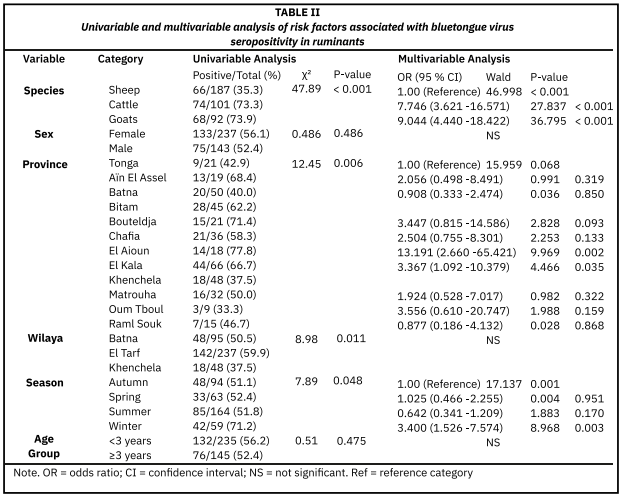
La lengua azul es una infección viral transmitida por vectores causada por el virus de la lengua azul, un orbivirus de la familia Reoviridae. El virus de la lengua azul afecta principalmente a rumiantes domésticos y silvestres, siendo las ovejas las más susceptibles clínicamente, seguidas de las cabras y el ganado vacuno. El virus se transmite por mosquitos hematófagos del género Culicoides. Este estudio transversal evaluó la seroprevalencia del virus de la lengua azul e identificó los factores de riesgo asociados en ovejas, cabras y bovinos en tres provincias (Wilayas) del noreste de Argelia. Entre marzo de 2024 y abril de 2025, se recogieron muestras de suero (n = 380) y se analizaron mediante un ensayo inmunoabsorbente ligado a enzimas competitivo. La seroprevalencia global del virus de la lengua azul fue del 54,74 % (208/380). Las tasas de seroprevalencia específicas por especie fueron más altas en las cabras (73,91 %, 68/92), seguidas de los bovinos (73,27 %, 74/101) y las ovejas (35,29 %, 66/187). El análisis de regresión logística multivariable reveló asociaciones significativas entre la seropositividad al virus de la lengua azul y la especie animal (P < 0,001), la ubicación geográfica (P < 0,05) y la temporada de muestreo (P < 0,05). En comparación con las ovejas, el ganado vacuno presentó una probabilidad siete veces mayor de seropositividad (OR = 7,746, IC del 95 %: 3,621-16,571), mientras que las cabras presentaron una probabilidad nueve veces mayor (OR = 9,044, IC del 95 %: 4,440- 18,422). Los animales muestreados durante el invierno mostraron tasas de seropositividad significativamente más altas (OR = 3,400, IC del 95 %: 1,526-7,574). Estos hallazgos indican la circulación endémica del virus de la lengua azul en el noreste de Argelia, con una variación significativa entre especies y espacios geográficos, lo que requiere estrategias específicas de vigilancia y control.
Descargas
Citas
Rivera NA, Varga C, Ruder MG, Dorak SJ, Roca AL, Novakofski JE, Mateus-Pinilla NE. Bluetongue and epizootic hemorrhagic disease in the United States of America at the wildlife-livestock interface. Pathogens. [Internet]. 2021; 10(8):915. doi: https://doi.org/qv4s DOI: https://doi.org/10.3390/pathogens10080915
Spedicato M, Compagni ED, Caporale M, Teodori L, Leone A, Ancora M, Mangone I, Perletta F, Portanti O, Di Giallonardo F, Bonfini B, Savini G, Lorusso A. Reemergence of an atypical bluetongue virus strain in goats, Sardinia, Italy. Res. Vet. Sci. [Internet]. 2022; 151:36-41. doi: https://doi.org/qv4t DOI: https://doi.org/10.1016/j.rvsc.2022.07.003
Maclachlan NJ, Drew CP, Darpel KE, Worwa G. The pathology and pathogenesis of bluetongue. J. Comp. Pathol. [Internet]. 2009; 141(1):1-16. doi: https://doi.org/d9ht65 DOI: https://doi.org/10.1016/j.jcpa.2009.04.003
Rojas JM, Rodríguez-Martín D, Martín V, Sevilla N. Diagnosing bluetongue virus in domestic ruminants: current perspectives. Vet. Med. Res. Rep. [Internet]. 2019; 10:17-27. doi: https://doi.org/qv4v DOI: https://doi.org/10.2147/VMRR.S163804
Ahmad S, Shafee M, Razzaq A, Badshah F, Khan NU, Ibáñez-Arancibia E, De los Ríos Escalante PR, Muhammad Arif H, Hussain A. Prevalence of bluetongue virus disease in a small ruminant population in Kalat, Balochistan, Pakistan. Vet. World. [Internet]. 2024; 17(9):1966-1971. doi: https://doi.org/qv4w DOI: https://doi.org/10.14202/vetworld.2024.1966-1971
Caporale M, Di Giallonardo L, Janowicz A, Wilkie G, Shaw A, Savini G, Van-Rijn PA, Mertens P, Di Ventura M, Palmarini M. Virus and host factors affecting the clinical outcome of bluetongue virus infection. J. Virol. [Internet]. 2014; 88(18):10399-10411. doi: https://doi.org/qv4x DOI: https://doi.org/10.1128/JVI.01641-14
Medrouh B, Abdelli A, Belkessa S, Ouinten Y, Brahimi M, Hakem A, Kernif T, Singer SM, Ziam H, Tsaousis AD, Jokelainen P, Savini G, Pasolli E. Seroprevalence and risk factors of bluetongue virus in domestic cattle, sheep, goats and camels in Africa: a systematic review and metaanalysis. Vet. Q. [Internet]. 2024; 44(1):1-12. doi: https://doi.org/g8n4fh DOI: https://doi.org/10.1080/01652176.2024.2396118
World Organisation for Animal Health (WOAH). Terrestrial Animal Health Code. 32nd ed. Paris, France: WOAH. 2024 [cited 11 Sept 2025]. Available in: https://goo.su/6279T
Kardjadj M, Luka PD, Ben-Mahdi MH. Sero-epidemiology of bluetongue in Algerian ruminants. Afr. J. Biotechnol. [Internet]. 2016; 15(20):868-871. doi: https://doi.org/qv4z DOI: https://doi.org/10.5897/AJB2016.15343
de Klerk J, Tildesley M, Robbins A, Gorsich E. Parameterisation of a bluetongue virus mathematical model using a systematic literature review. Prev. Vet. Med. [Internet]. 2024; 232:106328. doi: https://doi.org/qv42 DOI: https://doi.org/10.1016/j.prevetmed.2024.106328
Guis H, Caminade C, Calvete C, Morse AP, Tran A, Baylis M. Modelling the effects of past and future climate on the risk of bluetongue emergence in Europe. J. R. Soc. Interface. [Internet]. 2012; 9(67):339-350. doi: https://doi.org/dhctdf DOI: https://doi.org/10.1098/rsif.2011.0255
Van Leeuw V, De Leeuw I, Degives N, Depoorter P, Dewulf J, Hanon JB, Hooyberghs J, Linden A, Praet L, Raemaekers M, Saegerman C, Simons X, Sohier C, Steurbaut N, Sury A, Thiry E, Zientara S, Mauroy A, De Regge N. Impact of BTV3 circulation in Belgium in 2024 and current knowledge gaps hindering an evidence-based control program. Viruses. [Internet]. 2025; 17(4):521. doi: https://doi.org/qv43 DOI: https://doi.org/10.3390/v17040521
Santman-Berends IMGA, van den Brink KMJA, Dijkstra E, van Schaik G, Spierenburg MAH, van den Brom R. The impact of the bluetongue serotype 3 outbreak on sheep and goat mortality in the Netherlands in 2023. Prev. Vet. Med. [Internet]. 2024; 231:106289. doi: https://doi.org/qv44 DOI: https://doi.org/10.1016/j.prevetmed.2024.106289
Ben-Salem A, Ben-Aicha E, Kalthoum S, Dhaouadi A, Hajlaoui H, Bel-Haj-Mohamed B, Ben-Slimen I, Khalfaoui W, Gharbi R, Guesmi K, Ben-Ali M, Fatnassi N, Seghaier C, Ben-Hassine T, Gharbi M. Estimation of the economic impact of a bluetongue serotype 4 outbreak in Tunisia. Front. Vet. Sci. [Internet]. 2024; 11:1310202. doi: https://doi.org/qv45 DOI: https://doi.org/10.3389/fvets.2024.1310202
Ferrara G, Improda E, Piscopo F, Esposito R, Iovane G, Pagnini U, Montagnaro S. Bluetongue virus seroprevalence and risk factor analysis in cattle and water buffalo in southern Italy (Campania region). Vet. Res. Commun. [Internet]. 2024; 48(1):579-584. doi: https://doi.org/g636vv DOI: https://doi.org/10.1007/s11259-023-10215-w
Daif S, El-Berbri I, Lhor Y, Fassi-Fihri O. Serological and molecular prevalence study of bluetongue virus in small domestic ruminants in Morocco. Sci. Rep. [Internet]. 2022; 12(1):19448. doi: https://doi.org/g8n4dw DOI: https://doi.org/10.1038/s41598-022-24067-y
Beyan A, Molla W, Molla AB, Birhan M, Ibrahim SM, Dessalegn B, Kenubih A, Gessese AT, Kinde MZ, Dagnaw GG, Fenta MD, Tesfaye H, Tesgera T, Tesfaw L, Abesha H, Tarekegn ZS, Dejene H, Bitew M. Seroprevalence and risk factors of bluetongue virus infection in sheep and goats in West Gondar zone, Northwest Ethiopia. Front. Vet. Sci. [Internet]. 2025; 12:1565624. doi: https://doi.org/qv47 DOI: https://doi.org/10.3389/fvets.2025.1565624
Madani H, Casal J, Alba A, Allepuz A, Cêtre-Sossah C, Hafsi L, Kount-Chareb H, Bouayed-Chaouach N, Saadaoui H, Napp S. Animal diseases caused by orbiviruses, Algeria. Emerg. Infect. Dis. [Internet]. 2011; 17(12):2325-2327. doi: https://doi.org/cd2s22 DOI: https://doi.org/10.3201/eid1712.110928
Abraheem HH, Hussien MO, Elhassan AM, Enan KA, Musa AB, Ahmed SK, El-Hussein ARM. Seroepidemiological survey on bluetongue virus (BTV) among cattle, sheep, and goats in Gadarif State, Eastern Sudan. Int. J. Microbiol. [Internet]. 2024; 2024:7712412. doi: https://doi.org/qv48 DOI: https://doi.org/10.1155/2024/7712412
Hosmer DW, Lemeshow S. Applied logistic regression. 2nd ed [Internet]. Hoboken, NJ: John Wiley & Sons; 2000. doi: https://doi.org/c96pnx DOI: https://doi.org/10.1002/0471722146
Mahmoud AS, Savini G, Spedicato M, Monaco F, Carmine I, Lorusso A, Francesco T, Mazzei M, Forzan M, Eldaghayes I, Dayhum A. Exploiting serological data to understand the epidemiology of bluetongue virus serotypes circulating in Libya. Vet. Med. Sci. [Internet]. 2019; 5(1):79-86. doi: https://doi.org/qv5b DOI: https://doi.org/10.1002/vms3.136
Malek SS, Abou El-Wafa SA. High seroprevalence of bluetongue in sheep, goats and cattle in Assiut Governorate, Egypt. Kafrelsheikh Vet. Med. J. [Internet]. 2016; 14(1):285-296. doi: https://doi.org/qv5c DOI: https://doi.org/10.21608/kvmj.2016.108867
Navarro-Mamani DA, Jurado J, Vargas-Calla A, Ponce K, Sherman T, Zarate Y, Murga-Moreno CA, Perez I, Villacaqui R, Ara M, Ortiz P, Rivera H, Mayo CE. National seroprevalence and risk factors of bluetongue virus in domestic ruminants of Peru. Transbound. Emerg. Dis. [Internet]. 2025; 2025:2690231. doi: https://doi.org/g9ccbb DOI: https://doi.org/10.1155/tbed/2690231
Munmun TK, Islam S, Zamil S, Rahman MA, Abedin J, Ahad A, Islam A. Seroprevalence and risk factors of bluetongue virus in sheep of Chattogram, Bangladesh. Vet. World. [Internet]. 2022; 15(6):1589-1594. doi: https://doi.org/g4f6b2 DOI: https://doi.org/10.14202/vetworld.2022.1589-1594
Ishaq M, Shah SAA, Khan N, Jamal SM. Prevalence and risk factors of bluetongue in small and large ruminants maintained on government farms in north-western Pakistan. Res. Vet. Sci. [Internet]. 2023; 161:38-44. doi: https://doi.org/qv5f DOI: https://doi.org/10.1016/j.rvsc.2023.06.004
Bakhshesh M, Otarod V, Fallah-Mehrabadi MH. Large-scale seroprevalence and risk factors associated with bluetongue virus in Iran. Prev. Vet. Med. [Internet]. 2020; 179:104994. doi: https://doi.org/qv5g DOI: https://doi.org/10.1016/j.prevetmed.2020.104994
Gong QL, Wang Q, Yang XY, Li DL, Zhao B, Ge GY, Zong Y, Li JM, Leng X, Shi K, Liu F, Du R. Seroprevalence and risk factors of the bluetongue virus in cattle in China from 1988 to 2019: a comprehensive literature review and meta-analysis. Front. Vet. Sci. [Internet]. 2021; 7:550381. doi: https://doi.org/g8n4d5 DOI: https://doi.org/10.3389/fvets.2020.550381
Hakima B, Hwang HS, Lee KY. Molecular identification of Culicoides (Diptera: Ceratopogonidae) species in Algeria. Acta Trop. [Internet]. 2020; 202:105261. doi: https://doi.org/qv5j DOI: https://doi.org/10.1016/j.actatropica.2019.105261
Purse BV, Mellor PS, Rogers DJ, Samuel AR, Mertens PP, Baylis M. Climate change and the recent emergence of bluetongue in Europe. Nat. Rev. Microbiol. [Internet]. 2005; 3(2):171-181. doi: https://doi.org/bm478b DOI: https://doi.org/10.1038/nrmicro1090
Acosta A, Barrera M, Jarrín D, Maldonado A, Salas J, Camargo G, Mello B, Burbano A, DelaTorre E, Hoffman B, Dietze K. Linking vector favourable environmental conditions with serological evidence of widespread bluetongue virus exposure in livestock in Ecuador. Sci. Rep. [Internet]. 2025; 15(1):14382. doi: https://doi.org/qv5k DOI: https://doi.org/10.1038/s41598-025-95918-7