Evaluación de campo de la transferencia pasiva en terneros Holstein: refractometría de Brix en suero frente a inmunodifusión radial y asociaciones con cambios tempranos en el peso corporal.
Resumen
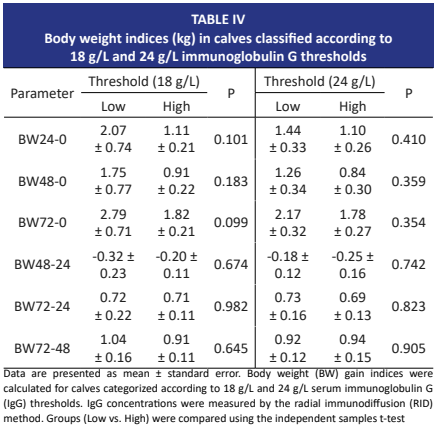
Este estudio comparó el rendimiento del refractómetro Brix y la inmunodifusión radial para evaluar la inmunidad de transferencia pasiva en terneros Holstein y examinó la relación entre la inmunidad de transferencia pasiva y el aumento de peso corporal temprano durante las primeras 72 horas de vida. Se incluyeron un total de 136 terneros Holstein que recibieron ≥ 3 L de calostro de alta calidad (Brix ≥ 22 %) en los 30 minutos posteriores al nacimiento. Se tomaron muestras de sangre para determinar los niveles de Inmunoglobulina G y Brix entre 36 y 48 horas después del nacimiento, y se registró el peso corporal a las 0, 24, 48 y 72 horas. Se aplicaron dos umbrales de Inmunoglobulina G: 24 g/L (inmunidad de transferencia pasiva «excelente»; grupo 24) y 18 g/L (inmunidad de transferencia pasiva «adecuado»; grupo 18). Se realizaron análisis de correlación entre los valores de inmunodifusión radial y Brix, así como entre los índices de Inmunoglobulina G y peso corporal temprano en los distintos intervalos (0-24, 0-48, 0-72, 24-48, 24- 72 y 48-72 horas). Se encontraron correlaciones significativas entre Brix y inmunodifusión radial (r = 0,804; P < 0,001), lo que confirma la fiabilidad del refractómetro para su uso en el campo. Las concentraciones medias de Inmunoglobulina G difirieron significativamente entre los grupos bajo y alto para ambos umbrales (P < 0,001). No se observaron diferencias significativas en Inmunoglobulina G por sexo (29,54 ± 1,26 frente a 28,04 ± 1,17 g/L; P = 0,432) o peso al nacer (≤ 38,7 frente a > 38,7 kg; P = 0,466). Las correlaciones entre IgG y peso corporal temprano fueron débiles y no significativas (P > 0,05). El peso corporal temprano no difirió según la categoría de inmunidad de transferencia pasiva, aunque los machos mostraron una pérdida de peso ligeramente mayor a las 24- 48 horas (P = 0,026) y una ganancia mayor a las 48-72 horas (P = 0,048). En general, el refractómetro Brix se correlacionó fuertemente con el inmunodifusión radial, lo que valida su uso práctico, pero el peso corporal temprano no fue un indicador fiable del estado de inmunidad de transferencia pasiva.
Descargas
Citas
Van TD, Hue DT, Bottema CD, Werid GM, Skirving R, Petrovski KR. Meta-analysis on the prevalence of failed transfer of passive immunity in calves from pasture- based dairy farms in Australasia. Animals. [Internet]. 2023; 13(11):1792. doi: https://doi.org/qr2x DOI: https://doi.org/10.3390/ani13111792
Quigley J. Passive immunity in newborn calves. Adv. Dairy Technol. [Internet]. 2002 [cited 22 Oct 2025]; 14:273-292. Available in: https://goo.su/DRCXKlj
Kara E, Ceylan E. Failure of passive transfer in neonatal calves in dairy farms in Ankara region. Turk. J. Vet. Anim. Sci. [Internet]. 2021; 45(3):556-565. doi: https://doi.org/qr2z DOI: https://doi.org/10.3906/vet-2011-26
Lopez AJ, Steele MA, Nagorske M, Sargent R, Renaud DL. Accuracy of refractometry as an indirect method to measure failed transfer of passive immunity in dairy calves fed colostrum replacer and maternal colostrum. J. Dairy Sci. [Internet]. 2021; 104(2):2032-2039. doi: https://doi.org/qr22 DOI: https://doi.org/10.3168/jds.2020-18947
Wilm J, Costa JH, Neave HW, Weary DM, von Keyserlingk MA. Serum total protein and immunoglobulin G concentrations in neonatal dairy calves over the first 10 days of age. J. Dairy Sci. [Internet]. 2018; 101(7):6430- 6436. doi: https://doi.org/gdtvc3 DOI: https://doi.org/10.3168/jds.2017-13553
de Passillé AM, Rabeyrin M, Rushen J. Associations between milk intake and activity in the first days of a calf’s life and later growth and health. Appl. Anim. Behav. Sci. [Internet]. 2016; 175:2-7. doi: https://doi.org/qr23 DOI: https://doi.org/10.1016/j.applanim.2014.10.002
Demir O, Tütüncü M. Samsun yöresi sığırlarda kolostrum kalitesi ve pasif transfer yetmezliğin Brix dijital refraktometre ile araştırılması. Vet. Sci. Pract. [Internet]. 2022; 17(2):55-60. doi: https://doi.org/qr24 DOI: https://doi.org/10.5152/VetSciPract.2022.221529
Mancini GJAJ, Carbonara AT, Heremans JF. Immunochemical quantitation of antigens by single radial immunodiffusion. Immunochemistry. [Internet]. 1965; 2(3):235-254. doi: https://doi.org/dbb5dt DOI: https://doi.org/10.1016/0019-2791(65)90004-2
Lombard J, Urie N, Garry F, Godden S, Quigley J, Earleywine T, McGuirk S, Moore D, Branan M, Chamorro M, Smith G, Shivley C, Catherman D, Haines D, Heinrichs AJ, James R, Maas J, Sterner K. Consensus recommendations on calf- and herd-level passive immunity in dairy calves in the United States. J. Dairy Sci. [Internet]. 2020; 103(8):7611- 7624. doi: https://doi.org/qr25 DOI: https://doi.org/10.3168/jds.2019-17955
Deelen SM, Ollivett TL, Haines DM, Leslie KE. Evaluation of a Brix refractometer to estimate serum immunoglobulin G concentration in neonatal dairy calves. J. Dairy Sci. [Internet]. 2014; 97(6):3838-3844. doi: https://doi.org/ f54dsf DOI: https://doi.org/10.3168/jds.2014-7939
Godden S. Colostrum management for dairy calves. Vet. Clin. North Am. Food Anim. Pract. [Internet]. 2008; 24(1):19-39. doi: https://doi.org/czr4s3 DOI: https://doi.org/10.1016/j.cvfa.2007.10.005
Buczinski S, Lu Y, Chigerwe M, Fecteau G, Dendukuri N. Systematic review and meta-analysis of refractometry for diagnosis of inadequate transfer of passive immunity in dairy calves: quantifying how accuracy varies with threshold using a Bayesian approach. Prev. Vet. Med. [Internet]. 2021; 189:105306. doi: https://doi.org/qr26 DOI: https://doi.org/10.1016/j.prevetmed.2021.105306
Akköse M, Kutsal HG, Kurban M, Çınar EM, Polat Y, Cengiz M. Diagnostic accuracy of digital Brix and serum total protein refractometers in estimating different passive immunity levels in dairy calves. Vet. Immunol. Immunopathol. [Internet]. 2022; 249:110442. doi: https://doi.org/qr27 DOI: https://doi.org/10.1016/j.vetimm.2022.110442
Godden SM, Lombard JE, Woolums AR. Colostrum management for dairy calves. Vet. Clin. North Am. Food Anim. Pract. [Internet]. 2019; 35(3):535-556. doi: https://doi.org/jnmv DOI: https://doi.org/10.1016/j.cvfa.2019.07.005
Mila H, Grellet A, Feugier A, Desario C, Decaro N, Buonavoglia C, Mariani C, Chastant-Maillard S. General and type 2 parvovirus-specific passive immune transfer in puppies: evaluation by early growth. Reprod. Domest. Anim. [Internet]. 2018; 53(S3):96-102. doi: https://doi.org/gfqrmb DOI: https://doi.org/10.1111/rda.13334
Raboisson D, Trillat P, Cahuzac C. Failure of passive immune transfer in calves: a meta-analysis on the consequences and assessment of the economic impact. PLoS One. [Internet]. 2016; 11(3):e0150452. doi: https://doi.org/bkmn DOI: https://doi.org/10.1371/journal.pone.0150452
Weaver DM, Tyler JW, VanMetre DC, Hostetler DE, Barrington GM. Passive transfer of colostral immunoglobulins in calves. J. Vet. Intern. Med. [Internet]. 2000; 14(6):569-577. doi: https://doi.org/ccqhxv DOI: https://doi.org/10.1111/j.1939-1676.2000.tb02278.x
Cavirani S, Gambetti C, Schiano E, Casaletti E, Spadini C, Mezzasalma N, Cabassi CS, Taddei S. Comparison of immunoglobulin G concentrations in colostrum and newborn calf serum from animals of different breeds, parity and gender. Large Anim. Rev. [Internet]. 2024 [cited 22 Sept 2025]; 30(3):105-111. Available in: https://goo.su/UjaO5
Lopez AJ, Jones CM, Geiger AJ, Heinrichs AJ. Variation in serum immunoglobulin G concentrations from birth to 112 days of age in Holstein calves fed a commercial colostrum replacer or maternal colostrum. J. Dairy Sci. [Internet]. 2020; 103(8):7535-7539. doi: https://doi.org/qr28 DOI: https://doi.org/10.3168/jds.2020-18400
Silva FLM, Miqueo E, Silva MDD, Torrezan TM, Rocha NB, Salles MSV, Bittar CMM. Thermoregulatory responses and performance of dairy calves fed different amounts of colostrum. Animals. [Internet]. 2021; 11(3):703. doi: https://doi.org/qr29 DOI: https://doi.org/10.3390/ani11030703
Hyde RM, Green MJ, Hudson C, Down PM. Factors associated with daily weight gain in preweaned calves on dairy farms. Prev. Vet. Med. [Internet]. 2021; 190:105320. doi: https://doi.org/qr3b DOI: https://doi.org/10.1016/j.prevetmed.2021.105320
Besser TE, Gay CC, Pritchett L. Comparison of three methods of feeding colostrum to dairy calves. J. Am. Vet. Med. Assoc. [Internet]. 1991 [cited 22 Sep 2025];198(3):419-422. Available in: https://goo.su/lVoD DOI: https://doi.org/10.2460/javma.1991.198.03.419
Azwai SM, Carter SD, Woldehiwet Z. Immunoglobulins of camel (Camelus dromedarius) colostrum. J. Comp. Pathol. [Internet]. 1996; 114(3):273-282. doi: https://doi.org/fq57hk DOI: https://doi.org/10.1016/S0021-9975(96)80049-1