Relación entre los perfiles de ciclicidad ovárica posparto y algunos parámetros nutricionales en vacas lecheras importadas en Argelia
Resumen
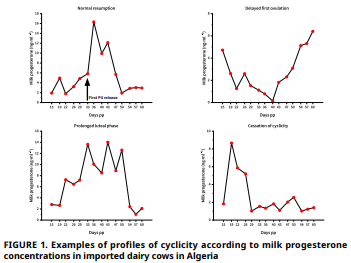
El objetivo de estudio fue evaluar la asociación entre ciertos parámetros nutricionales séricos, la condición corporal y el peso corporal, con la reanudación de la ciclicidad ovárica posparto en vacas lecheras Prim’Holstein y Montbeliard en Argelia. Se recolectaron muestras de leche de 30 vacas lecheras dos veces por semana entre los días (d) 15 y 60 posparto, y se determinó la concentración de progesterona en la leche mediante un ELISA. La condición corporal y el peso corporal se determinaron en los d 0, 30 y 60 posparto, y se recolectaron muestras de sangre en los d 0, 15, 30, 45 y 60 posparto para determinar las concentraciones séricas de urea, proteínas totales, colesterol, triglicéridos, glucosa, calcio, fósforo, aspartato transaminasa y alanina transaminasa. Una vaca se consideró con una ciclicidad ovárica normal si la ovulación ocurrió antes del d 35 posparto, seguida de un ciclo regular. Los resultados mostraron que 40% de las vacas tuvieron una reanudación normal de la ciclicidad ovárica. Entre el grupo con reanudación anormal, la ovulación tardía fue la más registrada. La condición corporal, el peso corporal y las concentraciones de colesterol, urea y aspartato transaminasa cambiaron durante los 60 d posparto. La condición corporal cambió durante los primeros 60 d posparto (P<0,0001). Hubo un efecto de la condición corporal entre la reanudación normal y la reanudación anormal (P=0,02). La condición corporal y la pérdida de condición corporal tuvieron un efecto en la reanudación anormal y la reanudación normal en todos los momentos de muestreo (P=0,01). Hubo un efecto de la pérdida de condición corporal ≥ 0,75 y pérdida < 0,75 en la reanudación de la ciclicidad en 30 d posparto. La concentración de urea y fósforo fueron más altas en la reanudación normal que en la reanudación anormal. Monitoreo de la condición corporal es esencial para controlar el manejo nutricional, con el fin de minimizar la reanudación anormal de la ciclicidad ovárica en vacas lecheras.
Descargas
Citas
Gautam G, Nakao T, Yamada K, Yoshida C. Defining delayed resumption of ovarian activity post–partum and its impact on subsequent reproductive performance in Holstein cows. Theriogenology [Internet]. 2010; 73(2):180–189. doi: https://doi.org/fkcv7g DOI: https://doi.org/10.1016/j.theriogenology.2009.08.011
Kim DS, Lee JH, Jang GW, Choi EJ, Kim JJ, Lee JA, Son JK. The studies on characteristics of return to estrus in postpartum dairy cattle. J. Anim. Reprod. Biotechnol. [Internet]. 2021; 36(4):230–238. doi: https://doi.org/qgdw DOI: https://doi.org/10.12750/JARB.36.4.230
Cheong SH, Sá Filho OG, Absalón–Medina VA, Pelton SH, Butler WR, Gilbert RO. Metabolic and endocrine differences between dairy cows that do or do not ovulate first postpartum dominant follicles. Biol. Reprod. [Internet]. 2016; 94(1):1–11. doi: https://doi.org/qgdx DOI: https://doi.org/10.1095/biolreprod.114.127076
Souames S, Abdelli A, Berrama Z. Factors associated with abnormal resumption of ovarian activity after calving of Holstein–Friesian cows reared in northern Algeria. Livest. Res. Rural Dev. [Internet]. 2018 [cite Jun 18, 2025]; 30(3):52. Available in: https://goo.su/Wpf6GP
Shrestha HK, Nakao T, Suzuki T, Akita M, Higaki T. Relationships between body condition score, body weight, and some nutritional parameters in plasma and resumption of ovarian cyclicity postpartum during pre–service period in high–producing dairy cows in a subtropical region in Japan. Theriogenology [Internet]. 2005; 64(4):855–866. doi: https://doi.org/d5q6h3 DOI: https://doi.org/10.1016/j.theriogenology.2004.12.007
Peter AT, Vos PLAM, Ambrose DJ. Postpartum anestrus in dairy cattle. Theriogenology [Internet]. 2009; 71(9):1333–1342. doi: https://doi.org/dsw85j DOI: https://doi.org/10.1016/j.theriogenology.2008.11.012
Chen J, Soede NM, Van Dorland HA, Remmelink GJ, Bruckmaier RM, Kemp B, Van Knegsel ATM. Relationship between metabolism and ovarian activity in dairy cows with different dry period lengths. Theriogenology [Internet]. 2015; 84(8):1387–1396. doi: https://doi.org/f7tpdf DOI: https://doi.org/10.1016/j.theriogenology.2015.07.025
Rukkwamsuk T, Wensing T, Kruip TAM. Relationship between triacylglycerol concentration in the liver and first ovulation in postpartum dairy cows. Theriogenology [Internet]. 1999; 51(6):1133–1142. doi: https://doi.org/dhqsk6 DOI: https://doi.org/10.1016/S0093-691X(99)80016-8
Barletta RV, Maturana Filho M, Carvalho PD, Del Valle TA, Netto AS, Rennó FP, Mingoti RD, Gandra JR, Mourão GB, Fricke PM, Sartori R, Madureira EH, Wiltbank MC. Association of changes among body condition score during the transition period with NEFA and BHBA concentrations, milk production, fertility, and health of Holstein cows. Theriogenology [Internet]. 2017; 104:30–36. doi: https://doi.org/qgfb DOI: https://doi.org/10.1016/j.theriogenology.2017.07.030
Saqib MN, Qureshi MS, Khan RU. Changes in postpartum metabolites and resumption of ovarian cyclicity in primiparous and multiparous dairy cows. Appl. Biol. Chem. [Internet]. 2018; 61(1):107–111. doi: https://doi.org/qgfn DOI: https://doi.org/10.1007/s13765-017-0331-7
Jeong JK, Choi IS, Kang HG, Hur TY, Jung YH, Kim IH. Relationship between serum metabolites, body condition, peri and post–partum health and resumption of post– partum cyclicity in dairy cows. Livest. Sci. [Internet]. 2015; 181(2):31–37. doi: https://doi.org/f7zvcd DOI: https://doi.org/10.1016/j.livsci.2015.09.022
Hernandez–Gotelli C, Manríquez D, Azocar J, De Vries A, Pinedo PJ. Factors associated with the time and magnitude of the nadir body condition score in early lactation and its subsequent effects on fertility of Holstein cows. J. Anim. Sci. [Internet]. 2023; 101:skad119. doi: https://doi.org/qgfq DOI: https://doi.org/10.1093/jas/skad119
Machado–Pfeifer LF, De Lima RA, Nakashima SH, Da Silva JT, Schmitt E. Early versus late body condition score loss in dairy cows: reproductive performance. Trop. Anim. Health Prod. [Internet]. 2023; 55(3):149. doi: https://doi.org/qgfr DOI: https://doi.org/10.1007/s11250-023-03559-7
Dezetter C, Bidan F, Delaby L, Blanc F, Freret S, Bedere N. Association between body condition profiles, milk production, and reproduction performance in Holstein and Normande cows. J. Dairy Sci. [Internet]. 2024; 107(12):11621–11638. doi: https://doi.org/qgf7 DOI: https://doi.org/10.3168/jds.2024-24766
Manríquez D, Thatcher WW, Santos JEP, Chebel RC, Galvão KN, Schuenemann GM, Bicalho RC, Gilbert RO, Rodriguez–Zas S, Seabury CM, Rosa GJM, Pinedo P. Effect of body condition change and health status during early lactation on performance and survival of Holstein cows. J. Dairy Sci. [Internet]. 2021; 104(12):12785–12799. doi: https://doi.org/qgf8 DOI: https://doi.org/10.3168/jds.2020-20091
Civiero M, Cabezas–Garcia EH, Ribeiro–Filho HMN, Gordon AW, Ferris CP. Relationships between energy balance during early lactation and cow performance, blood metabolites, and fertility: A meta–analysis of individual cow data. J. Dairy Sci. [Internet]. 2021; 104(6):7233–7251. doi: https://doi.org/qggm DOI: https://doi.org/10.3168/jds.2020-19607
Constantin NT, Bercea–Strugariu CM, Bîrtoiu D, Posastiuc FP, Iordache F, Bilteanu L, Serban AI. Predicting Pregnancy Outcome in Dairy Cows: The Role of IGF–1 and Progesterone. Animals. [Internet]. 2023; 13(10):1579. doi: https://doi.org/qggn DOI: https://doi.org/10.3390/ani13101579
Ferguson JD, Galligan DT, Thomsen N. Principal descriptors of body condition score in Holstein cows. J. Dairy Sci. [Internet]. 1994; 77(9):2695–2703. doi: https://doi.org/dm64q7 DOI: https://doi.org/10.3168/jds.S0022-0302(94)77212-X
Butler WR. Energy balance relationships with follicular development, ovulation and fertility in postpartum dairy cows. Livest. Prod. Sci. [Internet]. 2003; 83(2–3):211–218. doi: https://doi.org/bm7h2r DOI: https://doi.org/10.1016/S0301-6226(03)00112-X
Kalem A, Hanzen C, Abdelli A, Kaidi R. Body condition score, some nutritional parameters in plasma, and subsequent reproductive performance of Montbéliarde cows in Algeria. Livest. Res. Rural Dev. [Internet]. 2017 [cited Jun 20, 2025]; 29(1). Available in: https://goo.su/ePFglj
Jorritsma R, Wensing T, Kruip TAM, Vos PLAM, Noordhuizen JPTM. Metabolic changes in early lactation and impaired reproductive performance in dairy cow. Vet. Res. [Internet]. 2003; 34(1):11–26. doi: https://doi.org/fj7vdp DOI: https://doi.org/10.1051/vetres:2002054
Santos JEP, Rutigliano HM, Sá Filho MF. Risk factors for resumption of postpartum estrous cycles and embryonic survival in lactating dairy cows. Anim. Reprod. Sci. [Internet]. 2009; 110(3–4):207–221. doi: https://doi.org/b432qd DOI: https://doi.org/10.1016/j.anireprosci.2008.01.014
Rodríguez A, Mellado R, Bustamante H. Prepartum Fat Mobilization in Dairy Cows with Equal Body Condition and Its Impact on Health, Behavior, Milk Production and Fertility during Lactation. Animals [Internet]. 2020; 10(9):1478. doi: https://doi.org/g9k8mk DOI: https://doi.org/10.3390/ani10091478
Guáqueta MH, Zambrano VJ, Jiménez EC. Risk factors for ovarian postpartum resumption in Holstein cows, under high tropical conditions. Rev. MVZ Córdoba. [Internet]. 2014 [cited Jun 20, 2025]; 19(1):3970–3983. Available in: https://goo.su/IEMXNO DOI: https://doi.org/10.21897/rmvz.117
Garnsworthy PC, Lock A, Mann GE, Sinclair KD, Webb R. Nutrition, metabolism, and fertility in dairy cows: 1. dietary energy source and ovarian function. J. Dairy Sci. [Internet]. 2008; 91(10):3814–3823. doi: https://doi.org/bmr3mw DOI: https://doi.org/10.3168/jds.2008-1031
Mikuła R, Pruszynska–Oszmałek E, Pszczola M, Rzasinska J, Sassek M, Nowak KW, Nogowski L, Kołodziejski PA. Changes in metabolic and hormonal profiles during transition period in dairy cattle. The role of spexin. BMC Vet. Res. [Internet]. 2021; 17(1):359. doi: https://doi.org/g9dzxd DOI: https://doi.org/10.1186/s12917-021-03069-4
Chacha F, Bouzebda Z, Afri–Bouzebda F, Gherissi D, Lamraoui R, Djaout A, Mouffok C. Effect of some blood metabolites on the conception risk of Montbeliard cows. Livest. Res. Rural Dev. [Internet]. 2018 [cited Jun 20, 2025]; 30(5). Available in: https://goo.su/e0Qkai
Kusza S, Bagi Z, Astuti PK, Wanjala G, Szenci O, Bajcsy AC. Calcium metabolism, immunity and reproduction in early postpartum dairy cows. Animals [Internet]. 2025; 15(14):2103. doi: https://doi.org/qgg6 DOI: https://doi.org/10.3390/ani15142103
Tallam, SK, Ealy AD, Bryan KA, Wu Z. Ovarian Activity and Reproductive Performance of Dairy Cows Fed Different Amounts of Phosphorus. J. Dairy Sci. [Internet]. 2005; 88(10):3609–3618. doi: https://doi.org/fhn7xr DOI: https://doi.org/10.3168/jds.S0022-0302(05)73046-0
Zhou J, Zhang J, Xue B, Yue S, Yang C, Xue B. Effects of Premating Calcium and Phosphorus Supplementation on Reproduction Efficiency of Grazing Yak Heifers. Animals. [internet]. 2021; 11(2), 554. doi: https://doi.org/qgg7 DOI: https://doi.org/10.3390/ani11020554
Van den Top AM, Geelen MH, Wensing T, Wentink GH, van’t Klooster AT, Beynen AC. Higher postpartum hepatic triacylglycerol concentrations in dairy cows with free rather than restricted access to feed during the dry period are associated with lower activities of hepatic glycerolphosphate acyltransferase. J. Nutr. [Internet]. 1996; 126(1):76–85. doi: https://doi.org/qgg8 DOI: https://doi.org/10.1093/jn/126.1.76
Vlizlo V, Stasiv O, Sedilo H, Fedak N, Petryshyn M, Voloshyn R. Short–term reduction in feed intake by dairy cows in the postpartum period leads to subclinical ketosis development. Ukr. Biochem. J. [Internet]. 2024; 96(5):96–103. doi: https://doi.org/qgg9 DOI: https://doi.org/10.15407/ubj96.05.096
Yang Y, Yang S, Tang J, Ren G, Shen J, Huang B, Lei C, Chen H, Qu K. Comparisons of hematological and biochemical profiles in Brahman and Yunling cattle. Animals [Internet]. 2022; 12(14):1813. doi: https://doi.org/qghb DOI: https://doi.org/10.3390/ani12141813
Samarütel J, Ling K, Waldmann A, Jaakson H, Kaart T, Leesmäe A. Field trial on progesterone cycles, metabolic profiles, body condition score and their relation to fertility in Estonian Holstein dairy cows. Reprod. Domest. Anim. [Internet]. 2008; 43(4):457–463. doi: https://doi.org/bzhwfn DOI: https://doi.org/10.1111/j.1439-0531.2007.00935.x
Shin EK, Jeong JK, Choi IS, Kang HG, Hur TY, Jung YG, Kim IH. Relationships among ketosis, serum metabolites, body condition, and reproductive outcomes in dairy cows. Theriogenology [Internet]. 2015; 84(2):252–260. doi: https://doi.org/gj3djc DOI: https://doi.org/10.1016/j.theriogenology.2015.03.014
Rafa H, Oroian I, Cozma OM, Morohoschi AG, Dumitraș DA, Ștefănuț CL, Neagu D, Borzan A, Andrei S. Peripartal changes of metabolic and hormonal parameters in Romanian spotted cows and their relation with retained fetal membranes. Front. Vet. Sci. [Internet]. 2024; 11:1409666. doi: https://doi.org/qghd DOI: https://doi.org/10.3389/fvets.2024.1409666
Adjorlolo, L, Obese, FY, Tecku P. Blood metabolite concentration, milk yield, resumption of ovarian activity and conception in grazing dual purpose cows supplemented with concentrate during the post–partum period. Vet. Med. Sci. [Internet]. 2019; 5(2):103–111. doi: https://doi.org/qghf DOI: https://doi.org/10.1002/vms3.148
Maizon DO, Oltenacu PA, Gröhn YT, Strawderman RL, Emanuelson U. Effects of diseases on reproductive performance in Swedish red and white dairy cattle. Prev. Vet. Med. [Internet]. 2004; 66(1–4):113–126. doi: https://doi.org/dzkksm DOI: https://doi.org/10.1016/j.prevetmed.2004.09.002