Effects of different climatic conditions on intraocular pressure in Arabian horses
Abstract
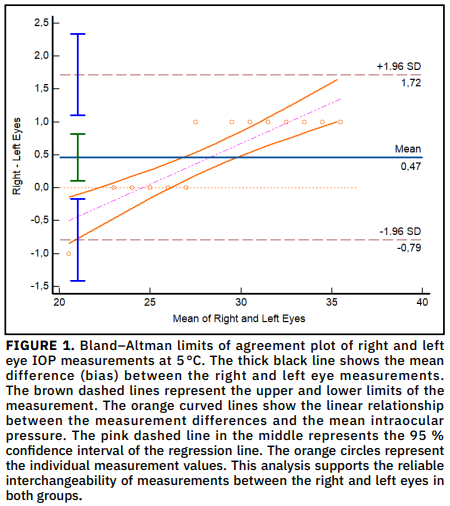
This study aimed to investigate the effects of different climatic conditions on intraocular pressure in Arabian horses. intraocular pressure is a critical parameter for the diagnosis and management of ocular diseases such as glaucoma and anterior uveitis, and accurate measurement is essential for equine eye health. The present study was conducted on 15 clinically healthy Arabian horses aged between 6 and 10 years and kept under the climatic conditions of Eastern Anatolia, Türkiye. Intraocular pressure measurements were performed at two different environmental temperatures, 5 °C and −20 °C, to evaluate the effect of ambient temperature on ocular physiology. During the measurements, the head position of the horses was kept at shoulder level, and no sedatives or topical anesthetics were administered to avoid possible interference with intraocular pressure values. Measurements were obtained using an Icare® rebound tonometer, and for each eye, six consecutive readings were recorded, with the mean value used for statistical evaluation. The analysis showed no statistically significant difference between the right and left eyes at either temperature level, indicating that intraocular pressure measurements obtained from both eyes can be used interchangeably without introducing systematic bias. At 5 °C, mean intraocular pressure values were 28.53 ± 4.88 mmHg in the right eye and 28.07 ± 4.30 mmHg in the left eye. When the ambient temperature decreased to −20 °C, mean intraocular pressure values increased to 32.33 ± 3.05 mmHg and 32.00 ± 2.09 mmHg for the right and left eyes, respectively. Statistical analyses, including paired t-tests and Bland– Altman evaluation, demonstrated that this increase was significant and consistent, and that it was not dependent on the magnitude of the measurements. These findings indicate that low environmental temperature has a clear physiological effect on intraocular pressure in Arabian horses. The absence of interocular differences further supports the reliability of the measurements and the suitability of using either eye for clinical assessment. Taken together, the results emphasize the importance of considering environmental temperature when interpreting intraocular pressure values, particularly in regions with extreme climatic conditions. Future studies involving different climatic zones, breeds, and age groups would be valuable to confirm and expand upon these findings.
Downloads
References
Yakan S, Isler CT, Denk H. Determination of intraocular pressure in clinically healthy Turkish Eastern Anatolian Red cattle of different age groups using rebound tonometry. Isr. J. Vet. Med. [Internet]. 2021 [cited 12 Oct 2025]; 76(4):150-155. Available in: https://goo.su/suYWN
Townsend WM. Canine and feline uveitis. Vet. Clin. North Am. Small Anim. Pract. [Internet]. 2008; 38(2):323–346. doi: https://doi.org/c8mmws DOI: https://doi.org/10.1016/j.cvsm.2007.12.004
McLellan GJ, Miller PE. Feline glaucoma: a comprehensive review. Vet. Ophthalmol. [Internet]. 2011; 14(1):15–29. doi: https://doi.org/csdt7m DOI: https://doi.org/10.1111/j.1463-5224.2011.00912.x
Komáromy AM, Garg CD, Ying GS, Liu C. Effect of head position on intraocular pressure in horses. Am. J. Vet. Res. [Internet]. 2006 [cite Jun. 23 2025]; 67(7):1232–1235. Available in: https://goo.su/cpf9 DOI: https://doi.org/10.2460/ajvr.67.7.1232
Murgatroyd H, Bembridge J. Intraocular pressure. Contin. Educ. Anaesth. Crit. Care Pain. [Internet]. 2008; 8(3):100–103. doi: https://doi.org/cpj6cr DOI: https://doi.org/10.1093/bjaceaccp/mkn015
Hartmann A, Grabitz SD, Hoffmann EM, Wild PS, Schmidtmann I, Lackner KJ, Beutel ME, Münzel T, Tüscher O, Schattenberg JM, Pfeiffer N, Schuster AK. Intraocular pressure and its relation to climate parameters—results from the Gutenberg Health Study. Invest. Ophthalmol. Vis. Sci. [Internet]. 2023; 64(7):15. doi: https://doi.org/qs37 DOI: https://doi.org/10.1167/iovs.64.7.15
Chae JJ, Jeong MB, Choi JS, Park SA, Yi NY, Kim WT, Seo KM. Seasonal variations of intraocular pressure in normal Sapsaree dogs. J. Vet. Clin. [Internet]. 2013 [cite 19 Sept 2025]; 30(2):95–99. Available in: https://goo.su/bxUw
Ikushima T, Iwase A, Araie M, Murata H, Ueno M, Mori K, Ikeda Y, Mieno H, Sotozono C, Kinoshita S, Yamamoto T. Effects of ambient atmospheric pressure on intraocular pressure measured using a Goldmann applanation tonometer in normal eyes under ordinary conditions. Graefe’s Arch. Clin. Exp. Ophthalmol. [Internet]. 2025; 263:1391–1398. doi: https://doi.org/qs38 DOI: https://doi.org/10.1007/s00417-024-06711-7
Cohen J. Statistical power analysis for the behavioral sciences. 2nd ed. New York, USA: Lawrence Erlbaum Associates, Publishers. [Internet]. 1988 [cited 12 Oct 2025].Available in: https://goo.su/zURhb
Bland JM, Altman DG. Statistical methods for assessing agreement between two methods of clinical measurement. Lancet. [Internet]. 1986; 327(8476):307–310. doi: https://doi.org/bf8tkx DOI: https://doi.org/10.1016/S0140-6736(86)90837-8
Terauchi R, Ogawa S, Sotozono A, Noro T, Tatemichi M, Nakano T. Seasonal fluctuation in intraocular pressure and its associated factors in primary open-angle glaucoma. Eye. [Internet]. 2021; 35(12):3325–3332. doi: https://doi.org/qs39 DOI: https://doi.org/10.1038/s41433-021-01403-6
Asaoka R, Murata H, Muto S, Obana A. Influence of meteorological factors on intraocular pressure variability using a large-scale cohort. Sci. Rep. [Internet]. 2024; 14:23703. doi: https://doi.org/qs4b DOI: https://doi.org/10.1038/s41598-024-69140-w
Almeida DE, Rezende ML, Nunes N, Laus JL. Evaluation of intraocular pressure in association with cardiovascular parameters in normocapnic dogs anesthetized with sevoflurane and desflurane. Vet. Ophthalmol. [Internet]. 2004; 7(4):265-269. doi: https://doi.org/dc7xvc DOI: https://doi.org/10.1111/j.1463-5224.2004.04041.x
Liao N, Xie YQ, Mao GY, Bao FJ, Lin Z, Jiang HL, Liang YB. Observation seasonal variation of intraocular pressure in young healthy volunteers. Int. J. Ophthalmol. [Internet]. 2022; 15(1):59–64. doi: https://doi.org/qs4c DOI: https://doi.org/10.18240/ijo.2022.01.09
Bertens CJF, van Mechelen RJS, Berendschot TTJM, Gijs M, Wolters JEJ, Gorgels TGMF, Nuijts RMMA, Beckers HJM. Repeatability, reproducibility, and agreement of three tonometers for measuring intraocular pressure in rabbits. Sci. Rep. [Internet]. 2021; 11:19217. doi: https://doi.org/qs4d DOI: https://doi.org/10.1038/s41598-021-98762-7
Bar-Ilan A. Diurnal and seasonal variations in intraocular pressure in the rabbit. Exp. Eye Res. [Internet]. 1894; 39(2):175-181. doi: https://doi.org/ffhqx6 DOI: https://doi.org/10.1016/0014-4835(84)90006-X
Gelatt KN. Essentials of Veterinary Ophthalmology. 3rd ed. Hoboken, NJ, USA: Wiley-Blackwell. 2014. DOI: https://doi.org/10.1002/9781118910337
Çinar H, Yanmaz LE, Büyükkaraca N, Kaya Z, Kosuncu M. Comparing the effects of intraocular pressure and tear production measurements in horses in two different environments: horse stable and medical barn. Equine Vet. J. [Internet]. 2025; 57(1):271–276. doi: https://doi.org/qs4f DOI: https://doi.org/10.1111/evj.14067
Özcan C, Safak T, Dellalbasi AB, Dogan E. The effects of pregnancy status on lacrimal caruncle temperature, intraocular pressure and rectal temperature in cats: a preliminary study. Vet. Med. Sci. [Internet]. 2024; 10(6):e70077. doi: https://doi.org/qs4g DOI: https://doi.org/10.1002/vms3.70077
Bayram LC, Isler CT, Ekebas G. Determination of reference values for tear production and intraocular pressure in Pygoscelis penguins of the Antarctic Peninsula. BMC Vet. Res. [Internet]. 2023; 19:235. doi: https://doi.org/qs4h DOI: https://doi.org/10.1186/s12917-023-03794-y