Evaluating Youtube™ videos on ruminal acidosis: integrating human and AI assessment for quality and reliability.
Abstract
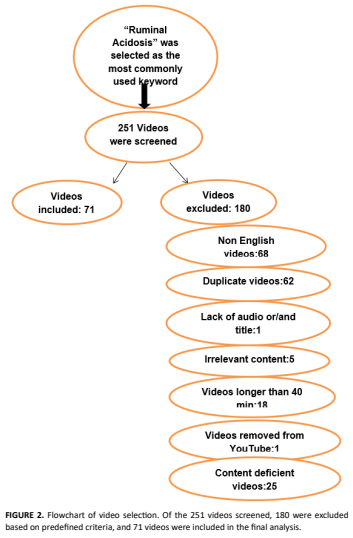
Ruminal acidosis is a common metabolic disorder in ruminants that carries significant health and economic consequences. As online platforms such as YouTube™ are increasingly used for veterinary guidance, assessing the quality and reliability of digital content has become essential. In this cross-sectional study, 71 publicly available English-language videos on ruminal acidosis were analyzed using a combined human–AI evaluation approach. Video content was assessed with three validated tools: the Video Content Quality Index, the Global Quality Scale, and a modified DISCERN instrument, measuring scientific accuracy, educational value, and reliability. Viewer engagement, including likes, comments, and viewing rates, was also recorded. The average Video Content Quality Index, the Global Quality Scale , and DISCERN scores were 9.80, 3.12, and 2.87, respectively, reflecting moderate overall quality and reliability. Videos uploaded by professional associations scored highest, whereas content from commercial sources had the lowest Video Content Quality Index values. Inter rater comparison revealed systematic differences between human reviewers and AI, with AI assigned higher Video Content Quality Index, the Global Quality Scale, and DISCERN scores compared to the human reviewer highlighting its potential to standardize evaluations across large datasets. Importantly, viewer engagement metrics did not consistently correlate with video quality, emphasizing that popularity does not equate to scientific rigor. These findings underscore the necessity for veterinary professionals and educators to actively contribute accurate, evidence-based content online. Integrating AI- assisted evaluation provides a scalable, consistent approach to identifying high-quality educational resources, offering a promising tool for enhancing digital veterinary education and supporting informed decision-making among students, practitioners, and livestock producers.
Downloads
References
Owens FN, Secrist DS, Hill WJ, Gill DR. Acidosis in cattle: a review. J. Anim. Sci. [Internet]. 1998; 76(1):275-286. doi: https://doi.org/qmpj DOI: https://doi.org/10.2527/1998.761275x
Krause KM, Oetzel GR. Understanding and preventing subacute ruminal acidosis in dairy herds: a review. Anim. Feed Sci. Technol. [Internet]. 2006; 126(3-4):215-236. doi: https://doi.org/cg9fnm DOI: https://doi.org/10.1016/j.anifeedsci.2005.08.004
Plaizier JC, Krause DO, Gozho GN, McBride BW. Subacute ruminal acidosis in dairy cows: the physiological causes, incidence and consequences. Vet. J. [Internet]. 2008; 176(1):21-31. doi: https://doi.org/c4bdpf DOI: https://doi.org/10.1016/j.tvjl.2007.12.016
Adrogué HJ, Madias NE. Management of life-threatening acid-base disorders. First of two parts. N. Engl. J. Med. [Internet]. 1998; 338(1):26-34. doi: https://doi.org/fv2n3q DOI: https://doi.org/10.1056/NEJM199801013380106
Enemark JM. The monitoring, prevention and treatment of sub-acute ruminal acidosis (SARA): a review. Vet. J. [Internet]. 2008; 176(1):32-43. doi: https://doi.org/bk27b3 DOI: https://doi.org/10.1016/j.tvjl.2007.12.021
Khafipour E, Krause DO, Plaizier JC. A grain-based subacute ruminal acidosis challenge causes translocation of lipopolysaccharide and triggers inflammation. J. Dairy Sci. [Internet]. 2009; 92(3):1060-1070. doi: https://doi.org/cndwsv DOI: https://doi.org/10.3168/jds.2008-1389
Kleen JL, Hooijer GA, Rehage J, Noordhuizen JPTM. Subacute ruminal acidosis in dairy cattle: a review. J. Vet. Med. A Physiol. Pathol. Clin. Med. [Internet]. 2003; 50(8):406-414. doi: https://doi.org/fs2525 DOI: https://doi.org/10.1046/j.1439-0442.2003.00569.x
Gledhill L, Dale VHM, Powney S, Gaitskell-Phillips GHL, Short NRM. An International Survey of Veterinary Students to Assess Their Use of Online Learning Resources. J. Vet. Med. Educ. [Internet]. 2017; 44(4):692-703. doi: https://doi.org/qmp4 DOI: https://doi.org/10.3138/jvme.0416-085R
Li M, Wang X, Du Y, Zhang H, Liao B. Based on digital intelligence: teaching innovation and practice of veterinary internal medicine in China’s southwest frontier. Front. Vet. Sci. [Internet]. 2025; 12:1651179. doi: https://doi.org/qmp5 DOI: https://doi.org/10.3389/fvets.2025.1651179
Monteiro HF, Figueiredo CC, Mion B, Santos JEP, Bisinotto RS, Peñagaricano F, Ribeiro ES, Marinho MN, Zimpel R, da Silva AC, Oyebade A, Lobo RR, Coelho WM Jr, Peixoto PMG, Ugarte Marin MB, Umaña-Sedó SG, Rojas TDG, Elvir-Hernandez M, Schenkel FS, Weimer BC, Brown CT, Kebreab E, Lima FS. An artificial intelligence approach of feature engineering and ensemble methods depicts the rumen microbiome contribution to feed efficiency in dairy cows. Anim. Microbiome. [Internet]. 2024; 6(1):5. doi: https://doi.org/qmp6 DOI: https://doi.org/10.1186/s42523-024-00289-5
Bernard A, Langille M, Hughes S, Rose C, Leddin D, van Zanten SV. A systematic review of patient inflammatory bowel disease information resources on the World Wide Web. Am. J. Gastroenterol. [Internet]. 2007; 102(9):2070- 2077. doi: https://doi.org/bnwm6b DOI: https://doi.org/10.1111/j.1572-0241.2007.01325.x
Charnock D, Shepperd S, Needham G, Gann R. DISCERN: an instrument for judging the quality of written consumer health information on treatment choices. J. Epidemiol. Community Health. [Internet]. 1999; 53(2):105-111. doi: https://doi.org/c3qmsk DOI: https://doi.org/10.1136/jech.53.2.105
Kruskal WH, Wallis WA. Use of Ranks in One-Criterion Variance Analysis. J Am. Stat. Assoc. [Internet]. 1952; 47(260):583–621. doi: https://doi.org/gfsnx8 DOI: https://doi.org/10.1080/01621459.1952.10483441
R Core Team. R: A language and environment for statistical computing. Vienna, Austria: R Foundation for Statistical Computin. [Internet]. 2015 [cited 20 Aug 2025]. Available in: https://goo.su/23IZam
Yildiz S, Toros SZ. The quality, reliability, and popularity of YouTube education videos for vestibular rehabilitation: a cross-sectional study. Otol. Neurotol. [Internet]. 2021; 42(8):e1077-e1083. doi: https://doi.org/gj6pkk DOI: https://doi.org/10.1097/MAO.0000000000003197
Hansen C, Basel MT, Curtis A, Malreddy P. Pre-lab videos as a supplemental teaching tool in first-year veterinary gross anatomy. J. Vet. Med. Educ. [Internet]. 2024; 51(6):795-806. doi: https://doi.org/qmqd DOI: https://doi.org/10.3138/jvme-2023-0067
Akkaya S, Saglam Akkaya G. Educational quality and reliability of YouTube content related to musculoskeletal ultrasound. Arch. Rheumatol. [Internet]. 2025; 40(3):365-375. doi: https://doi.org/qmqf DOI: https://doi.org/10.5152/ArchRheumatol.2025.25038
Roshier AL, Foster N, Jones MA. Veterinary students’ usage and perception of video teaching resources. BMC Med. Educ. [Internet]. 2011; 11:1. doi: https://doi.org/dc9734 DOI: https://doi.org/10.1186/1472-6920-11-1
Azer SA, AlGrain HA, AlKhelaif RA, AlEshaiwi SM. Evaluation of the educational value of YouTube videos about physical examination of the cardiovascular and respiratory systems. J. Med. Internet Res. [Internet]. 2013; 15(11):e241. doi: https://doi.org/f5jpz5 DOI: https://doi.org/10.2196/jmir.2728
Morgado M, Botelho J, Machado V, Mendes JJ, Adesope O, Proença L. Video-based approaches in health education: a systematic review and meta-analysis. Sci. Rep. [Internet]. 2024; 14:23651. doi: https://doi.org/g9rs52 DOI: https://doi.org/10.1038/s41598-024-73671-7
Klupiec C, Pope S, Taylor R, Carroll D, Ward MH, Celi P. Development and evaluation of online video teaching resources to enhance student knowledge of livestock handling. Aust. Vet. J. [Internet]. 2014; 92(7):235-239. doi: https://doi.org/f6cjzx DOI: https://doi.org/10.1111/avj.12195

This work is licensed under a Creative Commons Attribution-NonCommercial-ShareAlike 4.0 International License.