Influence of photoperiod on productive economic performance of Japanese quail (Coturnix japonica).
Abstract
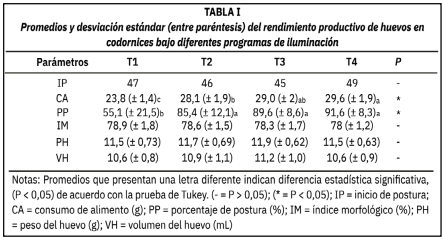
Quail (Coturnix coturnix japonica) egg production is a highly efficient production model, characterized by the species' reproductive precocity and optimal feed conversion. Therefore, the objective of this study was to determine the influence of light programs on the productive performance and egg morphometry of japanese quails in the first phase of laying, using 100 female quails of six weeks of age. They were distributed in a completely randomized design in four lighting programs: 12, 14, 16 and 18 hours of light, with five replications, obtaining 20 experimental units with five birds in each one. Laying initiation, laying percentage, feed consumption (g/bird/week), egg morphological index, egg weight and volume were evaluated. The experimental data were processed using InfoStat statistical software. The results indicated a significant influence of photoperiod on egg production and feed intake. However, no statistical differences were recorded in egg morphometric characteristics. Finally, it was concluded that treatments that incorporated additional hours of light beyond natural light demonstrated greater economic profitability.
Downloads
References
Albuquerque M, Guedes R, Dornbusch P, Laskoski L, Mangini P, Lange, R. Ovarian radiographic and direct measurements of Japanese Quail (Coturnix coturnix japonica) submitted to light restriction. Arq. Bras. Med. Vet. Zootec. [Internet]. 2017; 69(3):651–658. doi: https://doi.org/grz9nb DOI: https://doi.org/10.1590/1678-4162-8992
Murgas LDS, Melo LM, Oliveira BL, Zangeronimo MG. Producción de codornices (Coturnix coturnix) sometidas a diferentes programas de iluminación. Anatom. Vet. (Murcia). [Internet]. 2006 [Recuperado 12 Sept. 2025]; 22(1):79–85. Disponible en: https://goo.su/9OAU17
Lázaro R, Serrano MP, Capdevila J. Nutrición y alimentación de avicultura complementaria: codornices. [Internet]. En: FEDNA. Avances en nutrición y alimentación animal. Madrid, España: Fundación Española para el Desarrollo de la Nutrición Animal (FEDNA); 2005. p. 369-408. disponible en: https://goo.su/KsP1E
Huss D, Poynter G, Lansford R. Japanese quail (Coturnix japonica) as a laboratory animal model. Lab. Anim. [Internet]. 2008; 37(11):513–519. doi: https://doi.org/ft7c8t DOI: https://doi.org/10.1038/laban1108-513
Nakao N, Ono H, Yamamura T, Anraku T, Takagi T, Higashi K, Yasuo S, Katou Y, Kageyama S, Uno Y, Kasukawa T, Iigo M, Sharp PJ, Iwasawa A, Suzuki Y, Sugano S, Niimi T, Mizutani M, Namikawa T, Ebihara S, Ueda HR, Yoshimura T. Thyrotrophin in the pars tuberalis triggers photoperiodic response. Nature. [Internet]. 2008; 452(7185):317–322. doi: https://doi.org/dbb8gq DOI: https://doi.org/10.1038/nature06738
Nakane Y, Yoshimura T. Deep brain photoreceptors and a seasonal signal transduction cascade in birds. Cell Tissue Res. [Internet]. 2010; 342(3):341–344. doi: https://doi.org/fb23tq DOI: https://doi.org/10.1007/s00441-010-1073-6
Jácome I, Borille R, Rossi L, Rizzotto D, Becker J, Sampaio C. Desempenho produtivo de codornas alojadas em diferentes sistemas de iluminação artificial. Arch. Zoot. [Internet]. 2012; 61(235):449–456. doi: https://doi.org/qkhf DOI: https://doi.org/10.4321/S0004-05922012000300013
Shereen ESAH, Fattah AFA. How the diurnal hours affects maintenance behavior in Japanese quail concerning rearing modification systems. J. Anim. Behav. Biometeorol. [Internet]. 2020; 8(4):276–281. doi: https://doi.org/qkhg DOI: https://doi.org/10.31893/jabb.20035
Ávalos-Cerdas JM, Villalobos-Monge A. Análisis económico: un estudio de caso en Jatropha curcas L. mediante la metodología de presupuestos parciales. Agron. Mesoam. [Internet]. 2018; 29(1):95–104. doi: https://doi.org/qkhh DOI: https://doi.org/10.15517/ma.v29i1.27901
Gabriel-Ortega J, Valverde-Lucio A, Indacochea-Ganchozo B, Castro-Piguave C, Vera-Tumbaco M, Alcívar-Cobeña J. Diseños experimentales: Teoría y práctica para experimentos agropecuarios. Guayaquil: Editorial Grupo Compás; 2021. DOI: https://doi.org/10.26820/978-9942-602-26-8
Di Rienzo JA, Casanoves F, Balzarini MG, Gonzalez L, Tablada M, Robledo CW. InfoStat 2020 [Internet]. Córdoba, Argentina: Grupo InfoStat, FCA, Universidad Nacional de Córdoba; 2020 [Recuperado 23 Jun 2025]. Disponible en: https://goo.su/dJMNpE
Khaskheli AA. Effects of Light Intensity and Photoperiod on growth and reproductive performance of Coturnix japonica: A review. Turk. J. Agric. Food Sci. Technol. [Internet]. 2020; 8(10):2113–2117. doi: https://doi.org/qkhj DOI: https://doi.org/10.24925/turjaf.v8i10.2113-2117.3572
Borges-Soares M, Freire-Fuentes MDF, Rodrigues-Freitas E, Vieira-Lopes IR, Ferreira-Moreira R, Silveira-Sucupira F, Braz NDM, Castro R. Farelo de amêndoa da castanha de caju na alimentação de codornas japonesas na fase de postura. Rev. Bras. Zootec. [Internet]. 2007; 36(4):1076–1082. doi: https://doi.org/drmgpx DOI: https://doi.org/10.1590/S1516-35982007000500013
Furtado DA, Braz JRB, do Nascimento JWB, Lopes JP, Oliveira DL. Production and quality of Japanese quail eggs submitted to environments with different light spectrums. Eng. Agríc. [Internet]. 2018; 38(4):504–509. doi: https://doi.org/qkhk DOI: https://doi.org/10.1590/1809-4430-eng.agric.v38n4p504-509/2018
Kinyua M. Factors influencing quail farming: a critical literature review. Anim. Health J. [Internet]. 2022; 3(1):38–53. doi: https://doi.org/qkhm DOI: https://doi.org/10.47941/ahj.774
Rosario J, Nieves D. Producción y calidad de huevos de codornices alimentadas con dietas con harina de residuos aserrados de carnicerías. Rev. Cient. FCV-LUZ. [Internet]. 2015 [Citado 16 Ago 2025]; 25(2):139–144. Disponible en: https://goo.su/2GISQ5A
Genchev A. Quality and composition of Japanese quail eggs (Coturnix japonica). Trakia J. Sci. [Internet]. 2012 [Recuperado 2 Ago 2025]; 10(2):91–101. Disponible en: https://goo.su/DdUfCF
Maxkwee EN, Perry JJ, Lee PK. Flavor and appearance of whole eggshell eggs made safe with ozone pasteurization. Food Sci. Nutr. [Internet]. 2014; 2(5):578–584. doi: https://doi.org/gmsfxk DOI: https://doi.org/10.1002/fsn3.134
Rodríguez-Moya J, Cruz-Bermúdez AI. Factores que afectan la incubabilidad de huevo fértil en aves de corral. Nutr. Anim. Trop. [Internet]. 2017; 11(1):16–37. doi: https://doi.org/qkhn DOI: https://doi.org/10.15517/nat.v11i1.28295
Degollado-Aguayo K, Bernal-Barragán H, Olivares-Sáenz E, Sánchez-Dávila F, Cervantes-Ramírez M, Morales A, Vásquez-Aguilar N. Egg production and quality from laying quails fed three levels of moringa meal. J. Anim. Sci. [Internet]. 2017; 4(95):41. doi: https://doi.org/qkhp DOI: https://doi.org/10.2527/asasann.2017.083
Patarón-Andino SP, Duchi-Duchi NA, Patarón I, Muyulema-Erazo R. Aplicación de diferentes niveles de proteína y aminoácidos sintéticos en el comportamiento productivo de codornices. Esp. I+D Innov. Desarr. [Internet]. 2020; 9(24):51–67. doi: https://doi.org/qkhq DOI: https://doi.org/10.31644/IMASD.24.2020.a03