Monorchidism in cattle (Bos taurus). Case report
Abstract
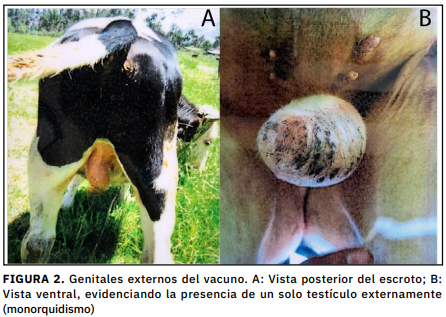
Monorchidism is a condition defined as the total absence of one of the testicles due to testicular agenesis. However, this absence may be associated with one of two causes: 1) This anomaly is usually related to the failure of the testicle to descend from the abdominal cavity, equivalent to cryptorchidism, but unilateral; 2) Testicular agenesis is known as anorchism, also described as Testicular Regression Syndrome, which can occur bilaterally or unilaterally. Both causes fall within what is known as Testicular Dysgenesis Syndrome. The objective of this study was to identify a pathology in a bovine animal. A case was reported of an 18-month-old Holstein bovine weighing 382 kg, with unknown parental history. Clinical inspection determined monorchidism, since only one testicle had developed and there was no failure to descend. The sample was transferred to the Veterinary Pathology Laboratory of the Faculty of Veterinary Sciences of the National University of Cajamarca. The presence of a single fully developed testicle with a scrotal circumference of 33 cm was observed. As a result of the macroscopic inspection, it was determined that the bovine had only one testicle. It was concluded that this was a case of monorchidism in cattle.
Downloads
References
Amann RP, Veeramachaneni DNR. Cryptorchidism in common eutherian mammals. Reproduction. [Internet]. 2007; 133(3):541-561. doi: https://doi.org/c64wgb DOI: https://doi.org/10.1530/REP-06-0272
Cicirelli V, Aiudi GG, Carbonara S, Caira M, Lacalandra GM. Case of anorchia in a mixed-breed dog. Top. Companion Anim. Med. [Internet]. 2021; 45:100554. doi: https://doi.org/qk7v DOI: https://doi.org/10.1016/j.tcam.2021.100554
Bajowa Edozien GY. Sexual Offenses, Adult: Normal Anogenital Anatomy and Variants. In: Payne-James J, Byard RW, eds. Encyclopedia of forensic and legal medicine. 2nd ed. Oxford: Elsevier; 2016. p. 286-311. DOI: https://doi.org/10.1016/B978-0-12-800034-2.00074-4
Foster RA. Male genital system. In: Grant Maxie M, editor. Jubb, Kennedy & Palmer's Pathology of Domestic Animals. 6th ed. Philadelphia (PA): Elsevier; 2016. p. 465-510. DOI: https://doi.org/10.1016/B978-0-7020-5319-1.00016-5
Strong M, Dart AJ, Malikides N, Hodgson DR. Monorchidism in two horses. Aust. Vet. J. [Internet].1997; 75(5):333– 335. doi: https://doi.org/d33h3v DOI: https://doi.org/10.1111/j.1751-0813.1997.tb15704.x
Parks AH, Scott EA, Cox JE, Stick JA. Monorchidism in the horse. Equine. Vet. J. [Internet]. 1989; 21(3):215–217. doi: https://doi.org/cj7khf DOI: https://doi.org/10.1111/j.2042-3306.1989.tb02150.x
Bar-Maor JA, Groisman G, Lam M. Antenatal torsion of the testes, a cause of vanishing testis syndrome. Pediatr. Surg. Int. [Internet]. 1993; 8(3):236–238. doi: https://doi.org/bk6dcx DOI: https://doi.org/10.1007/BF00182526
Fontana de Magalhães J, Mattos Jardim Costa G, Alves de Oliveira C, Gomes Corrêa M, da Silva Rocha Júnior S, Lilian Beier S, Falcão Mendes HM, Silveira Alves GE, Resende Faleiros R. Monorquidismo em um equino marchador. Cienc. Rural. [Internet]. 2015; 45(6):1058–1061. doi: https://doi.org/qk7z DOI: https://doi.org/10.1590/0103-8478cr20140159
Clements PE, Coomer RPC, McKane SA, Gorvy D, Bladon B, Mair T. Clinical findings in 10 horses diagnosed with monorchidism following exploratory laparotomy or standing laparoscopic surgery. Equine. Vet. Educ. [Internet]. 2020; 32(8):431–436. doi: https://doi.org/qk73 DOI: https://doi.org/10.1111/eve.13074
Gardner AK, Santschi EM, Aeffner F, Pigott JH, Russell DS. Testicular ischaemic necrosis as a cause of equine cryptorchidism. Equine. Vet. Educ. [Internet]. 2017; 29(6):314–317. doi: https://doi.org/qk74 DOI: https://doi.org/10.1111/eve.12544
Murase H, Ochi A, Tozaki T, Kakoi H, Munkhtuul T, Kurimoto S, Sato F, Hada T. A case of equine cryptorchidism with undetectable serum anti-müllerian hormone. J. Vet. Med. Sci. [Internet]. 2020; 82(2):209–211. doi: https://doi.org/qk76 DOI: https://doi.org/10.1292/jvms.18-0057
Jean G, Gaughan EM, Constable PD. Cryptorchidism in North American cattle: Breed predisposition and clinical findings. Theriogenology. [Internet]. 1992; 38(5):951–958. doi: https://doi.org/fk279j DOI: https://doi.org/10.1016/0093-691X(92)90169-R
Rebhun WC. Bilateral cryptorchidism in a bull. Cornell. Vet. 1976 [ consultado 2 Sep 2025]; 66(1):10–13. Disponible en: https://goo.su/xCmpKLU
Diamond DA, Flores C, Kumar S, Malhotra R, Seethalakshmi L. The effects of an LHRH agonist on testicular function in the cryptorchid rat. J. Urol. [Internet]. 1992; 147(1):264–269. doi: https://doi.org/qk78 DOI: https://doi.org/10.1016/S0022-5347(17)37210-5
Lane E, Bijnen M, Osborne M, More S, Henderson I, Duffy P, Crowe MA. Key Factors Affecting Reproductive Success of Thoroughbred Mares and Stallions on a Commercial Stud Farm. Reprod. Domest. Anim. [Internet]. 2016; 51(2):181–187. doi: https://doi.org/f8f68p DOI: https://doi.org/10.1111/rda.12655
Jlassi M, Jemmali B, Ouzari HI, Lasfer F, Ben Aoun B, Ben Gara A. Reproductive Performance of Tunisian Arabian Stallions: A Study on the Variance and Estimation of Heritability. Animals. [Internet]. 2023; 13(6):991. doi: https://doi.org/qk79 DOI: https://doi.org/10.3390/ani13060991
Nath LC, Anderson GA, McKinnon AO. Reproductive efficiency of Thoroughbred and Standardbred horses in north-east Victoria. Aust. Vet. J. [Internet]. 2010; 88(5):169–175. doi: https://doi.org/fcq63r DOI: https://doi.org/10.1111/j.1751-0813.2010.00565.x
Hynes V, Saldeña E, Ferré DM, Quero AAM, Albarracín L, Gorla NB. Estudio cromosómico en caninos con criptorquidismo y monorquidismo. En: XL Congreso Argentino de Genética; 2011 Sept 20-23; Corrientes, Argentina. 2011. p. 25-27.
Tibary A. Anomalías genitales masculinas de animales. Anomalías congénitas y hereditarias del aparato reproductor. Manual de Veterinaria de MSD. New Jersey, EE. UU: Merck & Co. [Internet]. [Consultado 4Sep 2025]. 2021. Disponible en: https://goo.su/VQYAIB0
Petrizzi L, Varasano V, Robbe D, Valbonetti L. Monorchidism in an appaloosa stallion. Vet. Rec. [Internet]. 2004; 155(14):424–425. doi: https://doi.org/ctx9rj DOI: https://doi.org/10.1136/vr.155.14.424
Miller NA, Van Lue SJ, Rawlings CA. Use of laparoscopicassisted cryptorchidectomy in dogs and cats. J. Am. Vet. Med. Assoc. [Internet]. 2004; 224(6):875-878. doi: https://doi.org/dgpjrc DOI: https://doi.org/10.2460/javma.2004.224.875
Storm D, Redden T, Aguiar M, Wilkerson M, Jordan G, Sumfest J. Histologic Evaluation of the Testicular Remnant Associated with the Vanishing Testes Syndrome: Is Surgical Management Necessary?. Urology. [Internet]. 2007; 70(6):1204–1206. doi: https://doi.org/dcvpgg DOI: https://doi.org/10.1016/j.urology.2007.08.020
Cendron M, Schned AR, Ellsworth PI. Histological evaluation of the testicular nubbin in the vanishing testis syndrome. J. Urol. [Internet]. 1998; 160(3 Pt. 2):1161–1162. doi: https://doi.org/fbzx3q DOI: https://doi.org/10.1016/S0022-5347(01)62726-5
Dhandore P, Hombalkar NN, Gurav PD, Ahmed MHS. Vanishing testis syndrome: Report of two cases. J. Clin. Diagn. Res. [Internet]. 2014; 8(8):ND03-ND04. doi: https://doi.org/qk8n
Pirgon Ö, Dündar BN. Vanishing testes: A literature review. J. Clin. Res. Pediatr. Endocrinol. [Internet]. 2012; 4(3):116–120. doi: https://doi.org/f37828 DOI: https://doi.org/10.4274/Jcrpe.728
Hegarty PK, Mushtaq I, Sebire NJ. Natural history of testicular regression syndrome and consequences for clinical management. J. Pediatr. Urol. [Internet]. 2007; 3(3):206–208.doi: https://doi.org/c8d58q DOI: https://doi.org/10.1016/j.jpurol.2006.08.007
Páez-Barón EM, Corredor-Camargo ES. Evaluación de la aptitud reproductiva del toro. Cienc. Agric. [Internet]. 2014 [Consultado 4 Sep 2025]; 11(2):49–59. Disponible en: https://goo.su/qrqfa DOI: https://doi.org/10.19053/01228420.3837