Consumers and future Veterinarians: Attitudes of Veterinary students toward welfare–friendly meat products and labelling in Türkiye
Abstract
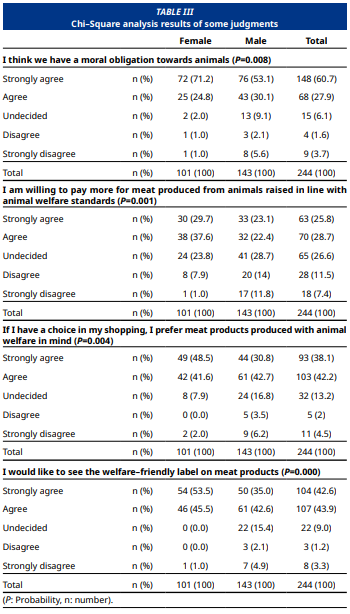
The animal welfare concept is gaining more importance at the international level in the production process of animal products, to ensure sustainability, ethical production, and food safety. Consumers’ sensitivity and approach to animal welfare affect their animal product preferences directly. The present study aimed to uncover the attitudes of veterinary faculty students in Türkiye toward meat products produced considering animal welfare and welfare–friendly labeling and the factors affecting this. To this end, this cross–sectional study was designed by applying a questionnaire to 256 participants. The questionnaire form consisted of 10 sociodemographic questions and 29 5-point Likert– type questions. Explanatory Factor Analysis and Confirmatory Factor Analysis were used along with the varimax rotation method. As a result of these analyses, the Welfare–Friendly Meat Product Scale (WFP–Cronbach alpha: 0.951) and the Welfare–Friendly Labeling Scale (WFL–Cronbach alpha: 0.960) were created. The total average score of the participants from the scales was found to be 71.85 (min: 17, max: 85) for WFP and 50.28 (min: 12, max: for WFL. It was found that women were more sensitive to animal welfare and had higher intentions to purchase ethical products compared to men. Only 1% of participants thought that consumers were responsible for ensuring animal welfare. Interestingly, participants thought that fish had more welfare problems than sheep, goats, and turkeys. It was also found that meat prices had a significant impact on participants’ consumption preferences (participants said they would consume more red meat and less chicken if their prices were the same).
Downloads
References
Buller H, Blokhuis H, Jensen P, Keeling L. Towards farm animal welfare and sustainability. Animals [Internet]. 2018; 8(6):81. doi: https://doi.org/gdt8bx DOI: https://doi.org/10.3390/ani8060081
Katzenberger K, Rauch E, Erhard M, Reese S, Gauly M. Evaluating the need for an animal welfare assurance programme in South Tyrolean dairy farming. Ital. J. Anim. Sci. [Internet]. 2020; 19(1):1146–1156. doi: https://doi.org/qgjj DOI: https://doi.org/10.1080/1828051X.2020.1823897
Chang MY, Chen HS. Consumer attitudes and purchase intentions in relation to animal welfare–friendly products: evidence from Taiwan. Nutrients [Internet]. 2022; 14(21):4571. doi: https://doi.org/qgjk DOI: https://doi.org/10.3390/nu14214571
Borriello G, Cagnotti G, Avedano E, Bergagna S, Iannello P, Di Muro G, Ferrini S, D’Angelo A, Bellino C. Qualitative and quantitative monitoring of antibiotics on dairy cattle farms in relation to animal welfare indicators. Ital. J. Anim. Sci. [Internet]. 2023; 22(1):760–768. doi: https://doi.org/qgjm DOI: https://doi.org/10.1080/1828051X.2023.2241878
Ducrot C, Barrio MB, Boissy A, Charrier F, Even S, Mormède P, Petit S, Pinard–van der Laan MH, Schelcher F, Casabianca F, Ducos A, Foucras G, Guatteo R, Peyraud JL, Vayssier–Taussat M, Veysset P, Friggens NC, Fernandez X. Animal board invited review: Improving animal health and welfare in the transition of livestock farming systems: Towards social acceptability and sustainability. Animal [Internet]. 2024; 18(3):101100. doi: https://doi.org/qgjn DOI: https://doi.org/10.1016/j.animal.2024.101100
Blanc S, Massaglia S, Borra D, Mosso A, Merlino VM. Animal welfare and gender: a nexus in awareness and preference when choosing fresh beef meat?. Ital. J. Anim. Sci. [Internet]. 2020; 19(1):410–420. doi: https://doi.org/qgjp DOI: https://doi.org/10.1080/1828051X.2020.1747952
Clark B, Stewart GB, Panzone LA, Kyriazakis I, Frewer LJ. A systematic review of public attitudes, perceptions and behaviours towards production diseases associated with farm animal welfare. J. Agric. Environ. Ethics. [Internet]. 2016; 29(3):455–478. doi: https://doi.org/qgjq DOI: https://doi.org/10.1007/s10806-016-9615-x
Spain CV, Freund D, Mohan–Gibbons H, Meadow RG, Beacham L. Are they buying it? United States consumers’ changing attitudes toward more humanely raised meat, eggs, and dairy. Animals [Internet]. 2018; 8(8):128. doi: https://doi.org/gd6kk2 DOI: https://doi.org/10.3390/ani8080128
de Boer J, Aiking H. Considering how farm animal welfare concerns may contribute to more sustainable diets. Appetite. [Internet]. 2022; 168:105786. doi: https://doi.org/qgjr DOI: https://doi.org/10.1016/j.appet.2021.105786
Heng Y, Peterson HH, Li X. Consumer responses to multiple and superfluous labels in the case of eggs. J. Food. Distrib. Res. [Internet]. 2016; 47(2):62–82. doi: https://doi.org/qgjs
Janssen M, Rödiger M, Hamm U. Labels for animal husbandry systems meet consumer preferences: Results from a meta– analysis of consumer studies. J. Agric. Environ. Ethics. [Internet]. 2016; 29(6):1071–1100. doi: https://doi.org/f9bvzf DOI: https://doi.org/10.1007/s10806-016-9647-2
Ufer D, Ortega DL, Wolf CA. Economic foundations for the use of biotechnology to improve farm animal welfare. Trends Food. Sci. Technol. [Internet]. 2019; 91:129–138. doi: https://doi.org/gj29z2 DOI: https://doi.org/10.1016/j.tifs.2019.07.002
Miranda–de la Lama GC, Estévez–Moreno LX, Villarroel M, Rayas–Amor AA, María GA, Sepúlveda WS. Consumer attitudes toward animal welfare–friendly products and willingness to pay: Exploration of Mexican market segments. J. Appl. Anim. Welf. Sci. [Internet]. 2019; 22(1):13–25. doi: https://doi.org/ghxrrn DOI: https://doi.org/10.1080/10888705.2018.1456925
Giannetto C, Biondi V, Previti A, De Pascale A, Monti S, Alibrandi A, Zirilli A, Lanfranchi M, Pugliese M, Passantino A. Willingness to pay a higher price for pork obtained using animal–friendly raising techniques: A consumers’ opinion survey. Foods [Internet]. 2023; 12(23):4201. doi: https://doi.org/qgjt DOI: https://doi.org/10.3390/foods12234201
European Commission. Attitudes of Europeans towards Animal Welfare. Special Eurobarometer. [Internet]. [cited Aug 18, 2025]. Available in: https://goo.su/2vGiD
Kehlbacher A, Bennett R, Balcombe K. Measuring the consumer benefits of improving farm animal welfare to inform welfare labelling. Food Policy [Internet]. 2012; 37(6):627– 633. doi: https://doi.org/f4gn5s DOI: https://doi.org/10.1016/j.foodpol.2012.07.002
Estévez–Moreno LX, María GA, Sepúlveda WS, Villarroel M, Miranda–de la Lama GC. Attitudes of meat consumers in Mexico and Spain about farm animal welfare: A cross–cultural study. Meat Sci. [Internet]. 2021; 173:108377. doi: https://doi.org/g6qhmq DOI: https://doi.org/10.1016/j.meatsci.2020.108377
Akova SB, Tapan İ. Evaluation of good agricultural practices within the scope of sustainable agriculture: the case of Malatya. Coğrafya Derg. [Internet]. 2022; 44:151–167. doi: https://doi.org/qgjv
Phan–Huy SA, Fawaz RB. Swiss market for meat from animal– friendly production–responses of public and private actors in Switzerland. J. Agric. Environ. Ethics [Internet]. 2003; 16(2):119–136. doi: https://doi.org/fvk3sx DOI: https://doi.org/10.1023/A:1022992200547
Di Pasquale J, Nannoni E, Adinolfi F, Del Duca I, Capitanio F, Sardi L, Vitali M, Martelli G. A case–study on profiling Italian consumers of animal–friendly foods. Ital. J. Anim. Sci. [Internet]. 2016; 15(2):294–302. doi: https://doi.org/f8sccg DOI: https://doi.org/10.1080/1828051X.2016.1180963
Peña–Avelino LY, Alva–Pérez J, Rosales–Martínez GN. Perception, knowledge and consumption preference of meat products produced with animal welfare in veterinary students. Rev. Bio. Ciencias [Internet]. 2023; 10:e1510. doi: https://doi.org/qgjx
Thibault M, Pailler S, Freund D. Why are they buying it? United States consumers’ intentions when purchasing meat, eggs, and dairy with welfare–related labels. Food Ethics [Internet]. 2022; 7(2):12. doi: https://doi.org/qgjw DOI: https://doi.org/10.1007/s41055-022-00105-3
Paul ES, Podberscek AL. Veterinary education and students’ attitudes towards animal welfare. Vet. Rec. [Internet]. 2000; 146(10):269–272. doi: https://doi.org/fvs922 DOI: https://doi.org/10.1136/vr.146.10.269
Liang Y, Meng C, Chen R, Yang Y, Zeng Y. Pet ownership and its influence on animal welfare attitudes and consumption intentions among Chinese university students. Animals [Internet]. 2024; 14(22):3242. doi: https://doi.org/qgjz DOI: https://doi.org/10.3390/ani14223242
Dommeyer CJ, Moriarty E. Comparing two forms of an e–mail survey: Embedded vs. attached. Int. J. Mark. Res. [Internet]. 2000; 42:39–50. doi: https://doi.org/qgj2 DOI: https://doi.org/10.1177/147078530004200103
Vanhonacker F, Verbeke W, Van Poucke E, Tuyttens FA. Segmentation based on consumers’ perceived importance and attitude toward farm animal welfare. Int. J. Sociol. Agric. Food [Internet]. 2007; 15(3):91–107. doi: https://doi.org/qgj3
Çavuş–Alan S, Özen A. The level of loyalty of pet owners to their animals in Türkiye. FU. Vet. J. Health. Sci. [Internet]. 2024 [cited Aug 18, 2025]; 38(3):219–226. Available in: https://goo.su/Vt5kWS
Ünsal Adaca A. Analysis of Turkish veterinary students’ self– perception of communication competencies based on gender differences. J. Vet. Med. Educ. [Internet]. 2021; 48(6):756– 763. doi: https://doi.org/qgj5 DOI: https://doi.org/10.3138/jvme-2020-0048
Özen R, Çavuş–Alan S, Özen A. Social Problem–Solving Skills and Empathy Levels of Veterinary Clinicians in Türkiye. Kafkas Univ. Vet. Fak. Derg. [Internet]. 2023; 29(6):697–703. doi: https://doi.org/g8rs4r DOI: https://doi.org/10.9775/kvfd.2023.30271
Izmirli S, Yasar A. A survey on animal welfare attitudes of veterinary surgeries, veterinary students, animal owners and society in Turkey. Kafkas Univ. Vet. Fak. Derg. [Internet]. 2010; 16(6):981–985. doi: https://doi.org/qgj6
Taylor N, Signal TD. Empathy and attitudes to animals. Anthrozoös [Internet]. 2005; 18:18–27. doi: https://doi.org/dvwqtw DOI: https://doi.org/10.2752/089279305785594342
Araç SK. The role of “women” in sustainability: A consumption– based approach. In: Bayram AT, Agarwal N, Raza A, editors. Women’s studies in social sciences I. Türkiye: Ozgur Press; 2023. p.117–164.
Auger B, Amiot CE. Testing and extending the pets as ambassadors hypothesis: The role of contact with pets and recategorization processes in predicting positive attitudes toward animals. Hum. Anim. Interact. Bull. [Internet]. 2017; 5(1):1–25. doi: https://doi.org/qgj7 DOI: https://doi.org/10.1079/hai.2017.0005
Pearce H, Neill CL, Royal K, Pairis–Garcia M. Can dogs help chickens? Pet owners’ willingness to pay for animal welfare– friendly pet food in the United States. Anim. Welf. [Internet]. 2023; 32:e11. doi: https://doi.org/qgj8 DOI: https://doi.org/10.1017/awf.2022.3
Sarıal GSK, Bozkurt Z. Animal welfare attitudes of pet owners: An investigation in central and western parts of Turkey. Kocatepe Vet. J. [Internet]. 2020; 13(4):388–395. doi: https://doi.org/qgj9
Metzger MM. Knowledge of the animal welfare act and animal welfare regulations influences attitudes toward animal research. J. Am. Assoc. Lab. Anim. Sci. [Internet]. 2015 [cited Aug 18, 2025]; 54(1):70–75. Available in: https://goo.su/o8iuc
Dawkins MS. The science of animal welfare: Understanding what animals want. Oxford (England): Oxford University Press; 2021.
American Veterinary Medical Association: Veterinarian’s oath. [Internet]. [cited Aug 18, 2025]. 2020. Available in: https://goo.su/tCqXh0
Lord LK, Millman ST, Carbone L, Cook N, Fisher A, McKeegan D, Morton D, Pajor E, Peralta JM, Robertson SA, Siegford J, Egrie PG, Mashima TY, Turner PV, Golab GC, Patterson–Kane E. A model curriculum for the study of animal welfare in colleges and schools of Veterinary Medicine. J. Am. Vet. Med. Assoc. [Internet]. 2017; 250(6):632–640. doi: https://doi.org/gn9x6j DOI: https://doi.org/10.2460/javma.250.6.632
Kolcu S. Examining the effect of sustainable marketing activities implemented by businesses on consumers’ behavior towards green products. [Master’s thesis on the internet]. Sakarya (Türkiye): Sakarya University; 2024 [cited Aug 18, 2025]. 93 p. Available in: https://goo.su/tukkz2
Șeker İ, Özen A, Güler H, Șeker P, Özden İ. Red meat consumption behavior in Elazığ and consumers’ opinion in animal welfare. Kafkas Univ. Vet. Fak. Derg. [Internet]. 2011; 17(4):543–550. doi: https://doi.org/qgkc
Seibel H, Weirup L, Schulz C. Fish welfare–between regulations, scientific facts and human perception. Food Ethics [Internet]. 2020; 5(1):4. doi: https://doi.org/ggvs6x DOI: https://doi.org/10.1007/s41055-019-00063-3
Regulation on Aquaculture. Official Gazette [Internet]. [cited Aug 18, 2025]. Available in: https://goo.su/k33D
Regulation on general provisions regarding the welfare of farm animals. Official Gazette [Internet]. [cited Aug 18, 2025]. Available in: https://goo.su/GUKhBK
Beck V, Ladwig B. Ethical consumerism: veganism. Wiley Interdiscip. Rev. Clim. Change. [Internet]. 2021; 12(1):e689. doi: https://doi.org/gpkvbg DOI: https://doi.org/10.1002/wcc.689
Selvi MS, Cavlak N. Gida Fiyatlarindaki Aşiri Artişlarin Olasi Nedenleri Ve COVID–19’un Etkisi [Possible causes of excessive increase in food prices and the impact of COVID– 19]. Gıda [Internet]. 2021; 47(1):42–54. Turkish. doi: https://doi.org/qgkf DOI: https://doi.org/10.15237/gida.GD21135
Schermelleh–Engel K, Moosbrugger H, Müller H. Evaluating the fit of structural equation models: Tests of significance and descriptive goodness–of–fit measures. Methods Psychol. Res. [Internet]. 2003 [cited Aug 18, 2025]; 8(2):23–74. Available in: https://goo.su/2JV27Il
Çavuş–Alan S, Özen A, Halisdemir N. Development and validation of a scale for measuring pet owners’ loyalty to their pet. Turk. J. Vet. Anim. Sci. [Internet]. 2023; 47(1):26–33. doi: https://doi.org/qgj4 DOI: https://doi.org/10.55730/1300-0128.4265