Xenoinjertos de colágeno marino aceleran la reparación tisular en heridas cutáneas abiertas de caninos: evidencia clínica e histopatológica
Resumen
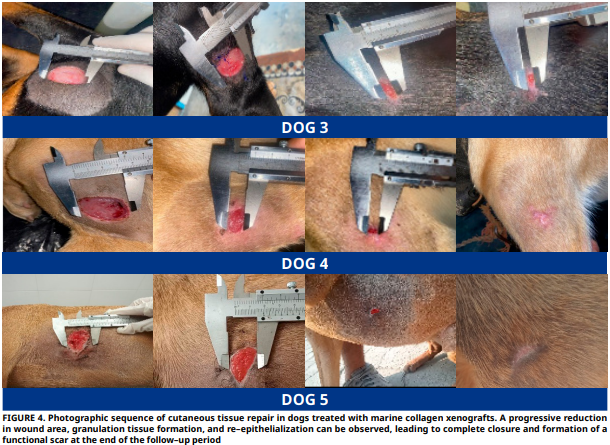
El uso de xenoinjertos de colágeno marino constituye una alternativa terapéutica innovadora en la medicina veterinaria regenerativa por su capacidad para acelerar la reparación tisular y mejorar la calidad estructural de la cicatrización cutánea. Este biomaterial de origen ictiológico presenta alta compatibilidad biológica, bajo riesgo inmunogénico y similitud con el colágeno dérmico de los mamíferos. La presente investigación evaluó su eficacia en la regeneración de heridas cutáneas abiertas en perros, mediante análisis clínico, fotográfico e histopatológico, en comparación con tratamiento convencional con crema cicatrizante. Se emplearon cinco perros mestizos con lesiones de entre 2,4 y 11,07 cm². Tres pacientes fueron tratados con xenoinjertos de colágeno marino deshidratado y esterilizado aplicados mediante la técnica MAHVET, y dos con limpiezas antisépticas diarias y crema cicatrizante. El seguimiento clínico y las mediciones morfométricas empleando un calibrador vernier de alta precisión, se realizaron semanalmente durante seis semanas. Los pacientes tratados con xenoinjertos mostraron reducciones del área lesionada superiores al 98 % desde las primeras semanas, alcanzando cierres casi completos (99,27– 99,82 %) en tres a cuatro semanas, mientras que los tratados convencionalmente alcanzaron reducciones del 97,05–98,81 % al finalizar la sexta semana. El análisis histopatológico evidenció en el grupo con xenoinjertos una epidermis íntegra, mínima inflamación, fibroblastos maduros y fibras colágenas compactas dispuestas paralelamente, en contraste con el grupo control, donde persistió inflamación y colágeno inmaduro. Los resultados demuestran que los xenoinjertos de colágeno marino favorecen el cierre de la herida, optimizan la organización y maduración tisular, representando una alternativa biocompatible y terapéutica eficaz en la cicatrización de heridas cutáneas abiertas.
Descargas
Citas
Aisa J, Mark P. Local wound management: a review of modern techniques and products. Vet. Dermatol. [Internet]. 2022; 33:463–478. doi: https://doi.org/qfvv DOI: https://doi.org/10.1111/vde.13104
Cruz MA, Araujo TA, Avanzi IR, Parisi JR. Collagen from marine sources and skin wound healing in animal experimental studies: a systematic review. Mar. Biotechnol. [Internet]. 2021; 23:1–11. doi: https://doi.org/gjh8dv DOI: https://doi.org/10.1007/s10126-020-10011-6
Oslan SNH, Li CX, Shapawi R, Mokhtar RAM, Noordin WNM, Huda N. Extraction and characterization of bioactive fish by– product collagen as a promising potential wound healing agent in pharmaceutical applications. Int. J. Food Sci. [Internet]. 2022; 2022:9437878. doi: https://doi.org/qfvw DOI: https://doi.org/10.1155/2022/9437878
Zhang Z, Wang J, Ding Y, Dai X, Li Y. Oral administration of marine collagen peptides from chum salmon skin enhances cutaneous wound healing and angiogenesis in rats. J. Sci. Food. Agric. [Internet]. 2011; 91:2173–2179. doi: https://doi.org/dcqj7j DOI: https://doi.org/10.1002/jsfa.4435
Mauer ES, Maxwell EA, Cocca CJ, Ganjei J, Spector D. Acellular fish skin grafts for the management of wounds in dogs and cats: 17 cases (2019–2021). Am. J. Vet. Res. [Internet]. 2022; 83(5):1–7. doi: https://doi.org/qfvx DOI: https://doi.org/10.2460/ajvr.21.09.0140
Alam K, Jeffery SL. Acellular fish skin grafts for management of split–thickness donor sites and partial–thickness burns: a case series. Mil. Med. [Internet]. 2019; 184(Suppl. 1):16–20. doi: https://doi.org/gq6znr DOI: https://doi.org/10.1093/milmed/usy280
Chen J, Gao K, Liu S, Wang S, Elango J, Bao B, Dong J, Liu N, Wu W. Fish collagen surgical compress repairing characteristics on wound healing process in vivo. Mar Drugs. [Internet]. 2019; 17(1):33. doi: https://doi.org/gjg8tm DOI: https://doi.org/10.3390/md17010033
Lim YS, Ok YJ, Hwang SY, Kwak JY, Yoon S. Marine collagen as a promising biomaterial for biomedical applications. Mar Drugs. [Internet]. 2019; 17(8):467. doi: https://doi.org/ghhwdm DOI: https://doi.org/10.3390/md17080467
Huppes RR, de Nardi AB, Pazzini JM, Castro JLC, editores. Cirugía reconstructiva en perros y gatos [Internet]. Barcelona (Spain): Multimédica Ediciones Veterinarias; 2024. 328 p. Available in: https://goo.su/m6BtT4
Murrell JC. La medicación preanestésica y la sedación. En: Duke–Novakovski T, de Vries M, Seymour C, editores. Manual de anestesia y analgesia de pequeños animales [Internet]. 2ª ed. Barcelona (Spain): Edra; 2022. 288 p. Available in: https://goo.su/sfuAn
Lujano–Guzmán AC, Caicho–Caicedo O. Validation of the instillation technique Advanced wound management in veterinary medicine (MAHVET). Salud Cienc. Tecnol. [Internet]. 2022; 2:71. doi: https://doi.org/qfvz DOI: https://doi.org/10.56294/saludcyt202271
La Mónica F, Cámpora S, Ghersi G. Collagen–based scaffolds for the treatment of chronic skin wounds. Gels [Internet]. 2024;10(2):137. doi: https://doi.org/qfv2 DOI: https://doi.org/10.3390/gels10020137
Zhang Q, Dou M, Su X, Yu Z, Wei B, Zhu L, Zhang J, Wang H. Collagen–based biomaterials: recent advances on regulating cell migration and correlated biomedical applications. Collagen & Leather. 2025; 7:17. doi: https://doi.org/qfv3 DOI: https://doi.org/10.1186/s42825-025-00197-7
Holzer–Geissler JCJ, Schwingenschuh S, Zacharias M, Einsiedler J, Kainz S, Reisenegger P, Holecek C, Hofmann E, Wolff–Winiski B, Fahrngruber H, Birngruber T, Kamolz LP, Kotzbeck P. The impact of prolonged inflammation on wound healing. Biomedicines [Internet]. 2022; 10(4):856 doi: https://doi.org/qfv5 DOI: https://doi.org/10.3390/biomedicines10040856
Zhou S, Xie M, Su J, Cai B, Li J, Zhang K. New insights into balancing wound healing and scarless repair. J. Tissue Eng. Regen. Med. [Internet]. 2023; 17(5):e2008–e2025. doi: https://doi.org/g7g3hm
Mamun AA, Shao C, Geng P, Wang S, Xiao J. Recent advances in molecular mechanisms of skin wound healing. Front Immunol. [Internet]. 2024; online ahead of print. doi: https://doi.org/g8qdxd DOI: https://doi.org/10.3389/fimmu.2024.1395479
Agivale SM, Shende HU, Mehendale SV, Rahul RG, Salunke VM, Ulemale AH. Use of tilapia fish (Oreochromis niloticus) skin graft for chronic wound management in six dogs. J. Entomol. Zool. Stud. [Internet]. 2024; 9(4h):1601. doi: https://doi.org/qfv6 DOI: https://doi.org/10.22271/veterinary.2024.v9.i4h.1601
Melotti L, Martinello T, Perazzi A, Iacopetti I, Ferrario C, Sugni M, Sacchetto R, Patruno M. A prototype skin substitute made of recycled marine collagen improves the skin regeneration of sheep. Animals [Internet]. 2021; 11(5):1219. doi: https://doi.org/qfv8 DOI: https://doi.org/10.3390/ani11051219
Galarza–Pesantez RL. Uso de la piel de tilapia (Oreochromis spp.) como tratamiento en heridas expuestas con pérdida de continuidad en caninos (Canis lupus familiaris) [master’s thesis on the Internet]. Cuenca (Ecuador): Universidad de Cuenca, 2022. 172 p. Available in: https://goo.su/jVrcG
Choi C, Linder T, Kirby A, Rosenkrantz W, Mueller M. Use of a tilapia skin xenograft for management of a large bite wound in a dog. Can. Vet. J. [Internet]. 2021 [cited June 23, 2025]; 62(10):1071–1076. Available in: https://goo.su/eZ6GWS0
Wu S, Yang L, Chen J. Preparation and characterization of tilapia collagen–thermoplastic polyurethane composite nanofiber membranes. Mar. Drugs [Internet]. 2022; 20(7):437. doi: https://doi.org/gsn63j DOI: https://doi.org/10.3390/md20070437
Ivana J, Smith L, Rogers P, Ahmed N, Brown T. Evaluation of the efficacy of fish skin grafts as wound dressings for chronic and complex wounds. J. Wound Care Res. [Internet]. 2025 [cited June 23, 2025]; 18(2):145–153. Available in: https://goo.su/Zi3igXt
Daidone C, Rossi M, Bianchi L, Ferrara P. The role of fish skin xenografts in healing complex wounds: a brief case report. J. Clin. Case Rep. Med. Imag. Health Sci. [Internet]. 2025 [cited May 29, 2025]; 9(1):23–27. Available in: https://goo.su/zRRUAy
El–Sayed A, El–Sherif M, El–Komy H, El–Kilany S, El–Dakhly K, El–Tantawy M. Evaluation of tilapia (Oreochromis niloticus) fish skin as a biological dressing for full–thickness metacarpal wounds in donkeys (Equus asinus). BMC Vet. Res. [Internet]. 2020; 16(1):178. doi: https://doi.org/qfv9 DOI: https://doi.org/10.1186/s12917-020-02693-w
Lima–Júnior EM, Picollo NS, Miranda MJB, Silva–Júnior FR, Ribeiro WL, Alves APNN, Pereira TMC, Soares MFAA, Moreira JR, Costa BA, Moraes Filho MO. Innovative treatment using tilapia skin as a xenograft for partial thickness burns in humans: a phase II randomized controlled trial. Medicina [Internet]. 2022; 58(7):912. Available in: https://doi.org/gsmf74
Shi S, Wang L, Song C, Yao L, Xiao J. Recent progresses of collagen dressings for chronic skin wound healing. J. Laser Health Sci Eng. [Internet]. 2023;12(2):31. doi: https://doi.org/g93xmc DOI: https://doi.org/10.1186/s42825-023-00136-4
Zhang Y, Wang Y, Li Y, Yang Y, Jin M, Lin X, Zhuang Z, Guo K, Zhang T, Tan W. Application of collagen–based hydrogel in skin wound healing. Gels [Internet]. 2023; 9(3):185. doi: https://doi.org/qfwd DOI: https://doi.org/10.3390/gels9030185
Kolimi P, Narala S, Nyavanandi D, Youssef AAA, Dudhipala N, Khammari D, Banala N, Kumar BP, Repka MA. Innovative treatment strategies to accelerate wound healing: trajectory and recent advancements. Cells [Internet]. 2022; 11(15):2439. doi: https://doi.org/gtxz27 DOI: https://doi.org/10.3390/cells11152439
Mathew–Steiner SS, Roy S, Sen CK. Collagen in wound healing. Bioengineering [Internet]. 2021; 8(5):63. doi: https://doi.org/gk73v6 DOI: https://doi.org/10.3390/bioengineering8050063
Yeung DA. The role of collagen–based biomaterials in chronic wounds. Bioengineering. [Internet]. 2021; 8(1):8. doi: https://doi.org/gp5gm5 DOI: https://doi.org/10.3390/bioengineering8010008