Evaluación de videos de Youtube™ sobre acidosis ruminal: integración de evaluaciones humanas e Inteligencıa Artificial para calidad y confiabilidad.
Resumen
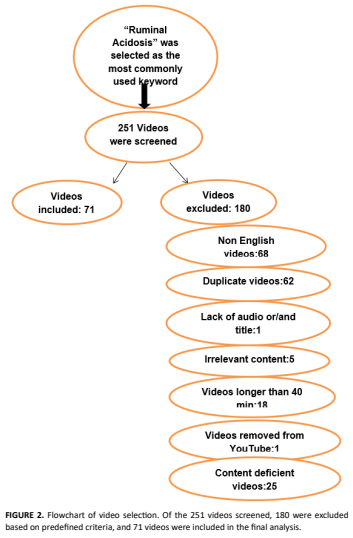
La acidosis ruminal es un trastorno metabólico frecuente en rumiantes que conlleva importantes consecuencias para la salud y la economía. Dado que plataformas en línea como YouTube™ se utilizan cada vez más como fuente de orientación veterinaria, evaluar la calidad y la fiabilidad del contenido digital se ha vuelto esencial. En este estudio transversal se analizaron 71 videos en inglés disponibles públicamente sobre la acidosis ruminal mediante un enfoque combinado de evaluación humano–IA. El contenido de los videos se evaluó utilizando tres herramientas: el Índice de Calidad del Contenido de Video , la Escala de Calidad Global y un instrumento DISCERN modificado, para medir la exactitud científica, el valor educativo y la fiabilidad. También se registraron métricas de interacción de los espectadores, incluidos los “likes”, comentarios y tasas de visualización. Los valores promedio del Índice de Calidad del Contenido de Video, la Escala de Calidad Global y DISCERN fueron 9.80, 3.12 y 2.87, respectivamente, lo que refleja una calidad y fiabilidad generales moderadas. Los videos publicados por asociaciones profesionales obtuvieron las puntuaciones más altas, mientras que los procedentes de fuentes comerciales presentaron los valores más bajos del Índice de Calidad del Contenido de Video. La comparación entre evaluadores reveló diferencias sistemáticas entre la evaluación humana y la realizada por la IA, ya que la IA asignó puntuaciones más altas del Índice de Calidad del Contenido de Video, la Escala de Calidad Global y DISCERN en comparación con el revisor humano, lo que pone de manifiesto su potencial para estandarizar evaluaciones en grandes conjuntos de datos. De manera importante, las métricas de interacción de los espectadores no se correlacionaron de forma consistente con la calidad del contenido, lo que subraya que la popularidad no equivale necesariamente al rigor científico. Estos hallazgos destacan la necesidad de que los profesionales y educadores veterinarios contribuyan activamente con contenido preciso y basado en la evidencia en entornos digitales. La integración de evaluaciones asistidas por inteligencia artificial proporciona un enfoque escalable y coherente para identificar recursos educativos de alta calidad, y representa una herramienta prometedora para fortalecer la educación veterinaria digital y apoyar la toma de decisiones informada entre estudiantes, profesionales y productores ganaderos.
Descargas
Citas
Owens FN, Secrist DS, Hill WJ, Gill DR. Acidosis in cattle: a review. J. Anim. Sci. [Internet]. 1998; 76(1):275-286. doi: https://doi.org/qmpj DOI: https://doi.org/10.2527/1998.761275x
Krause KM, Oetzel GR. Understanding and preventing subacute ruminal acidosis in dairy herds: a review. Anim. Feed Sci. Technol. [Internet]. 2006; 126(3-4):215-236. doi: https://doi.org/cg9fnm DOI: https://doi.org/10.1016/j.anifeedsci.2005.08.004
Plaizier JC, Krause DO, Gozho GN, McBride BW. Subacute ruminal acidosis in dairy cows: the physiological causes, incidence and consequences. Vet. J. [Internet]. 2008; 176(1):21-31. doi: https://doi.org/c4bdpf DOI: https://doi.org/10.1016/j.tvjl.2007.12.016
Adrogué HJ, Madias NE. Management of life-threatening acid-base disorders. First of two parts. N. Engl. J. Med. [Internet]. 1998; 338(1):26-34. doi: https://doi.org/fv2n3q DOI: https://doi.org/10.1056/NEJM199801013380106
Enemark JM. The monitoring, prevention and treatment of sub-acute ruminal acidosis (SARA): a review. Vet. J. [Internet]. 2008; 176(1):32-43. doi: https://doi.org/bk27b3 DOI: https://doi.org/10.1016/j.tvjl.2007.12.021
Khafipour E, Krause DO, Plaizier JC. A grain-based subacute ruminal acidosis challenge causes translocation of lipopolysaccharide and triggers inflammation. J. Dairy Sci. [Internet]. 2009; 92(3):1060-1070. doi: https://doi.org/cndwsv DOI: https://doi.org/10.3168/jds.2008-1389
Kleen JL, Hooijer GA, Rehage J, Noordhuizen JPTM. Subacute ruminal acidosis in dairy cattle: a review. J. Vet. Med. A Physiol. Pathol. Clin. Med. [Internet]. 2003; 50(8):406-414. doi: https://doi.org/fs2525 DOI: https://doi.org/10.1046/j.1439-0442.2003.00569.x
Gledhill L, Dale VHM, Powney S, Gaitskell-Phillips GHL, Short NRM. An International Survey of Veterinary Students to Assess Their Use of Online Learning Resources. J. Vet. Med. Educ. [Internet]. 2017; 44(4):692-703. doi: https://doi.org/qmp4 DOI: https://doi.org/10.3138/jvme.0416-085R
Li M, Wang X, Du Y, Zhang H, Liao B. Based on digital intelligence: teaching innovation and practice of veterinary internal medicine in China’s southwest frontier. Front. Vet. Sci. [Internet]. 2025; 12:1651179. doi: https://doi.org/qmp5 DOI: https://doi.org/10.3389/fvets.2025.1651179
Monteiro HF, Figueiredo CC, Mion B, Santos JEP, Bisinotto RS, Peñagaricano F, Ribeiro ES, Marinho MN, Zimpel R, da Silva AC, Oyebade A, Lobo RR, Coelho WM Jr, Peixoto PMG, Ugarte Marin MB, Umaña-Sedó SG, Rojas TDG, Elvir-Hernandez M, Schenkel FS, Weimer BC, Brown CT, Kebreab E, Lima FS. An artificial intelligence approach of feature engineering and ensemble methods depicts the rumen microbiome contribution to feed efficiency in dairy cows. Anim. Microbiome. [Internet]. 2024; 6(1):5. doi: https://doi.org/qmp6 DOI: https://doi.org/10.1186/s42523-024-00289-5
Bernard A, Langille M, Hughes S, Rose C, Leddin D, van Zanten SV. A systematic review of patient inflammatory bowel disease information resources on the World Wide Web. Am. J. Gastroenterol. [Internet]. 2007; 102(9):2070- 2077. doi: https://doi.org/bnwm6b DOI: https://doi.org/10.1111/j.1572-0241.2007.01325.x
Charnock D, Shepperd S, Needham G, Gann R. DISCERN: an instrument for judging the quality of written consumer health information on treatment choices. J. Epidemiol. Community Health. [Internet]. 1999; 53(2):105-111. doi: https://doi.org/c3qmsk DOI: https://doi.org/10.1136/jech.53.2.105
Kruskal WH, Wallis WA. Use of Ranks in One-Criterion Variance Analysis. J Am. Stat. Assoc. [Internet]. 1952; 47(260):583–621. doi: https://doi.org/gfsnx8 DOI: https://doi.org/10.1080/01621459.1952.10483441
R Core Team. R: A language and environment for statistical computing. Vienna, Austria: R Foundation for Statistical Computin. [Internet]. 2015 [cited 20 Aug 2025]. Available in: https://goo.su/23IZam
Yildiz S, Toros SZ. The quality, reliability, and popularity of YouTube education videos for vestibular rehabilitation: a cross-sectional study. Otol. Neurotol. [Internet]. 2021; 42(8):e1077-e1083. doi: https://doi.org/gj6pkk DOI: https://doi.org/10.1097/MAO.0000000000003197
Hansen C, Basel MT, Curtis A, Malreddy P. Pre-lab videos as a supplemental teaching tool in first-year veterinary gross anatomy. J. Vet. Med. Educ. [Internet]. 2024; 51(6):795-806. doi: https://doi.org/qmqd DOI: https://doi.org/10.3138/jvme-2023-0067
Akkaya S, Saglam Akkaya G. Educational quality and reliability of YouTube content related to musculoskeletal ultrasound. Arch. Rheumatol. [Internet]. 2025; 40(3):365-375. doi: https://doi.org/qmqf DOI: https://doi.org/10.5152/ArchRheumatol.2025.25038
Roshier AL, Foster N, Jones MA. Veterinary students’ usage and perception of video teaching resources. BMC Med. Educ. [Internet]. 2011; 11:1. doi: https://doi.org/dc9734 DOI: https://doi.org/10.1186/1472-6920-11-1
Azer SA, AlGrain HA, AlKhelaif RA, AlEshaiwi SM. Evaluation of the educational value of YouTube videos about physical examination of the cardiovascular and respiratory systems. J. Med. Internet Res. [Internet]. 2013; 15(11):e241. doi: https://doi.org/f5jpz5 DOI: https://doi.org/10.2196/jmir.2728
Morgado M, Botelho J, Machado V, Mendes JJ, Adesope O, Proença L. Video-based approaches in health education: a systematic review and meta-analysis. Sci. Rep. [Internet]. 2024; 14:23651. doi: https://doi.org/g9rs52 DOI: https://doi.org/10.1038/s41598-024-73671-7
Klupiec C, Pope S, Taylor R, Carroll D, Ward MH, Celi P. Development and evaluation of online video teaching resources to enhance student knowledge of livestock handling. Aust. Vet. J. [Internet]. 2014; 92(7):235-239. doi: https://doi.org/f6cjzx DOI: https://doi.org/10.1111/avj.12195

Esta obra está bajo licencia internacional Creative Commons Reconocimiento-NoComercial-CompartirIgual 4.0.