Uso del ensilado biológico de residuos del procesamiento del camarón como práctica sustentable en el rendimiento productivo del pollo de engorde
Resumen
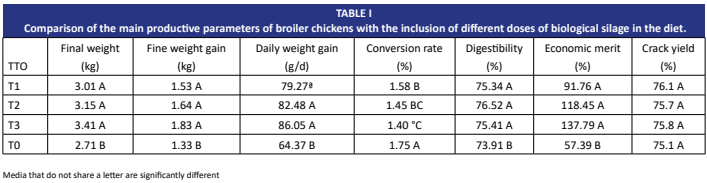
El uso de subproductos de la acuicultura transformados en ensilado biológico representa una alternativa ambiental sostenible para mejorar la eficiencia y el rendimiento de los sistemas de producción de pollos de engorde. Sin embargo, la evidencia científica sobre la eficacia del ensilado biológico formulado a partir de desechos de Penaeus vannamei en la nutrición de pollos de engorde sigue siendo escasa. Por lo tanto, este estudio tuvo como objetivo evaluar los efectos del ensilado biológico fermentado con bacterias nativas en el rendimiento productivo, la eficiencia de conversión alimenticia y la salud intestinal de pollos de engorde durante las fases de crecimiento y finalización. Se utilizó un diseño completamente aleatorizado con prueba de comparación múltiple de Tukey con cuatro tratamientos (0 %, 10 %, 15 % y 20 % de ensilado biológico). Las variables evaluadas incluyeron ganancia de peso corporal, índice de conversión alimenticia, digestibilidad aparente, rendimiento de la canal, valor económico y morfología intestinal. En conclusión, el uso de ensilado biológico de P. vannamei fermentado con bacterias nativas representa una estrategia nutricional sustentable y rentable que mejora el desempeño del pollo de engorde, promueve la producción sustentable utilizando desechos del procesamiento de la acuicultura y reduce los costos de producción, ofreciendo un alimento nutritivo y funcional.
Descargas
Citas
Abro Z, Kassie M, Tanga CM, Beesigamukama D, Diiro G. Socio-economic and environmental implications of replacing conventional poultry feed with insect-based feed in Kenya. J. Cleaner Prod. [Internet]. 2020; 265:121871. doi: https://doi.org/gg3dds DOI: https://doi.org/10.1016/j.jclepro.2020.121871
Ojewola GS, Okoye FC, Ukoha OA. Comparative Utilization of Three Animal Protein Sources by Broiler Chickens. Int. J. Poult. Sci. [Internet]. 2025; 4(7):462-467. doi: https://doi.org/fnd7s4 DOI: https://doi.org/10.3923/ijps.2005.462.467
Shabani A, Boldaji F, Dastar B, Ghoorchi T, Zerehdaran S, Ashayerizadeh A. Evaluation of increasing concentrations of fish waste silage in diets on growth performance, gastrointestinal microbial population, and intestinal morphology of broiler chickens. Anim. Feed Sci. Technol. [Internet]. 2021; 275:114874. doi: https://doi.org/qgd2 DOI: https://doi.org/10.1016/j.anifeedsci.2021.114874
Zulfan Z, Allaily A, Armya Y, Fitri CAF, Jeksi S, Primasari R, Afriyandi KN. Can the use of marlin fish by-product meal affect the performances of broiler chickens and the economic value of production? Rev. Acad. Ciênc. Anim. [Internet]. 2025; 23: e23002. doi: https://doi.org/qgd3 DOI: https://doi.org/10.7213/acad.2025.23002
Gaviria YSG, Figueroa OA, Zapata JE. Efecto de la inclusión de ensilado químico de vísceras de tilapia roja (Oreochromis spp.) en dietas para pollos de engorde sobre los parámetros productivos y sanguíneos. Inf. Tecnol. [Internet]. 2021; 32(3):79-88. doi: https://doi.org/n8m8 DOI: https://doi.org/10.4067/S0718-07642021000300079
Fernández-Herrero A. Ensilados químicos y biológicos. Una alternativa de aprovechamiento integral y sustentable de los residuos pesqueros en la Argentina. Marine Fish. Sci. [Internet]. 2021; 34(2):235-262. doi: https://doi.org/qgd4 DOI: https://doi.org/10.47193/mafis.3422021010603
Cooney R, de Sousa DB, Fernández-Ríos A, Mellett S, Rowan NJ, Morse AP, Hayes M, Laso J, Regueiro L, Alex HL, Wan AH, Clifford E. A circular economy framework for seafood waste valorisation to meet challenges and opportunities for intensive production and sustainability. J. Cleaner Prod. [Internet]. 2023; 392:136283. doi: https://doi.org/gwkr83 DOI: https://doi.org/10.1016/j.jclepro.2023.136283
Castillo-García WE, Sánchez-Suárez HA, Ochoa-Mogollón GM. Evaluación del ensilado de residuos de pescado y de cabeza de langostino fermentado con Lactobacillus fermentus aislado de cerdo. Rev. Investig. Vet. Perú [Internet]. 2020; 30(4):1456-1469. doi: https://doi.org/n8nm DOI: https://doi.org/10.15381/rivep.v30i4.17165
Fileto JB, Nepomuceno RC, Gomes TR, Silva VS, Dos Santos EO, De Souza OF, Watanabe GCA, De Oliveira Lima PJD, Freitas ER. Nutritional evaluation of shrimp waste and its inclusion in laying diet for meat-type quails. An. Acad. Bras. Ciênc. [Internet]. 2024; 96(3):e20230934. doi: https://doi.org/qgd6 DOI: https://doi.org/10.1590/0001-3765202420230934
Routray W, Orsat V. Plant By-Products and Food Industry Waste: A Source of Nutraceuticals and Biopolymers. In: Grumezescu AM, Holban AM (editors). Handbook of Food Bioengineering. Food Bioconversion. Ámsterdam, Países Bajos: Academic Press. [Internet]. 2017; 279-315 p. doi: https://doi.org/qgd7 DOI: https://doi.org/10.1016/B978-0-12-811413-1.00008-5
Rossi N, Grosso C, Delerue-Matos C. Shrimp Waste Upcycling: Unveiling the Potential of Polysaccharides, Proteins, Carotenoids, and Fatty Acids with Emphasis on Extraction Techniques and Bioactive Properties. Mar. Drugs. [Internet]. 2024; 22(4):153. doi: https://doi.org/qgd8 DOI: https://doi.org/10.3390/md22040153
Fotodimas I, Ioannou Z, Kanlis G. A Review of the Benefits of the Sustainable Utilization of Shrimp Waste to Produce Novel Foods and the Impact on Human Health. Sustainability. [Internet]. 2024; 16(16):6909. doi: https://doi.org/qgd9 DOI: https://doi.org/10.3390/su16166909
Taheri A, Abedian Kenari A, Aftabgard M. Partial Replacement of Fish Meal With Shrimp Waste Meal: Effects on Growth, Digestibility, and Immunity in Juvenile Beluga Sturgeon (Huso huso). Aquac. Res. [Internet]. 2025; 2025:5469830. doi: https://doi.org/qgfh DOI: https://doi.org/10.1155/are/5469830
Verardo V, Gómez-Caravaca AM, Tabanelli G. Bioactive Components in Fermented Foods and Food By-Products. Foods. [Internet]. 2020; 9(2):153. doi: https://doi.org/gt57pn DOI: https://doi.org/10.3390/foods9020153
Guimarães CC, Nóbrega TC, de Almeida Santos AN, Barai AA, Dos Santos Mourão L, da Silva Gomes MF, de Souza Ferreira W, de Lima Chaves FA, da Silva Junior JL, de Freitas Mendonça MA, da Silva AJI, Rufino JPF, de Oliveira AT. Biological silage from tambaqui (Colossoma macropomum) by-products on the productive performance, hematological parameters and egg quality of older commercial hens. Trop. Anim. Health Prod. [Internet]. 2025; 57(1):20. doi: https://doi.org/qgfj DOI: https://doi.org/10.1007/s11250-024-04273-8
Abelti AL. Evaluation of small barbus silage through inclusion into commercially formulated poultry feed. Int. J. Poul. Fish. Sci. [Internet]. 2018; 2(1):1–7. doi: https://doi.org/qgfk DOI: https://doi.org/10.15226/2578-1898/2/1/00105
Mogollón GO, Ordinola-Zapata A, Sanchez-Ochoa G, Vieyra-Peña E, Palacios-Pinto G, Sánchez-Suárez H. Efecto del ensilado biológico de cabeza de Litopenaeus vannamei en la composición microbiana intestinal y la salud de gallinas ponedoras. Rev. Cient. FCV-LUZ. [Internet]. 2025; 35(1):e35549. doi: https://doi.org/qgfm
Ramírez-Ramírez JC, Loya-Olguín JL, Ulloa JA, Rosas-UlloaP, Gutiérrez-Leyva R, Silva-Carrillo Y. Aprovechamiento de desechos de pescado y cáscara de piña para producir ensilado biológico. Abanico Vet. [Internet]. 2020; 10:e29. doi: https://doi.org/qgfp DOI: https://doi.org/10.21929/abavet2020.29
Samaddar A, Kaviraj A. Processing of fish offal waste through fermentation utilizing whey as inoculum. Int. J. Recycl. Org. Waste Agric. [Internet]. 2014; 3(1):45. doi: https://doi.org/g4m7nt DOI: https://doi.org/10.1007/s40093-014-0045-3
Abun A, Rusmana D, Haetami K, Widjastuti T. Evaluation of the nutritional value of fermented pangasius fish waste and its potential as a poultry feed supplement. Vet. World. [Internet]. 2025; 18(2):355–366. doi: https://doi.org/qgft DOI: https://doi.org/10.14202/vetworld.2025.355-366
Haider MS, Ashraf M, Azmat H, Khalique A, Javid A, Atique U, Zia M, Iqbal KJ, Akran S. Nutritive evaluation of fish acid silage in Labeo rohita fingerlings feed. J. Appl. Anim. Res. [Internet]. 2015; 44(1):158–164. doi: https://doi.org/gnn455 DOI: https://doi.org/10.1080/09712119.2015.1021811
Deng ZC, Cao KX, Huang YX, Peng Z, Zhao L, Yi D, Liu M, Sun LH. Comprehensive cultivation of the broiler gut microbiota guides bacterial isolation from chickens. Sci. China Life Sci. [Internet]. 2025; 68(3):836–845. doi: https://doi.org/qgfw DOI: https://doi.org/10.1007/s11427-024-2735-8
Abun A, Rusmana D, Widjastuti T, Haetami K. PrebioticsBLS from encapsulated of extract of shrimp waste bioconversion on feed supplement quality and its implication of metabolizable energy and digestibility at Indonesian local chicken. J. Appl. Anim. Res. [Internet]. 2021; 49(1):295–303. doi: https://doi.org/qgfz DOI: https://doi.org/10.1080/09712119.2021.1946402
Mao X, Guo N, Sun J, Xue C. Comprehensive utilization of shrimp waste based on biotechnological methods: A review. J. Clean. Prod. [Internet]. 2017; 143:814–823. doi: https://doi.org/f9prbz DOI: https://doi.org/10.1016/j.jclepro.2016.12.042
Mironenko GA, Zagorskii IA, Bystrova NA, Kochetkov KA. The Effect of a Biostimulant Based on a Protein Hydrolysate of Rainbow Trout (Oncorhynchus mykiss) on the Growth and Yield of Wheat (Triticum aestivum L.).Molecules. [Internet]. 2022; 27(19):6663. doi: https://doi.org/qgf2 DOI: https://doi.org/10.3390/molecules27196663
Nkosi BD, Ncobela CN, Thomas R, Malebana IMM, Müller F, Álvarez S, Meeske R. Microbial Inoculation to High Moisture Plant By-Product Silage: A Review In: Babinszky L, Oliveira J, Santos EM (editors). Advanced Studies in the 21st Century Animal Nutrition. Vet. Med. Sci. London: IntechOpen; 2021; 1-18. doi: https://doi.org/qgf6
Makala H. Impact of Selected Feed Additives in Broiler Nutrition on Breeding and the Meat Quality Features. In: Babinszky L, Oliveira J, Santos EM (editors). Advanced Studies in the 21st Century Animal Nutrition. Vet. Med. Sci. London: IntechOpen; 2021; 1-17. doi: https://doi.org/qgpc DOI: https://doi.org/10.5772/intechopen.99099
Moreno-Sader KA, Martínez-Consuegra JD, González-Delgado ÁD. Development of a biorefinery approach for shrimp processing in North-Colombia: Process simulation and sustainability assessment. Environ. Technol. Innov. [Internet]. 2021; 22:101461. doi: https://doi.org/gk6rmx DOI: https://doi.org/10.1016/j.eti.2021.101461
García PP, Ortiz JQ, Mogollón GO, Suárez HS. Biological silage of shrimp waste fermented with lactic acid bacteria: Use as a biofertilizer in pasture crops and as feed for backyard pigs. Sci. Agropecu. [Internet]. 2020; 11(4):459–471. doi: https://doi.org/qgpf DOI: https://doi.org/10.17268/sci.agropecu.2020.04.01
Leontopoulos S, Skenderidis P, Petrotos K, Giavasis I. Corn Silage Supplemented with Pomegranate (Punica granatum) and Avocado (Persea americana) Pulp and Seed Wastes for Improvement of Meat Characteristics in Poultry Production. Molecules. [Internet]. 2021; 26(19):5901. doi: https://doi.org/qgpg DOI: https://doi.org/10.3390/molecules26195901
Bezerra RA, Fonseca GG. Microbial count, chemical composition and fatty acid profile of biological silage obtained from pacu and spotted sorubim fish waste using lactic acid bacteria fermentation. Biocatal. Agric. Biotechnol. [Internet]. 2023; 54:102929. doi: https://doi.org/qgt8 DOI: https://doi.org/10.1016/j.bcab.2023.102929
Sun HY, Zhou HB, Liu Y, Wang Y, Zhao C, Xu LM. Comparison of organic acids supplementation on the growth performance, intestinal characteristics and morphology, and cecal microflora in broilers fed corn-soybean meal diet. Anim. Biosci. [Internet]. 2022; 35(11):1689–1697. doi: https://doi.org/qgvb DOI: https://doi.org/10.5713/ab.21.0448
Mebratu AT, Asfaw YT, Janssens GPJ. Exploring the functional and metabolic effects of adding garra fish meal to a plant-based broiler chicken diet. Trop. Anim. Health Prod. [Internet]. 2022; 54(3):196. doi: https://doi.org/qgvg DOI: https://doi.org/10.1007/s11250-022-03200-z
Al-Marzooqi W, Al-Farsi M, Kadim IT, Mahgoub O, Goddard JS. The Effect of Feeding Different Levels of Sardine Fish Silage on Broiler Performance, Meat Quality and Sensory Characteristics under Closed and Open-sided Housing Systems. AsianAustralas. J. Anim. Sci. [Internet]. 2010; 23(12):1614–1625. doi: https://doi.org/c3fv8m DOI: https://doi.org/10.5713/ajas.2010.10119
Safari R, Zadeh ZY, Saz ZB, Poul SR, Jafari A, Abbaszadeh MM. Evaluation of quality and chemical spoilage indicators of biological silage produced from chicken waste and its comparison with meat powder, blood powder and kilka fish powder. J. Food Sci. Technol. Iran. [Internet]. 2022; 18(121):203–213. doi: https://doi.org/n8ng DOI: https://doi.org/10.52547/fsct.18.121.16
Tanuja S, Kumar A, Nayak SK, Sarkar A. Effect of dietary supplementation of acid ensiled fish waste on the growth, carcass quality and serum biochemistry in «vanraja» chicken. Indian Vet. J. [Internet]. 2016 [cited 23 Jun 2025]; 93(10):45–47. Available in: https://goo.su/Rezj4
Rodríguez T, Montilla JJ, Bello RA. Ensilado de pescado a partir de la fauna de acompañamiento del camarón. II. Prueba de comportamiento en pollos de engorde. Arch. Latinoam. Nutr. [Internet]. 1990 [cited 23 Jun 2025]; 40(4):548–559. Available in: https://goo.su/pIjkJH
Cunha GTG, Ludke MCMM, Ludke JV, Rabello CBV, Barros JS, Santos JS. Metabolizabilidade da energia de farinhas mistas contendo silagem de peixes para frangos de corte. Arq. Bras. Med. Vet. Zootec. [Internet] 2017; 69(3):704– 710. doi: https://doi.org/qgvn DOI: https://doi.org/10.1590/1678-4162-8991
Boitai SS, Babu LK, Pati PK, Pradhan CR, Tanuja S, Kumar A, Kumar P. Effect of dietary incorporation of fish silage on growth performance, serum biochemical parameters and carcass characteristics of broiler chicken. Indian J. Anim. Res. [Internet] 2018; 52(7):1005-1009. doi: https://doi.org/qgvp DOI: https://doi.org/10.18805/ijar.B-3315
Ibrahim D, Abdelfattah-Hassan A, Arisha AH, El-Aziz RMA, Sherief WRIA, Adli SH, El Sayed R, Metwally AE. Impact of feeding anaerobically fermented feed supplemented with acidifiers on its quality and growth performance, intestinal villi and enteric pathogens of mulard ducks. Livest. Sci. [Internet]. 2020; 242:104299. doi:: https://doi.org/qgvq DOI: https://doi.org/10.1016/j.livsci.2020.104299
Dowarah R, Verma AK, Agarwal N, Singh P, Singh BR. Selection and characterization of probiotic lactic acid bacteria and its impact on growth, nutrient digestibility, health and antioxidant status in weaned piglets. PLoS One. [Internet]. 2018; 13(3):e0192978. doi: https://doi.org/ghggbv DOI: https://doi.org/10.1371/journal.pone.0192978