Frecuencia de serovariedades de Salmonella tifoidea y no tifoidea en la iguana verde bajo manejo en cautiverio en Chiapas, México
Resumen
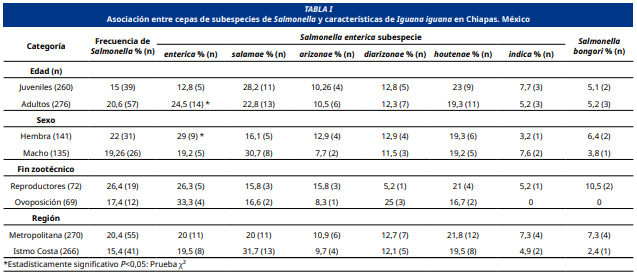
La salmonelosis es una zoonosis de relevancia en la salud pública mundial, ocasionada por bacterias del género Salmonella. La iguana verde, frecuentemente mantenida en cautiverio, puede actuar como portadora de Salmonella tifoidea y no tifoidea, lo que representa un riesgo zoonótico. Sin embargo, hasta ahora no se había documentado su presencia en Unidades de Manejo para la Conservación de la Vida Silvestre. El objetivo de este estudio fue determinar la frecuencia de subespecies y serovariedades de Salmonella, así como su perfil de susceptibilidad antimicrobiana, en iguana verde en cautiverio en Chiapas, México. Se realizó un estudio transversal entre otoño del 2017 y primavera de 2023, recolectando muestras de heces cloacales de 536 ejemplares. La identificación de subgrupos y serovariedades se llevó a cabo mediante la técnica de reacción en cadena de la polimerasa, y la susceptibilidad antimicrobiana se evaluó mediante el método de difusión en disco. Los análisis estadísticos se efectuaron con las pruebas exacta de Fisher y Chi-cuadrado en IBM SPSS. La frecuencia global de Salmonella fue de 17,9 %. El 79,1 % fueron subespecies no entéricas (salamae, houtenae, diarizonae, arizonae e indica), mientras que el 20,8 % de los aislamientos correspondieron a S. enterica subsp. enterica. De estas el 42,1 % correspondieron a la serovariedad Typhi, 21 % Typhimurium, 15,7 % Enteritidis y 5,2 % Paratyphi. Además, el 57,9 % de las cepas de subsp. enterica resultaron resistentes a ampicilina, y el 32,3 % mostraron multirresistencia, asociada al gen blaTEM. Este estudio reveló la circulación de Salmonella tifoidea y no tifoidea en iguana verde de Unidades de Manejo para la Conservación de la Vida Silvestre, lo que subraya un riesgo para la salud pública y la necesidad de reforzar medidas de bioseguridad.
Descargas
Citas
Sahu AA, Sephalika S, Mohakud NK, Sahu BR. Prevalence and multidrug resistance in non-typhoidal Salmonella in India: A 20-year outlook. Acta Microbiol. Hell. [Internet]. 2025; 70(1):6. doi: https://doi.org/qzs9 DOI: https://doi.org/10.3390/amh70010006
Onyeke BO, Nahed B. Pathogenicity, epidemiology, and advances in the treatment of multidrug-resistant Salmonella infections: A narrative review. Glob. Acad. J. Med. Sci. [Internet]. 2025; 7(3):102-114. doi: https://doi.org/qztb DOI: https://doi.org/10.36348/gajms.2025.v07i03.005
Buzilă ER, Dorneanu OS, Trofin F, Sima CM, Iancu LS. Assessing Salmonella Typhi pathogenicity and prevention: The crucial role of vaccination in combating typhoid fever. Int. J. Mol. Sci. [Internet], 2025; 26(9):3981. doi: https://doi.org/qztd DOI: https://doi.org/10.3390/ijms26093981
García DJ, Moura D, Grispoldi L, Cenci GB, Saraiva S, Silva F, Saraiva C, Ausina J. Salmonella spp. in domestic ruminants, evaluation of antimicrobial resistance based on the One Health approach-A systematic review and meta-analysis. Vet. Sci. [Internet]. 2024; 11(7):315. doi: https://doi.org/qztg DOI: https://doi.org/10.3390/vetsci11070315
Pees M, Brockmann M, Steiner N, Marschang RE. Salmonella in reptiles: a review of occurrence, interactions, shedding and risk factors for human infections. Front. Cell. Dev. Biol. [Internet]. 2023; 11:1251036. doi: https://doi.org/qzth DOI: https://doi.org/10.3389/fcell.2023.1251036
Benabdallah R, Saoudi H, Matallah F, Ebani VV, Ayachi A, Aoun L. Reptile trade and chelonians-associated Salmonellosis in humans: A public health concern. Comp. Immunol. Microbiol. Infect. Dis. [Internet]. 2025; 117:102305. doi: https://doi.org/qztj DOI: https://doi.org/10.1016/j.cimid.2025.102305
McWhorter AR, Whiley H. Zoonotic risks: Salmonella and Campylobacter in reptiles. Microbiol. Australia [Internet]. 2025; 46:34-37. doi: https://doi.org/qztk DOI: https://doi.org/10.1071/MA25011
Arcos GJL, Reynoso RVH, Mendoza MGD, Hernández SD. Identificación del sexo y medición del crecimiento en iguana negra (Ctenosaura pectinata) en las etapas de cría y juvenil. Vet. México [Internet]. 2005 [consultado 22 Ago 2025]; 36(1):53-62. Disponible en: https://goo.su/ZeEtrU
Gutiérrez JJ, Luna CLM, Mendoza OMI, Díaz MGJ, Burguete GJC, Feliciano GJM. Organización, mantenimiento y preservación de la Colección de Cultivos Bacterianos del Instituto de Ciencias Biológicas de la Universidad de Ciencias y Artes de Chiapas (UNICACH), México. Rev. Soc. Venezolana Microbiol. [Internet]. 2015 [consultado 18 Sep 2025]; 35:95-102. Disponible en: https://goo.su/VnwuZ
Lee K, Iwata T, Shimizu M, Taniguchi T, Nakadai A, Hirota Y, Hayashidani H. A novel multiplex PCR assay for Salmonella subspecies identification. J. Appl. Microbiol. [Internet]. 2009; 107(3): 805-811. doi: https://doi.org/bvdv44 DOI: https://doi.org/10.1111/j.1365-2672.2009.04263.x
Kumar S, Balakrishna K, Batra HV. Detection of Salmonella enterica serovar Typhi (S. Typhi) by selective amplification of invA, viaB, fliC-d and prt genes by polymerase chain reaction in mutiplex format. Lett. Appl. Microbiol. [Internet]. 2006; 42(2):149-154. doi: https://doi.org/fnpw7r DOI: https://doi.org/10.1111/j.1472-765X.2005.01813.x
O'Regan E, McCabe E, Burgess C, McGuinness S, Barry T, Duffy G, Whyte P, Fanning S. Development of a real-time multiplex PCR assay for the detection of multiple Salmonella serotypes in chicken samples. BMC Microbiol. [Internet]. 2008; 8:156. doi: https://doi.org/fq6wj6 DOI: https://doi.org/10.1186/1471-2180-8-156
Ahmed AM, Motoi Y, Sato M, Maruyama A, Watanabe H, Fukumoto Y, Shimamoto T. Zoo animals as reservoirs of gram-negative bacteria harboring integrons and antimicrobial resistance genes. Appl. Environ. Microbiol. [Internet]. 2007; 73(20):6686-6690. doi: https://doi.org/c7dgx9 DOI: https://doi.org/10.1128/AEM.01054-07
Gray JT, Hungerford LL, Fedorka-Cray PJ, Headrick ML. Extended-spectrum-cephalosporin resistance in Salmonella enterica isolates of animal origin. Antimicrob. Agents Chemother. [Internet]. 2004; 48(8):3179-3181. doi: https://doi.org/bpg2rb DOI: https://doi.org/10.1128/AAC.48.8.3179-3181.2004
Mazel D, Dychinco B, Webb VA, Davies J. Antibiotic resistance in the ECOR collection: integrons and identification of a novel aad gene. Antimicrob. Agents. Chemother. [Internet]. 2000; 44(6):1568-1574. doi: https://doi.org/bg4ktz DOI: https://doi.org/10.1128/AAC.44.6.1568-1574.2000
White PA, McIver CJ, Rawlinson WD. Integrons and gene cassettes in the Enterobacteriaceae. Antimicrob. Agents. Chemother. [Internet]. 2001; 45(9):2658-2661. doi: https://doi.org/dh4q56 DOI: https://doi.org/10.1128/AAC.45.9.2658-2661.2001
Clinical and Laboratory Standards Institute (CLSI). Performance standards for antimicrobial susceptibility testing. 30th ed. CLSI Supplement M100. Wayne (Penn, USA): CLSI, 2020 [consultado 18 Sep 2025]. Available in: https://goo.su/RSWFcz
Magiorakos AP, Srinivasan A, Carey RB, Carmeli Y, Falagas ME, Giske CG, Harbarth S, Hindler JF, Kahlmeter G, Olsson B, Paterson DL, Rice LB, Stelling J, Struelens MJ, Vatopoulos A, Weber JT, Monnet DL. Multidrug-resistant, extensively drug-resistant and pandrug-resistant bacteria: An international expert proposal for interim standard definitions for acquired resistance. Clin. Microbiol. Infect. [Internet]. 2012; 18(3):268-281. doi: https://doi.org/bbqpzj DOI: https://doi.org/10.1111/j.1469-0691.2011.03570.x
Prud'homme Y, Burton FJ, McClave C, Calle PP. Prevalence, incidence, and identification of Salmonella enterica from wild and captive Grand Cayman iguanas (Cyclura lewisi). J. Zoo Wildl. Med. [Internet]. 2018; 49(4):959-966. doi: https://doi.org/qztp DOI: https://doi.org/10.1638/2017-0234.1
Lukac M, Pedersen K, Prukner RE. Prevalence of Salmonella in captive reptiles from Croatia. J. Zoo Wildl. Med. [Internet]. 2015; 46(2):234-240. doi: https://doi.org/f7f2k2 DOI: https://doi.org/10.1638/2014-0098R1.1
Bruning AH, van den Beld M, Laverge J, Welkers MR, Kuil SD, Bruisten SM, van Dam AP, Stam AJ. Reptile-associated Salmonella urinary tract infection: a case report. Diagn. Microbiol. Infect. Dis. [Internet]. 2023; 105(4):115889. doi: https://doi.org/qztq DOI: https://doi.org/10.1016/j.diagmicrobio.2022.115889
Roncarati D, Vannini A, Scarlato V. Temperature sensing and virulence regulation in pathogenic bacteria. Trends. Microbiol. [Internet]. 2025; 33(1):66-79. doi: https://doi.org/g8jhp8 DOI: https://doi.org/10.1016/j.tim.2024.07.009
Rabiu AG, Fadiji O, Adesoji AT, Jimoh SO, Cho S. A review of the environmental spread of Salmonella enterica serovars through water in Africa. Lett. Appl. Microbiol. [Internet]. 2025; 78(2):ovaf005. doi: https://doi.org/qztr DOI: https://doi.org/10.1093/lambio/ovaf005
Godínez OA, Sampedro F, Bowman JP, Garcés VF, Hernández IM. Risk ranking of food categories associated with Salmonella enterica contamination in the central region of Mexico. Risk Anal. [Internet]. 2023; 43(2):308-323. doi: https://doi.org/g4n5mp DOI: https://doi.org/10.1111/risa.13907
Oludairo OO, Kwaga JK, Kabir J, Abdu PA, Gitanjali A, Perrets A, Cibin V, Lettini AA, Aiyedun JO. Ecology and epidemiology of Salmonella spp. isolated from the environment and the roles played by wild animals in their maintenance. Int. J. One Health [Internet]. 2023; 9(1):1-9. doi: https://doi.org/qzts DOI: https://doi.org/10.14202/IJOH.2023.1-9
Goetz MJ, Schmidt, Weissenbacher A. EAZA Best Practice Guidelines for the Lesser Antillean iguana (Iguana delicatissima). European Association of Zoos and Aquariums, Amsterdam (Netherlands): EAZA Reptile Taxon Advisory Group. 2023. 55 p. doi: https://doi.org/qztt
Song DH, He X, Chi Y, Zhang Z, Shuai J, Wang H, Li Q, Du M. Cytotoxicity and antimicrobial resistance of Salmonella enterica subspecies isolated from raised reptiles in Beijing, China. Animals [Internet]. 2023; 13(2):315. doi: https://doi.org/qztw DOI: https://doi.org/10.3390/ani13020315
Khan M, Shamim S. Understanding the mechanism of antimicrobial resistance and pathogenesis of Salmonella enterica serovar Typhi. Microorganisms [Internet]. 2022; 10(10):2006. doi: https://doi.org/qztx DOI: https://doi.org/10.3390/microorganisms10102006
Liu M, Zhu K, Li X, Han Y, Yang C, Liu H, Du X, Xu X, Yang H, Song H, Qiu S, Xiang Y. Genetic characterization of a Salmonella enterica serovar typhimurium isolated from an infant with concurrent resistance to ceftriaxone, ciprofloxacin and azithromycin. J. Global Antimicrob. Resist. [Internet]. 2023; 35:252-256. doi: https://doi.org/qztz DOI: https://doi.org/10.1016/j.jgar.2023.09.016
Sunagawa SW, Christopherson C, Bergman SJ, Miller MМ, Keintz MR, Wahlig TA, Fey P, Van Schooneveld TC. Rise of the (possible) resistance: a review of susceptibility patterns for nontyphoidal Salmonella enterica in Nebraska. Antimicrob. Steward. Healthc. Epidemiol. [Internet]. 2023; 3(1):e181. doi: https://doi.org/qzt2 DOI: https://doi.org/10.1017/ash.2023.464
Oh H, Choi Y, Lee J. Antibiotic-resistant Salmonella in animal products jeopardize human health. Food Sci. Anim. Resour. [Internet]. 2025; 45(2):409-428. doi: https://doi.org/qzt3 DOI: https://doi.org/10.5851/kosfa.2025.e4
Edris SN, Hamad A, Awad DA, Sabeq II. Prevalence, antibiotic resistance patterns, and biofilm formation ability of Enterobacterales recovered from food of animal origin in Egypt. Vet. World. [Internet]. 2023; 16(2):403-413. doi: https://doi.org/g5shzk DOI: https://doi.org/10.14202/vetworld.2023.403-413
Yebouet AC, Fossou KR, Kouadjo ZC, Okoh AI, Zézé A. Genetic diversity, Extended-Spectrum Beta-Lactamase (ESBL) screening, and potential public health implications of gram-negative bacteria recovered from man-made lakes and surrounding vegetables. Microorganisms [Internet]. 2025; 13(9):1997. doi: https://doi.org/qzt4 DOI: https://doi.org/10.3390/microorganisms13091997
Lamichhane B, Mawad AM, Saleh M, Kelley WG, Harrington PJ, Lovestad CW, Amezcua J, Sarhan MM, El Zowalaty ME, Ramadan H, Morgan M, Helmy YA. Salmonellosis: an overview of epidemiology, pathogenesis, and innovative approaches to mitigate the antimicrobial resistant infections. Antibiotics [Internet]. 2024; 13(1):76. doi: https://doi.org/g8rpmg DOI: https://doi.org/10.3390/antibiotics13010076