Supervivencia de patógenos en bebidas fermentadas probióticas lácteas y de origen vegetal que contienen Lacticaseibacillus rhamnosus GG
Resumen
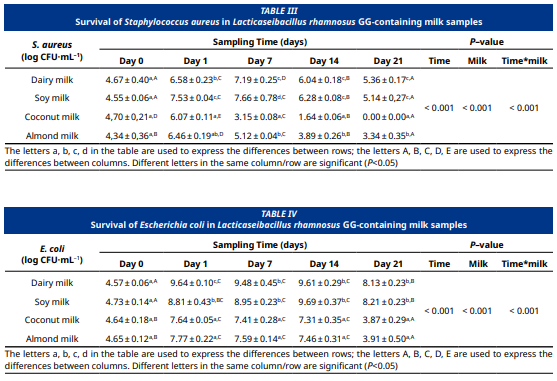
La supervivencia de Lacticaseibacillus rhamnosus GG y de dos patógenos transmitidos por alimentos (Staphylococcus aureus y Escherichia coli) se evaluó en leche láctea suplementada con L. rhamnosus GG y en tres alternativas vegetales a la leche (soja, almendra y coco). Las determinaciones microbiológicas se realizaron durante la fermentación (24 horas) y el almacenamiento refrigerado (21 días, 4°C), utilizando el grupo de leche de vaca suplementada con L. rhamnosus GG como matriz de referencia para la comparación. En todas las matrices, L. rhamnosus GG mantuvo recuentos superiores a 7 log UFC·mL–1 durante todo el período experimental. No se observaron diferencias significativas en los recuentos de L. rhamnosus GG entre la leche de vaca y las leches de origen vegetal (P>0,05). Aunque el tiempo, el tipo de leche y su interacción mostraron efectos estadísticamente significativos (P<0,05), estos cambios no se tradujeron en una pérdida de la viabilidad de L. rhamnosus GG, manteniéndose los recuentos estables en todos los tipos de leche durante el almacenamiento. Al día 21, los recuentos de aureus y E. coli fueron menores en las leches de almendra y coco en comparación con la leche de soja y la leche láctea (P<0,05). En conjunto, las alternativas vegetales a la leche en particular las de almendra y coco mostraron ser vehiculos eficaces de L. rhamnosus GG y presentaron un desempeño comparable al de la leche de vaca en el mantenimiento de la viabilidad probiótica. Dado que la reducción de patógenos fue dependiente de la matriz, futuros estudios deberían profundizar en las interacciones matriz-microorganismo y validar estos hallazgos a escala industrial mediante análisis microbiológicos, fisicoquímicos y composicionales integrados.
Descargas
Citas
Paul AA, Kumar S, Kumar V, Sharma R. Milk Analog: Plant based alternatives to conventional milk, production, potential and health concerns. Crit. Rev. Food Sci. Nutr. [Internet]. 2020; 60(18):3005–3023. doi: https://doi.org/gj33hn DOI: https://doi.org/10.1080/10408398.2019.1674243
Zahrani AJA, Shori AB. Viability of probiotics and antioxidant activity of soy and almond milk fermented with selected strains of probiotic Lactobacillus spp. LWT 2023; 176:114531. doi: https://doi.org/g6jmr8 DOI: https://doi.org/10.1016/j.lwt.2023.114531
Ranadheera RDCS, Baines SK, Adams MC. Importance of food in probiotic efficacy. Food Res. Int. [Internet]. 2010; 43(1):1–7. doi: https://doi.org/cwcsx8 DOI: https://doi.org/10.1016/j.foodres.2009.09.009
Craig WJ, Fresán U. International analysis of the nutritional content and a review of health benefits of non-dairy plant-based beverages. Nutrients [Internet]. 2021; 13(3):842. doi: https://doi.org/gqzs25 DOI: https://doi.org/10.3390/nu13030842
Kyrylenko A, Eijlander RT, Alliney G, Lucas-van de Bos E, Wells-Bennik MHJ. Levels and types of microbial contaminants in different plant-based ingredients used in dairy alternatives. Int. J. Food Microbiol. [Internet]. 2023; 407:110392. doi: https://doi.org/gszqzb DOI: https://doi.org/10.1016/j.ijfoodmicro.2023.110392
Rasika DMD, Vidanarachchi JK, Luiz SF, Azeredo DRP, Cruz AG, Ranadheera CS. Probiotic delivery through non-dairy plant-based food matrices. Agriculture [Internet]. 2021; 11(7):599. doi: https://doi.org/qx29 DOI: https://doi.org/10.3390/agriculture11070599
Abebe E, Gugsa G, Ahmed M. Review on major food–borne zoonotic bacterial pathogens. J. Trop. Med. [Internet]. 2020; 2020:4674235. doi: https://doi.org/gmq43k DOI: https://doi.org/10.1155/2020/4674235
Fetsch A, Johler S. Staphylococcus aureus as a foodborne pathogen. Curr. Clin. Microbiol. Rep. [Internet]. 2018; 5:88–96. doi: https://doi.org/qx3b DOI: https://doi.org/10.1007/s40588-018-0094-x
Lorenzo JM, Munekata PE, Dominguez-Valencia R, Pateiro M, Saraiva JA, Franco D. Main groups of microorganisms of relevance for food safety and stability: General aspects and overall description. In: Barba FJ, Santana AS, Orlien V, Koubaa M, editors. Innovative technologies for food preservation. London (UK): Academic Press; 2018 [cited 20 Dec 2025]. p. 53–107. Available in: https://goo.su/H0F4 DOI: https://doi.org/10.1016/B978-0-12-811031-7.00003-0
Yeşilova Y, Sula B, Yavuz E, Uçmak D. Probiyotikler [Probiotics]. J. Kartal TR. 2010; 21(1):49–56. https://goo.su/EsJ6t DOI: https://doi.org/10.5799/ahinjs.01.2010.01.0013
Tomasello F, Valero A, Serraino A, Possas A. Methods of inoculation and quantification for collecting data on microbial responses in foods. In: Alvarenga VO, editor. Basic protocols in predictive food microbiology. New York (USA): Springer; 2023. p. 31–46. doi: https://doi.org/qx7z DOI: https://doi.org/10.1007/978-1-0716-3413-4_2
Tekinşen OC, Atasever M, Keleş A, Tekinşen KK. Süt, Yoğurt, Tereyağı, Peynir: Üretim control [Milk, Yogurt, Butter, Cheese: Production control]. Konya (Türkiye): Selçuk University Press; 2002. 91 p. Turkish.
Kılınç GE, Keser A, Özer HB. Determination of nutritional value, antioxidant activities, microbiological and sensory properties of almond, soy and oat based fermented beverages. J. Culin. Sci. Technol. [Internet]. 2026; 24(1):16–32. doi: https://doi.org/qx75 DOI: https://doi.org/10.1080/15428052.2025.2477570
Fatima SM, Hekmat S. Microbial and sensory analysis of soy and dairy milk-based yogurt as a probiotic matrix for Lactobacillus rhamnosus GR–1. Fermentation [Internet]. 2020; 6(3):74. doi: https://doi.org/qx76 DOI: https://doi.org/10.3390/fermentation6030074
Bouarab-Chibane L, Degraeve P, Ferhout H, Bouajila J, Oulahal N. Plant antimicrobial polyphenols as potential natural food preservatives. J. Sci. Food Agric. [Internet]. 2019; 99(4):1457–1474. doi: https://doi.org/gkf5jt DOI: https://doi.org/10.1002/jsfa.9357
Nitbani FO, Tjitda PJP, Nitti F, Jumina J, Detha AIR. Antimicrobial properties of lauric acid and monolaurin in virgin coconut oil: a review. ChemBioEng. Rev. [Internet]. 2022; 9(5):442–461. doi: https://doi.org/qx78 DOI: https://doi.org/10.1002/cben.202100050
Mandalari G, Bisignano C, D’Arrigo M, Ginestra G, Arena A, Tomaino A, Wickham MSJ. Antimicrobial potential of polyphenols extracted from almond skins. Lett. Appl. Microbiol. [Internet]. 2010; 51(1):83–89. doi: https://doi.org/d3kk9r DOI: https://doi.org/10.1111/j.1472-765X.2010.02862.x
Eyres L, Eyres MF, Chisholm A, Brown RC. Coconut oil consumption and cardiovascular risk factors in humans. Nutr. Rev. [Internet]. 2016; 74(4):267–280. doi: https://doi.org/f8jfvd DOI: https://doi.org/10.1093/nutrit/nuw002
Nasir NAMM, Abllah Z, Jalaludin AA, Shahdan IA, Abd-Manan WNHW. Virgin coconut oil and its antimicrobial properties against pathogenic microorganisms: a review. Adv. Health Sci. Res. [Internet]. 2018 [cited 13 Oct 2025]; 192–199. Available in: https://goo.su/ByKb DOI: https://doi.org/10.2991/idcsu-17.2018.51
Shori AB, Al Zahrani AJ. Non-dairy plant-based milk products as alternatives to conventional dairy products for delivering probiotics. Food Sci. Technol. [Internet]. 2022; 42:e101321. doi: https://doi.org/qx8c DOI: https://doi.org/10.1590/fst.101321
Jogi S, Adhao A, Pachori RR. Exploration of probiotic bacteria from plant based milk. Int. J. Res. Anal. Rev. [Internet]. 2024 [cited 22 Dec 2025]; 11(1):157–163. Available in: https://goo.su/xuUSjt
Genet BML, Xiao H, Christensen LF, Laforce IN, Mohammadifar MA, Bang-Berthelsen CH, Hansen EB. Selection of proteolytic LAB starter cultures for acidification of soy based dairy alternatives. LWT [Internet]. 2023; 184:115082. doi: https://doi.org/qx8h DOI: https://doi.org/10.1016/j.lwt.2023.115082
Montemurro M, Pontonio E, Coda R, Rizzello CG. Plant-based alternatives to yogurt: state-of-the-art and perspectives of new biotechnological challenges. Foods. [Internet]. 2021; 10(2):316. doi: https://doi.org/gt57q2 DOI: https://doi.org/10.3390/foods10020316
Yuyama KT, Rohde M, Molinari G, Stadler M, Abraham WR. Unsaturated fatty acids control biofilm formation of Staphylococcus aureus and other gram-positive bacteria. Antibiotics 2020; 9(11):788. doi: https://doi.org/qx8k DOI: https://doi.org/10.3390/antibiotics9110788
Kusumah D, Wakui M, Murakami M, Xie X, Yukihito K, Maeda I. Linoleic acid, α–linolenic acid, and monolinolenins as antibacterial substances in the heat-processed soybean fermented with Rhizopus oligosporus. Biosci. Biotechnol. Biochem. [Internet]. 2020; 84(6):1285–1290. doi: https://doi.org/qx8m DOI: https://doi.org/10.1080/09168451.2020.1731299
Demircan B. Probiyotik laktik asit bakterileri kullanılarak bitkisel süt ikamelerinden fermente içecek tasarımı [Production of novel vegetal based beverages fermented by probiotic lactic acid bacteria]. [master’s thesis on the Internet]. İstanbul (Türkiye): Istanbul Technical University; 2017 [cited 20 Jan 2026]. 99 p. Turkish. Available in: https://goo.su/Cd2kx
Deziderio MA, de Souza HF, Kamimura ES, Petrus RR. Plant-based fermented beverages: Development and characterization. Foods [Internet]. 2023; 12(22):4128. doi: https://doi.org/qx8n DOI: https://doi.org/10.3390/foods12224128
Erik S, Ergenekon FS. Lor Peynirlerine İlave Edilen Probiyotik Kültürlerin Bazı Patojen Mikroorganizmaların Yaşam Süreleri Üzerine Etkisinin Araştırılması [Investigation of the effect of probiotic cultures added in lor cheese on the life span of some pathogenic microorganisms]. Akademik Et ve Süt Kurumu Derg. [Internet]. 2024 [cited 20 Dec 2025]; (7):4–14. Turkish. Available in: https://goo.su/ETJn3A8
Okur HH. Probiyotik Lactobacillus rhamnosus GG (ATCC 53103) suşu kullanarak fermente süt ürünü üretimi [Production of fermented milk product by using probiotic Lactobacillus rhamnosus GG (ATCC 53103) strain]. [master’s thesis on the Internet]. İzmir (Türkiye): Ege University; 2022 [Cited 20 Jan 2026]. 114 p. Turkish. Available in: https://goo.su/XnFVno8
Wang X, Kong X, Zhang C, Hua Y, Chen Y, Li X. Comparison of physicochemical properties and volatile flavor compounds of plant-based yoghurt and dairy yoghurt. Food Res. Int. [Internet]. 2023; 164:112375. doi: https://doi.org/grs87k DOI: https://doi.org/10.1016/j.foodres.2022.112375
Masia C, Geppel A, Jensen PE, Buldo P. Effect of Lactobacillus rhamnosus on Physicochemical Properties of Fermented Plant-Based Raw Materials. Foods [Internet]. 2021; 10(3):573. doi: https://doi.org/gjp38f DOI: https://doi.org/10.3390/foods10030573
Yiğit AA. Animal and plant-based milk and their antioxidant properties. MAEU Vet. Fak. Derg. [Internet]. 2019; 4(2):113–122. doi: https://doi.org/qx83 DOI: https://doi.org/10.24880/maeuvfd.549028