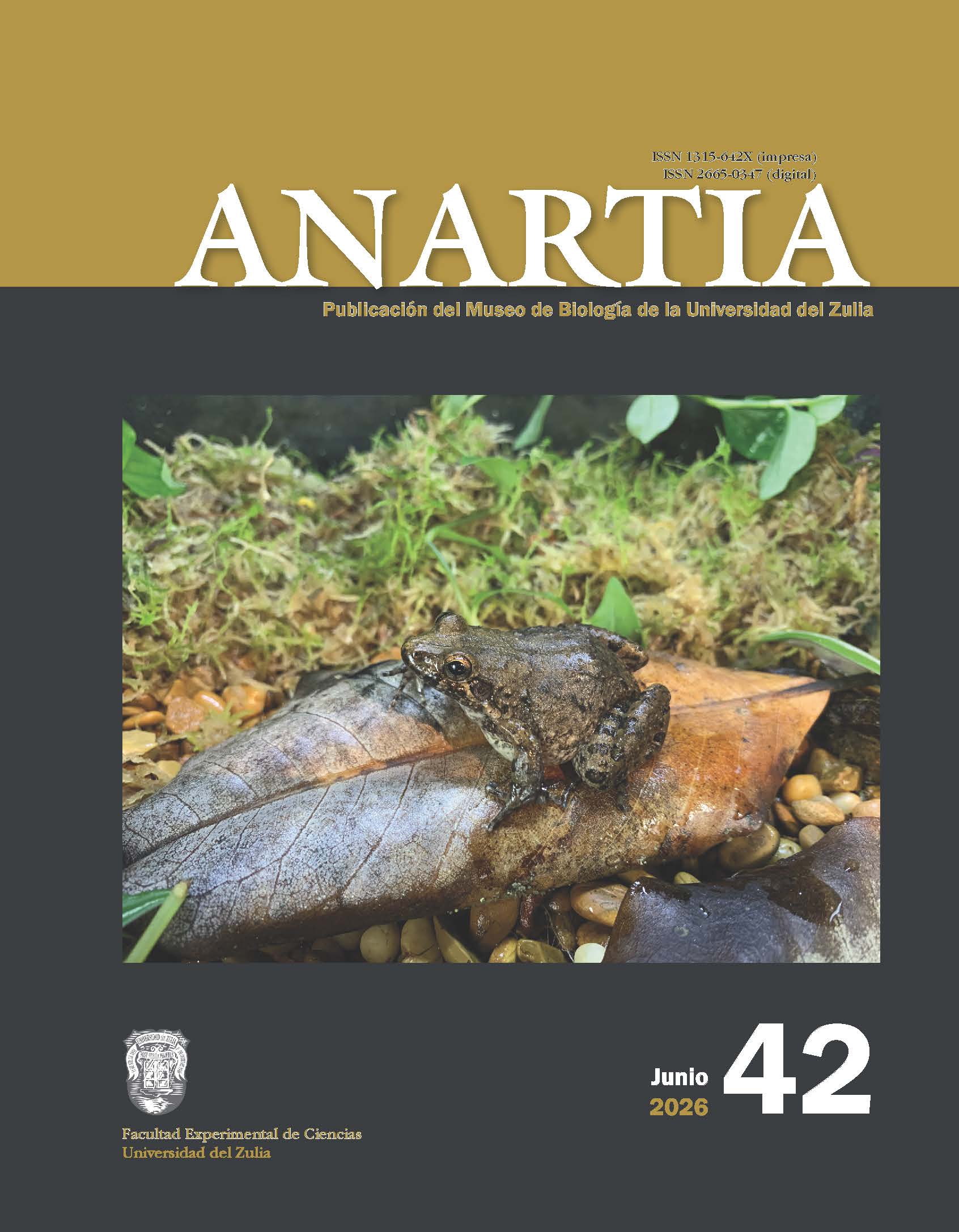
A new Andean rocket frog (Amphibia: Anura: Leptodactylidae: Leptodactylus) from urban spaces at Mérida, Venezuela
Una nueva rana andina (Amphibia: Anura: Leptodactylidae: Leptodactylus) de espacios urbanos en Mérida, Venezuela
Abstract
A new species of Leptodactylus is described from the city of Mérida, in the Andean mountains of Venezuela. The new taxon, a member of the Leptodactylus melanonotus species group, is distinguished from all congeners by a combination of morphological and bioacoustic characters, including: moderate body size (adult males mean SVL 37.4 mm; female 44.5 mm); a single pair of irregular, often interrupted dorsolateral folds; slightly expanded (knob-shaped) toe tips; and a ventral color pattern with pale mottling fading posteriorly. The new species is further characterized by an advertisement call with an exceptionally high note repetition rate (~240 calls/min) and a high dominant frequency (2.4 kHz). We provide a detailed description of the holotype and variation within the type series, including data on coloration in life and preservative and description of the larval stage. The species is restricted to internal valleys within the Cordillera de Mérida, where it dwells in urban and peri-urban environments. We provide preliminary data on its ecology and conservation status.
Downloads
References
Barrio-Amorós C. L. & A. Chacón-Ortiz. 2001. Geographic distribution. Leptodactylus colombiensis. Herpetological Review 32: 55.
Brown, R. W. 1956. Composition of scientific words. A manual of methods and a lexicon of materials for the practice of logotechnics. Revised version of the 1927 ed., which was first published in 1927 under title: Materials for word-study. Washington and London: Smithsonian Institution Press, 882 pp.
de Sá, R. O., T. Grant, A. Camargo, W. R. Heyer, M. L. Ponssa & E. Stanley. 2014. Systematics of the Neotropical genus Leptodactylus Fitzinger, 1826 (Anura: Leptodactylidae): Phylogeny, the relevance of non-molecular evidence, and species accounts. South American Journal of Herpetology 9 (Special Issue 1): S1-S128.
Ewell, J., A. Madriz, & J. A. Tosi, Jr. 1976. Zonas de vida de Venezuela. Memoria explicativa sobre el mapa ecológico. Caracas: MAC-FONAIAP, 270 pp + 1 mapa.
García, I. J., R. Albornoz & E. La Marca. 2007. Perturbaciones climáticas y disminución de Atelopus oxyrhynchus (Amphibia: Anura) en los Andes de Venezuela. Herpetotropicos 2(2): 63-71.
Heyer, W. R. 1970. Studies of the frogs of the genus Leptodactylus (Amphibia: Leptodactylidae). IV. Biosystematics of the melanonotus Group. Los Angeles County Museum Contributions in Science 191: 1-48.
Heyer, W. R. 1994. Variation within the Leptodactylus podicipinus-wagneri complex of frogs (Amphibia: Leptodactylidae). Smithsonian Contributions to Zoology 546: 1-124.
Karlsdóttir, B. 2017a. Studying the barriers to amphibian captive breeding programs in Latin America, Africa and Asia. Amphibian Ark Newsletter 41: 16-17.
Karlsdóttir, B. 2017b. Estudiando las barreras de los programas de cría en cautiverio de anfibios en Latinoamérica, África y Asia. Amphibian Ark Boletín Informativo 41: 16-17.
La Marca, E. 1992. Catálogo taxonómico, biogeográfico y bibliográfico de las ranas de Venezuela. Cuadernos Geográficos (Mérida, Venezuela) 9: 1-197.
La Marca, E. 1994. Taxonomy of the frogs of the genus Mannophryne (Amphibia: Anura: Dendrobatidae). Bulletin of the Maryland Herpetological Society 30(4): 157-204.
La Marca, E. 1999. Biodiversidad de anfibios en los Andes de Venezuela: análisis preliminar por pisos de vegetación. pp. 199-210. In: Halffter, G. (ed.). Diversidad Biológica en Iberoamérica III. Volumen Especial, Acta Zoologica Mexicana, nueva serie. Xalapa: Instituto de Ecología.
La Marca, E. 2015. Sapito Silbador de Mérida. pp. 217 In: Rodríguez, J. P., A. García-Rawlins & F. Rojas-Suárez (eds.). Libro Rojo de la fauna venezolana. 4ª ed. Caracas: Provita - Fundación Empresas Polar.
[La Marca, E.]. 2016a. An ex-situ initiative to rescue Mérida's whistling frog, an endangered undescribed Leptodactylus species. Amphibian Ark Newsletter 35: 3.
[La Marca, E.]. 2016b. Una iniciativa para rescatar ex situ a la Rana Silbadora de Mérida, una especie de Leptodactylus en peligro de extinción aún no descrita. Amphibian Ark Boletín Informativo 35: 3.
La Marca, E. 2016c. An ex-situ conservation program for the Mérida's collared frog. Amphibian Ark Newsletter 35:7.
La Marca, E. 2016d. Un programa de conservación ex situ de la rana de collar merideña. Amphibian Ark Boletín Informativo 35:7.
La Marca, E. 2017a. The whistling sapphire of Mérida is whistling again! Amphibian Ark Newsletter 39: 5.
La Marca, E. 2017b. ¡El sapito silbador de Mérida está silbando de nuevo! Amphibian Ark Boletín Informativo 39: 5.
La Marca, E. 2020a. To the rescue of endangered Venezuelan amphibians. Progress Report. Amphibian Survival Alliance Newsletter August 2020: [2].
La Marca, E. 2020b. Amphibian conservation at REVA during the coronavirus pandemic. Amphibian Survival Alliance Newsletter October 2020: [4].
La Marca, E. 2021. On the edge of attention: the conservation of Cinderella's frogs (The REVA experience) Rescue for Endangered Venezuelan Amphibians (REVA) Conservation Center, Mérida, Venezuela. Pp. 31. In: Programm und Zusammenfassungen. Program and Summaries. Deutsche Gesellschaft für Herpetologie und Terrarienkunde (DGHT) e. V. 57. Jahrestagung für Herpetologie und Terrarienkunde & Jahrestagung der AG Schildkröten. 6. bis 10. Oktober 2021.
La Marca, E. 2022a. Continuing captive breeding efforts for La Culata frog (Aromobates duranti) and the Mucuchies frog (A. zippeli). Amphibian Ark Newsletter 58: 7-8.
La Marca, E. 2022b. Continuando con los esfuerzos de reproducción en cautiverio de la rana [de] La Culata (Aromobates duranti) y la rana de Mucuchies (A. zippeli). Amphibian Ark Boletín Informativo 58:7-8.
La Marca, E. & M. Castellanos. 2017. Managing ex situ amphibian programs during adverse conditions. AArk Newsletter 41: 15.
La Marca, E. & M. Castellanos. 2018a. A rich food formula to raise tadpoles in captivity. Amphibian Ark Newsletter 43: 17-18.
La Marca, E. & M. Castellanos. 2018b. Fórmula alimenticia enriquecida para criar renacuajos en cautiverio. Amphibian Ark Boletín Informativo 43:17-18.
La Marca, E., F. Pereira & E. Albornoz. 2015a. A Venezuelan initiative for endangered Andean herps. Amphibian Ark Newsletter 30: 10.
La Marca, E., F. Pereira & E. Albornoz. 2015b. Una iniciativa venezolana para herpetos andinos en peligro de extinción. AArk Boletín Informativo 30: 10.
Lampo, M., A. Rodríguez, E. La Marca & P. Daszak. 2005. Chytridiomycosis epidemics and a severe dry season precede the local disappearance of three Atelopus species from the Venezuelan Andes. pp. 113. In: Book of Abstracts. XIX Annual Meeting of the Society for Conservation Biology. Universidade de Brasilia, DF, Brazil.
Lampo, M., A. Rodríguez, E. La Marca & P. Daszak. 2006. A chytridiomycosis epidemic and a severe dry season precede the disappearance of Atelopus species from the Venezuelan Andes. Herpetological Journal 16: 395-402.
Rivero, J. A. 1961. Salientia of Venezuela. Bulletin of the Museum of Comparative Zoology 126(1): 1-207 + 1 plate.
Rodríguez Adrados, F. (ed.). 1980. Diccionario Griego-Español. Vol. I. Madrid: Consejo Superior de Investigaciones Científicas, 304 pp.